Virtual Data Room for Startups: Simple & Secure
Table of Contents
- A virtual data room for startups can stay simple
- What a lightweight virtual data room for startups does
- What belongs in a startup fundraising data room
- Protected investor links and secure document sharing for startups
- How to build a virtual data room for startups
- Protected investor links, updates, and version history
- Investor data room analytics without becoming creepy
- Four practical startup data room examples
- Lightweight sharing versus a dedicated enterprise VDR
- Final thoughts
- A virtual data room for startups can stay simple
- What a lightweight virtual data room for startups does
- What belongs in a startup fundraising data room
- Protected investor links and secure document sharing for startups
- How to build a virtual data room for startups
- Protected investor links, updates, and version history
- Investor data room analytics without becoming creepy
- Four practical startup data room examples
- Lightweight sharing versus a dedicated enterprise VDR
- Final thoughts
A virtual data room for startups can stay simple
A virtual data room for startups need not feel built for a billion-dollar acquisition. Early fundraising is simpler: investors need a safe, orderly way to view a deck, financial model, product material, and due diligence files.
A good startup fundraising data room should:
- Control access to sensitive material
- Replace files without a new link
- Use activity to time follow-ups
- Keep old versions for recovery
This guide covers secure startup document sharing with protected browser links, Verified Email access, version history, and restrained analytics. It also defines a lightweight room’s limits. A seed-stage founder should not pay for unnecessary machinery, but a regulated transaction should not run on wishful thinking.
What a lightweight virtual data room for startups does
An investor data room is a controlled online workspace for fundraising and due diligence documents. Investors use a browser link; founders control access and keep documents current.
The room changes as conversations progress:
| Fundraising stage | Material shared | Sensible access |
|---|---|---|
| Initial outreach | Pitch deck or short memo | Public or protected link |
| First meetings | Deck, demo, market notes | Password or Verified Email |
| Due diligence | Financials, legal records, cap table, contracts | Named-email access |
| Closing | Final legal and financial documents | Tight access or enterprise VDR |
Do not upload everything on day one. Disclose information in layers. A potential investor may need the deck before a meeting, but not employee agreements or customer contracts yet.
DocSend reported that investors in one pre-seed study spent just over three minutes reviewing an average deck. A startup VDR should reduce friction. Investors should quickly grasp the structure, open the main document, and navigate onward.
What belongs in a startup fundraising data room
Be selective. Document dumps look disorganized and expose more sensitive information. Start with a document map, then add detail during due diligence.
| Area | Include when relevant | Hold back until needed |
|---|---|---|
| Company | Incorporation documents and ownership summary | Personal identity documents |
| Fundraising | Current deck, round terms, use of funds | Negotiations with other investors |
| Financials | Historical results, forecast, assumptions | Raw bank credentials or tax identifiers |
| Traction | KPI definitions, cohorts, pipeline summary | Unredacted customer personal data |
| Product | Demo, roadmap, security overview | Source code, secrets, production access |
| Legal | Material contracts and IP assignments | Privileged legal advice |
Use plain file names such as 2026-07-financial-model.pdf instead of model-final-v7-really-final.xlsx. Add an index listing each important file’s owner, reporting period, and status.
Secure startup document sharing requires restraint. The FTC advises businesses to collect and retain only needed information. Redact bank details, home addresses, signatures, customer records, and employee data unless the reviewer legitimately needs them.
Protected investor links and secure document sharing for startups
Match access to sensitivity. A public link may suit a general deck. It is unsuitable for a detailed cap table.
| Access method | Best use | Limitation |
|---|---|---|
| Public link | Non-confidential teaser or demo | Anyone with the URL can enter |
| Password | Small trusted group needing access | The password can be forwarded |
| Verified Email | Investor-specific access and activity | Confirms inbox control, not legal identity |
With Revdoku, founders can share a PDF or folder from a private bucket through a browser link. Access can be public, password-protected, or gated by a one-time email code. Founders can grant specific email addresses or company domains access. Owners can receive open notifications and see visitor-level activity. See the Revdoku product page.
Inbox-tied Verified Email is stronger than a shared password. It is not KYC, an electronic signature, or proof the recipient kept documents confidential. Browser protection cannot prevent screen photos, and downloaded files may leave the room.
Treat access controls as one security layer. Use an NDA when appropriate, disclose material gradually, and remove access when talks end.
How to build a virtual data room for startups
A founder can prepare a first room in an afternoon. The process is operational, not technical.
-
Choose the scope. Choose initial outreach, active diligence, or closing. Mixing them creates confusion.
-
Prepare the files. Remove duplicates, redact unnecessary personal data, use stable presentation formats when practical, and date file names.
-
Create the room. In Revdoku, drag a PDF or organized folder into the dashboard. Manual upload requires no API.
-
Set access. Use a public link only for material safe to forward. Use passwords for trusted groups and Verified Email for named investors.
-
Test as a visitor. Open the link in a private window. Check navigation, mobile display, downloads, forms, permissions, and the one-time code flow.
-
Send the link with context. Describe the contents, reporting period, and how investors can ask questions.
A built-in form can collect questions without a separate backend. If publishing becomes repetitive, an AI agent, API, or CLI can update the same buckets. Automation is optional. Most founders should start by dragging, dropping, protecting, and sending.
Protected investor links, updates, and version history
Fundraising documents change. Revenue is booked, forecasts change, legal files are signed, and the deck sharpens. A new URL after every edit obscures the current version.
Protected investor links solve this problem. Revdoku lets owners replace or reorganize files behind one link. Its dashboard also provides versions, change review, and rollback, according to the current product description.
| Change | Recommended handling | Investor experience |
|---|---|---|
| Monthly KPI update | Replace and date the report | Existing link shows current figures |
| Deck correction | Publish the correction and retain history | No second email thread needed |
| Accidental deletion | Restore an earlier version | Room returns to a known state |
Version history is not permission to rewrite the past silently. Use a simple publishing policy:
- Assign one person to approve financial and legal updates
- Date material changes and record what changed
- Tell active investors when an update materially affects their analysis
- Freeze the closing set once final documents are executed
A startup fundraising data room should show the current view while preserving enough history to explain changes.
Investor data room analytics without becoming creepy
Useful analytics answer practical questions. Did the investor enter? What did they examine? Did they download the model or submit a question? More can create false confidence.
| Signal | Reasonable interpretation | Sensible response |
|---|---|---|
| First open | Delivery and access worked | Follow up later with relevant context |
| Several pages viewed | The investor inspected part of the room | Prepare for questions on those topics |
| Repeat visit | Interest may be continuing | Send a concise update if one exists |
| File download | The document may be under deeper review | Confirm that the file is current |
| Form submission | The investor has an explicit request | Reply promptly and directly |
Revdoku reports pages viewed, links clicked, and files downloaded by visitor and time. Verified Email makes those events more useful by identifying the inbox used to enter. Still, an open is not enthusiasm; ten minutes may mean an unattended browser.
Use open notifications to time follow-ups. After a thoughtful visit, follow up later that day or the next business day. Do not message someone seconds after every click.
Analytics can improve the material. DocSend’s 2023 seed research found investors spent 65% more time on “why now,” 33% more on traction, and 88% more on competition than the prior year. If visitors repeatedly stop there, clarify the explanation instead of celebrating the traffic.
Four practical startup data room examples
The right setup depends on the round, documents, and reviewers. Each example reflects a common fundraising workflow.
| Situation | Room setup | Practical response |
|---|---|---|
| Solo founder raising pre-seed | Deck and product demo behind Verified Email | After a repeat visit, offer to discuss the product |
| Agency spinning out a SaaS tool | Deck, protected demo, and customer case studies | Keep client identities redacted until permitted |
| Seed-stage SaaS company | Separate folders for financials, legal, traction, and security | Grant named-email access only after a partner meeting |
| AI product team with frequent releases | Stable link updated from the dashboard or optional CLI | Retain history and notify investors only of material changes |
Common mistakes include:
- One password for dozens of unrelated investors
- Raw customer exports when aggregate metrics suffice
- Treating every open as proof of a coming term sheet
- Replacing financial figures without dates or change notes
- Leaving access active after an investor passes
Secure startup document sharing should be predictable. Each person sees what the current stage requires, and the founder can explain who received access, what changed, and why.
Lightweight sharing versus a dedicated enterprise VDR
A lightweight startup VDR suits decks, demos, reports, and early due diligence. It is not a substitute for every enterprise transaction platform.
| Capability | Email or cloud folder | Lightweight startup room | Dedicated enterprise VDR |
|---|---|---|---|
| Browser access | Sometimes | Yes | Yes |
| Named visitor activity | Limited | Yes | Yes |
| Stable updates | Inconsistent | Yes | Yes |
| Document-level permissions | Basic | Varies | Granular |
| Dynamic watermarking | Rare | Varies | Common |
| Formal Q&A workflow | No | Basic forms | Common |
| Detailed audit export | Limited | Varies | Common |
| SSO, MFA, retention controls | Varies | Plan-dependent | Expected |
For regulated M&A, litigation, large financings, or deals with hundreds of reviewers, buyers often expect granular rights, MFA, dynamic watermarking, a complete audit trail, structured Q&A, and evidence such as ISO 27001 certification or a SOC 2 Type II report. These enterprise criteria appear at Euronext Corporate Solutions.
Revdoku states that files are private by default and encrypted at rest and in transit, with two-factor authentication available and AWS and Cloudflare providing the infrastructure. Its security page says SSO, custom retention, private deployments, and other enterprise controls need a separate written contract. A cloud provider’s certification does not automatically cover applications using it, so request vendor evidence when compliance matters.
Choose a dedicated enterprise VDR when counsel, regulators, or buyers require controls your lightweight room cannot document. That is prudent.
Final thoughts
A startup VDR should simplify fundraising without treating every seed round as an acquisition. Start with clean documents, staged disclosure, and access matched to sensitivity.
TL;DR, the pattern is straightforward:
- Share a protected browser link
- Use Verified Email for investor-specific access
- Keep the link stable while documents change
- Preserve version history and explain material updates
- Read analytics as signals, not promises
For a typical startup data room, Revdoku offers a manual path: add files, choose access, and send one link. Automation can wait. If the transaction develops formal compliance, watermarking, audit, or permission requirements, move to an enterprise arrangement or dedicated VDR before they become a problem.
Frequently asked questions
When should a startup create a virtual data room?
Create one before active investor conversations begin so the core documents are organized and tested. Start with a deck and product material, then add financial, legal, and ownership records as investors move into due diligence.
Which documents should not be shared in an investor data room?
Avoid uploading credentials, source code secrets, raw personal data, privileged legal advice, or unredacted bank and identity records. Share sensitive contracts and employee or customer information only when necessary, with appropriate redactions and tighter access.
Should every investor receive access to the same files?
No. Match disclosure to the investor’s stage and legitimate needs: an introductory contact may need only the deck, while an investor conducting diligence may require financial and legal records. Named-email access is preferable once the material becomes sensitive.
Is Verified Email access enough to protect confidential documents?
Verified Email confirms that a visitor controls the inbox used to enter, making it stronger than a shared password. It does not verify legal identity, create an NDA, or prevent screenshots and redistribution, so it should be combined with staged disclosure and revoked when discussions end.
How should founders handle updates without confusing investors?
Replace documents behind a stable link, use dated file names, and retain version history. Record significant changes and notify active investors when new information could materially affect their evaluation.
How should data room analytics influence investor follow-ups?
Use activity to confirm access and identify topics that may deserve discussion, not to predict an investment decision. A concise follow-up later that day or the next business day is usually more appropriate than reacting immediately to every open or click.
When does a startup need an enterprise VDR instead of a lightweight room?
Move to an enterprise platform when a deal requires granular permissions, MFA, dynamic watermarking, structured Q&A, detailed audit exports, or documented compliance controls. This is especially relevant for regulated transactions, litigation, large financings, and reviews involving many participants.
Related Articles
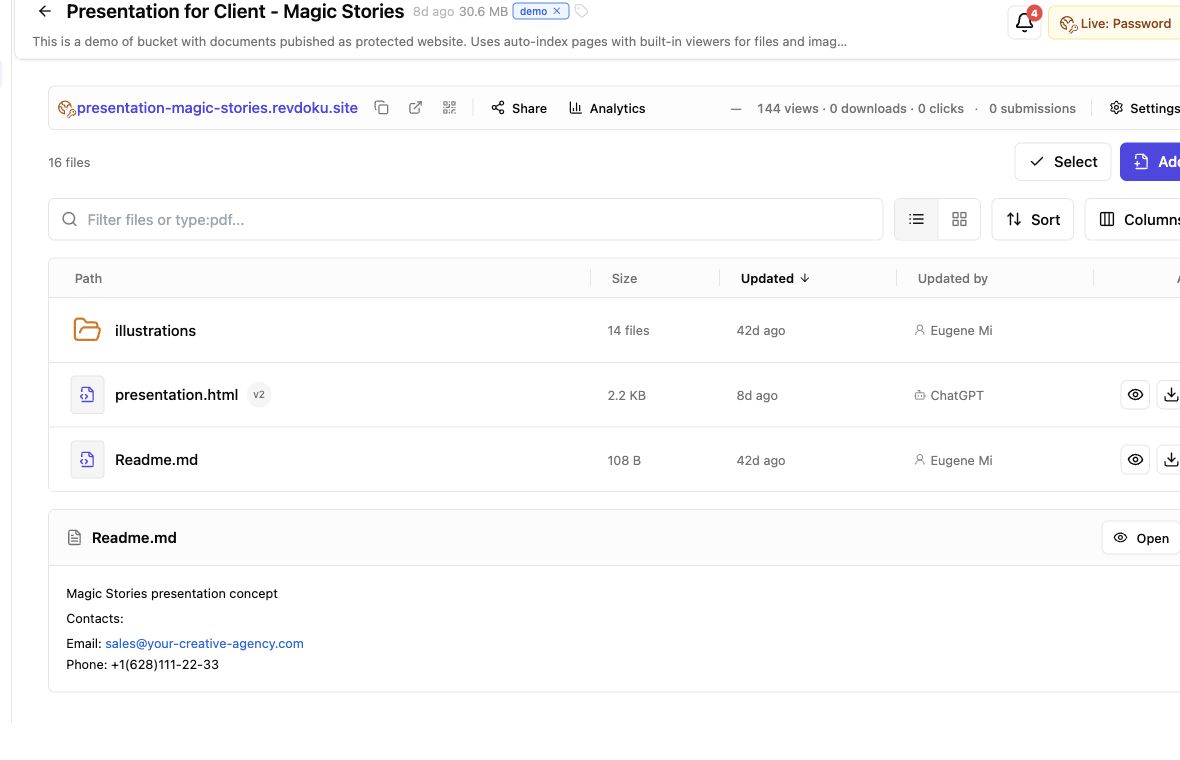
Client Deliverables Portal: Share Work in One Link
Share client files through one secure, stable link with browser viewing, access controls, feedback, analytics, and simple updates.
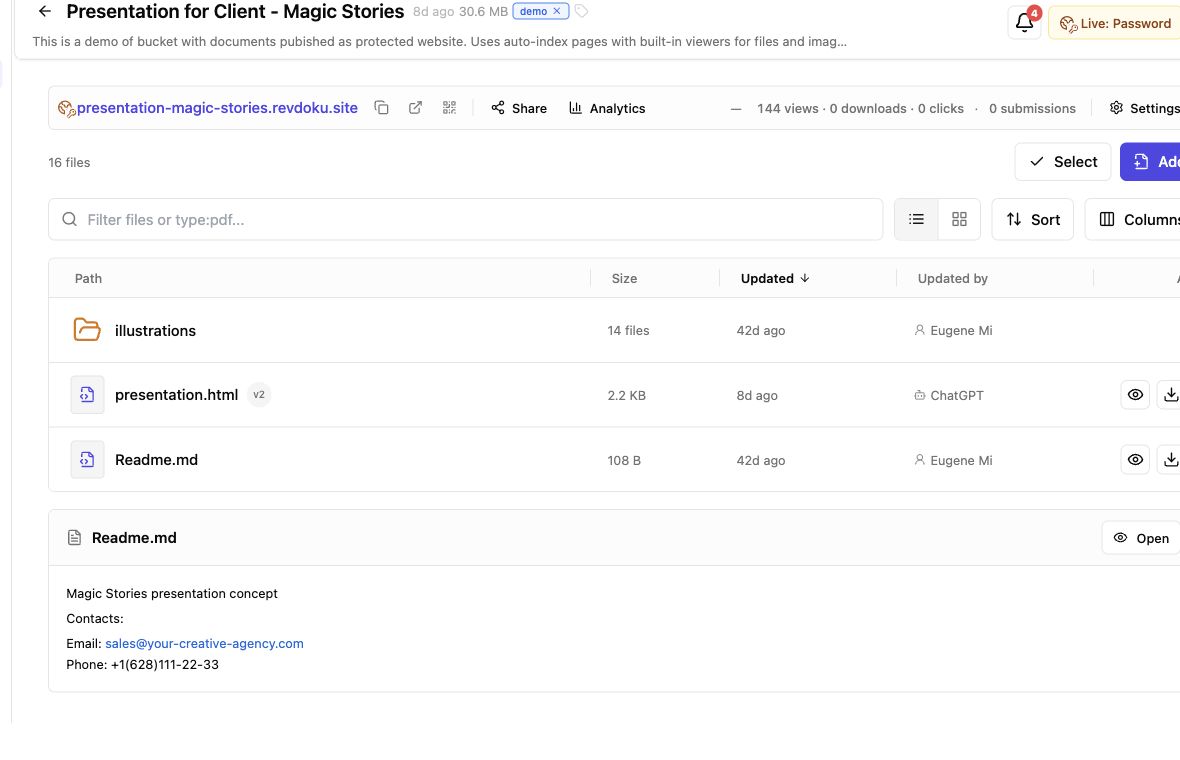
Fundraising Data Room: A Founder's Guide
Build a secure fundraising data room, stage investor access, organize due diligence files, track engagement, and prevent version chaos.
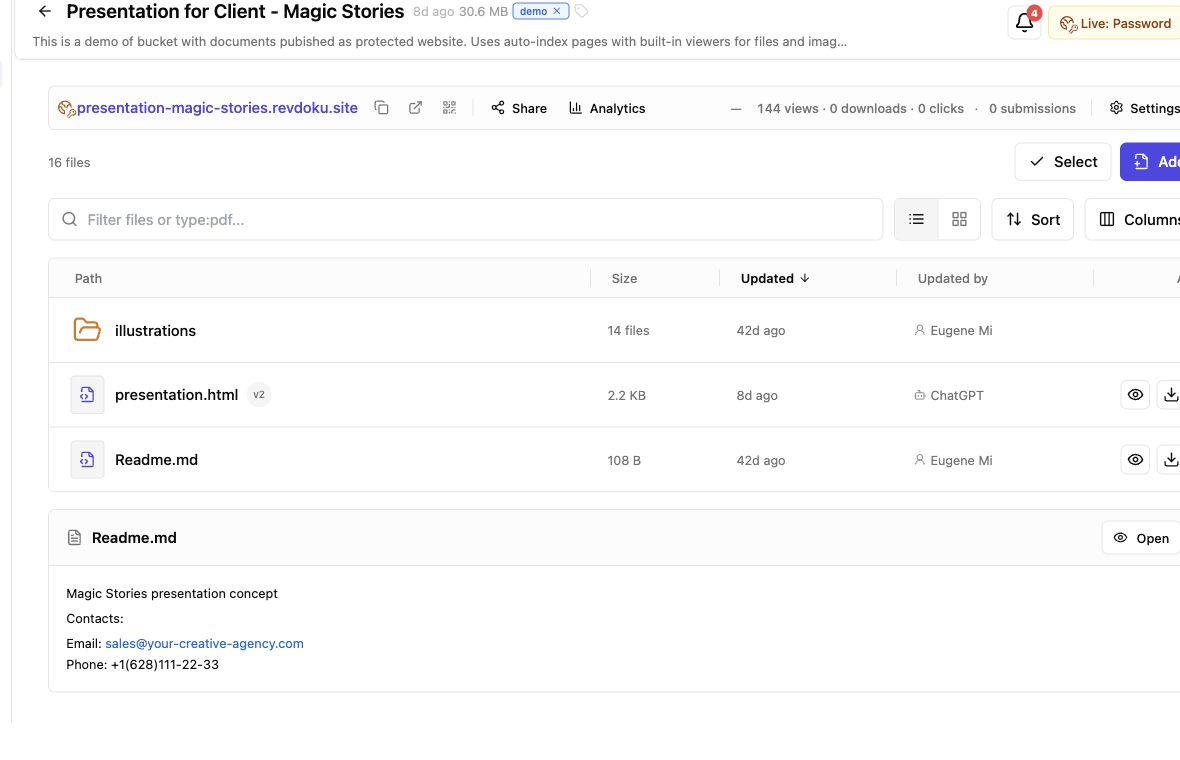
Papermark Alternative: Revdoku vs Papermark
Compare Revdoku and Papermark for secure sharing, analytics, data rooms, mixed-file deliverables, self-hosting, and automation.