Fundraising Data Room: A Founder's Guide
Table of Contents
- Why a Fundraising Data Room Pays Off Early
- What a Fundraising Data Room Is and When to Open It for Investor Due Diligence
- What Goes in a Startup Fundraising Data Room
- Stage the Fundraising Data Room for Investor Due Diligence
- Protect a Virtual Data Room for Startups Without Slowing It Down
- Build an Investor Data Room for Fundraising in Revdoku
- Use Fundraising Data Room Analytics During Investor Due Diligence
- Keep the Startup Fundraising Data Room Current and Avoid Version Chaos
- Revdoku, Cloud Drive, or Dedicated VDR?
- Final Thoughts on Building a Fundraising Data Room
- Why a Fundraising Data Room Pays Off Early
- What a Fundraising Data Room Is and When to Open It for Investor Due Diligence
- What Goes in a Startup Fundraising Data Room
- Stage the Fundraising Data Room for Investor Due Diligence
- Protect a Virtual Data Room for Startups Without Slowing It Down
- Build an Investor Data Room for Fundraising in Revdoku
- Use Fundraising Data Room Analytics During Investor Due Diligence
- Keep the Startup Fundraising Data Room Current and Avoid Version Chaos
- Revdoku, Cloud Drive, or Dedicated VDR?
- Final Thoughts on Building a Fundraising Data Room
Why a Fundraising Data Room Pays Off Early
A fundraising data room is a controlled online space where investors verify your pitch.
It helps when someone asks for a model, cap table, customer evidence, or legal document. Founders should prepare early: Carta startups raised $119.5 billion in 2025, up 16.9%, yet the year’s 4,859 rounds were the lowest annual count in at least six years, according to Carta’s 2025 market review. Capital was plentiful but concentrated.
A good startup fundraising data room helps you:
- Answer diligence questions without searching email
- Reveal sensitive material only when warranted
- Keep every investor on a current, consistent version
TL;DR: Build your fundraising data room before outreach; stage access as interest grows, protect sensitive files, and keep documents current during investor due diligence.
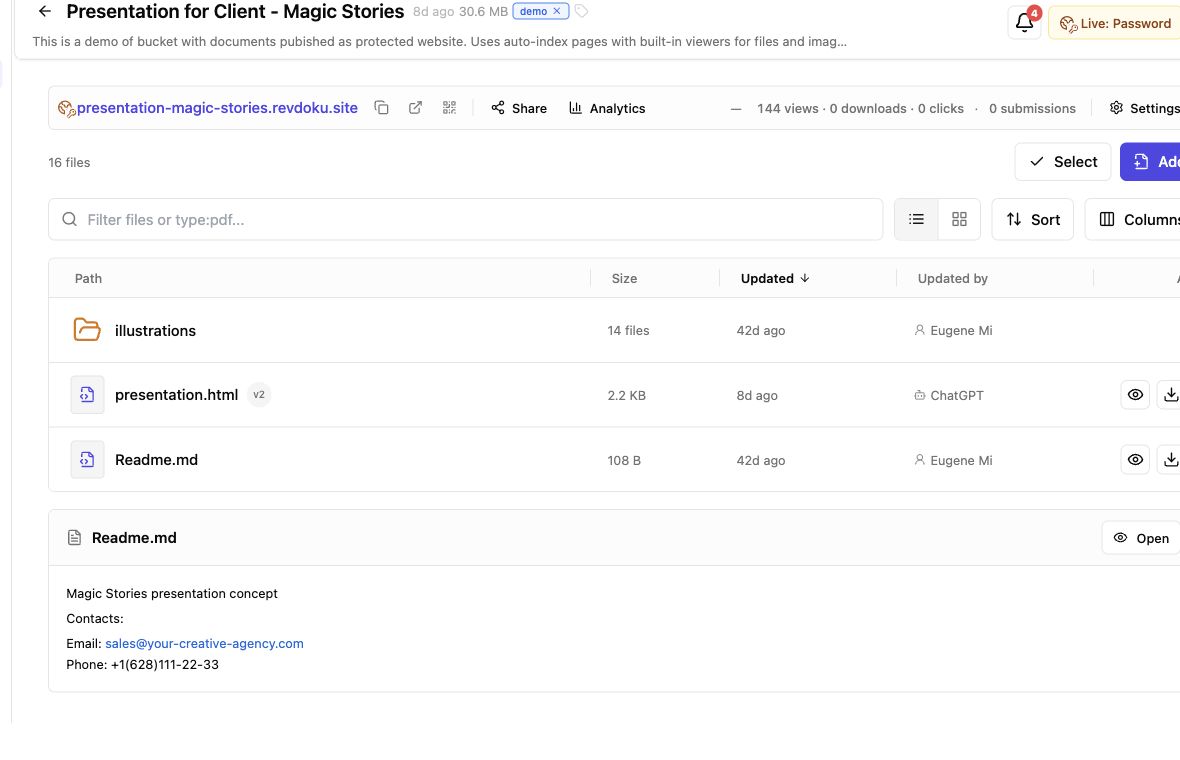
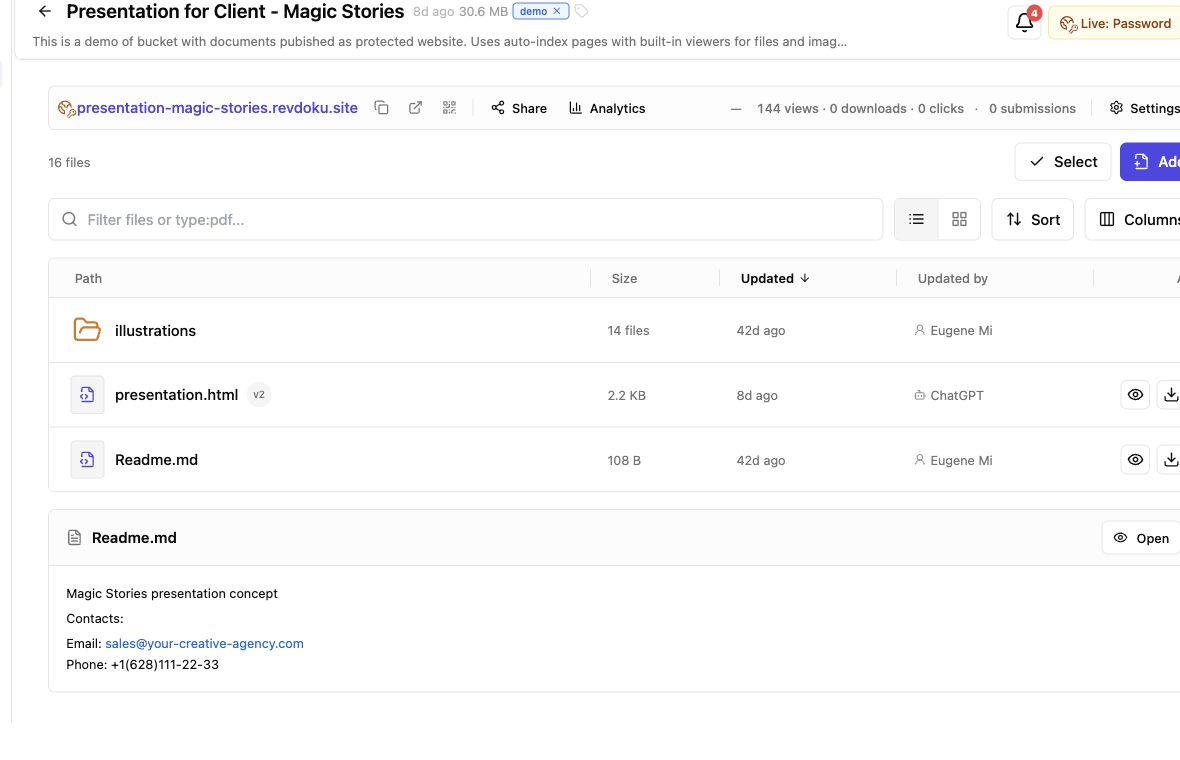
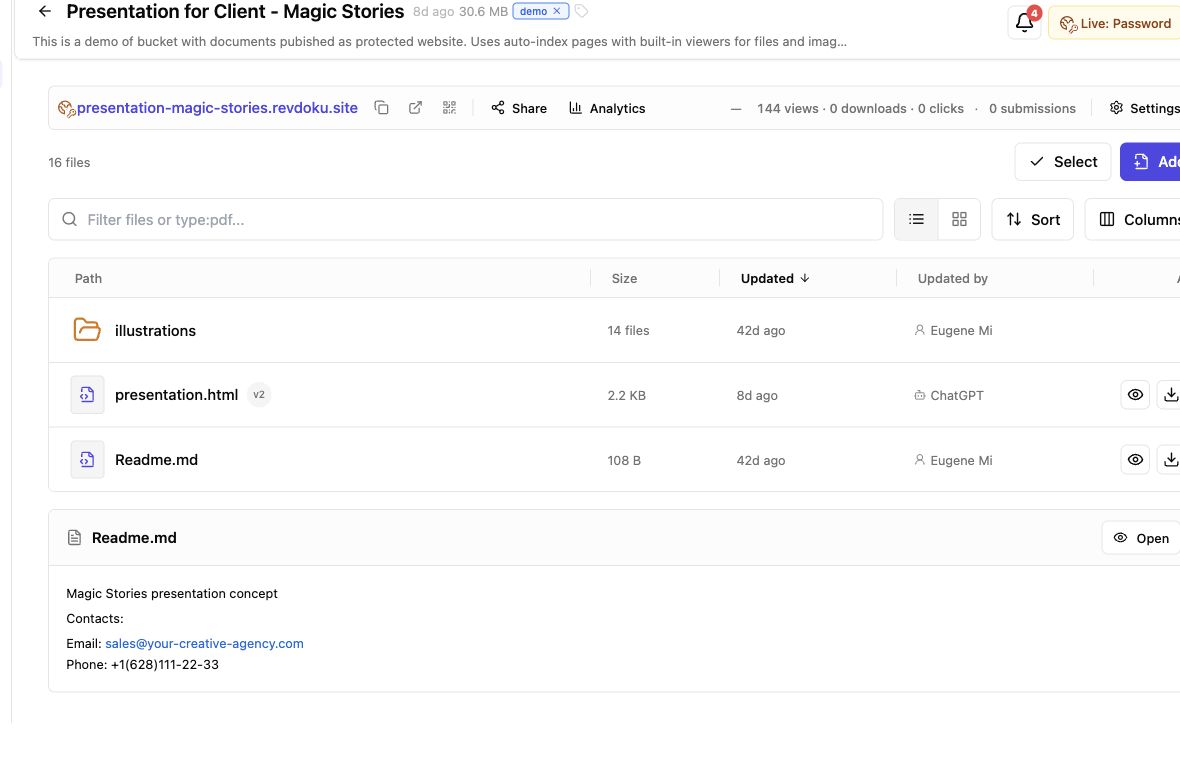
Screenshot of the Revdoku Magic Stories demo bucket in app.revdoku.com, made on July 31, 2026.
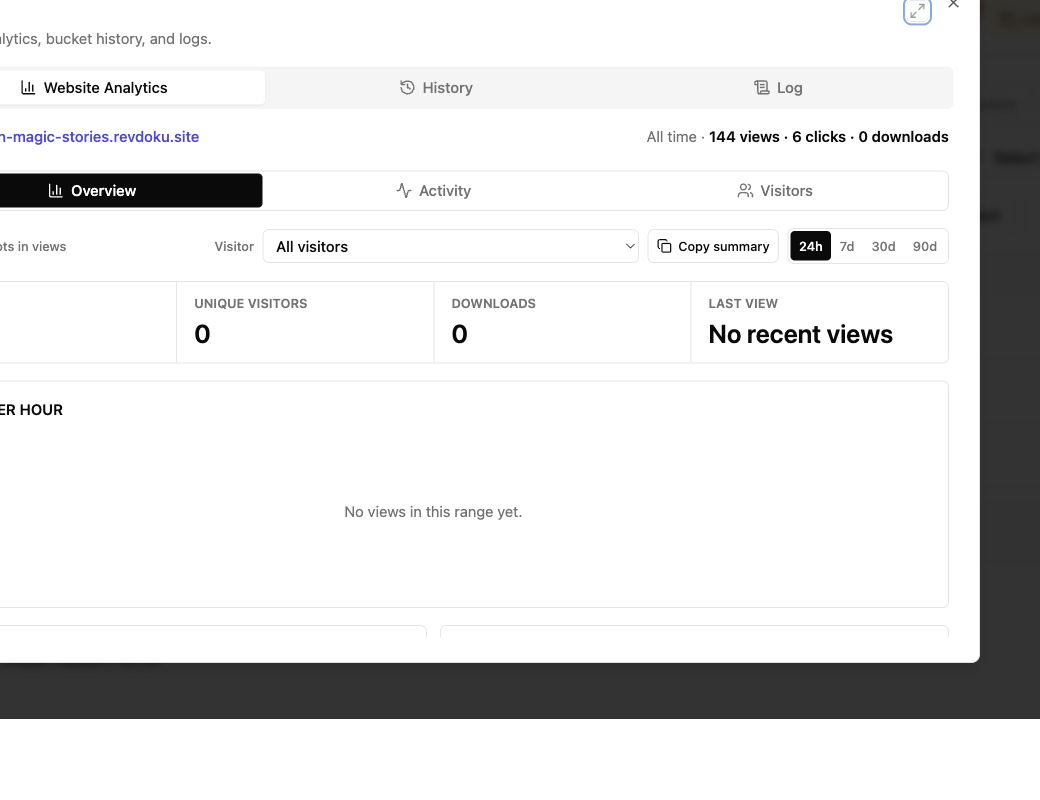
Screenshot of Revdoku website analytics for the Magic Stories demo bucket in app.revdoku.com, made on July 31, 2026.
What a Fundraising Data Room Is and When to Open It for Investor Due Diligence
The pitch deck is the front door; the investor data room for fundraising is the house behind it, organizing financial evidence, ownership records, operating metrics, product material, and legal files. A well-organized investor data room for fundraising helps investors verify your story without burying it in folders.
Build the fundraising data room before outreach, but do not send it with a cold introduction. Investors spend less than 3.5 minutes on the average pre-seed deck in DocSend’s pitch-deck research. Your first link has one job: earn the conversation. Share deeper material as interest grows.
Use three access layers:
- Introduction: Current deck, short company summary, and a product demo safe to forward
- Active diligence: Financial model, KPI definitions, cap table summary, market evidence, and selected commercial material
- Confirmatory review: Corporate records, financing documents, IP assignments, major contracts, board approvals, and final deal files
Example: A two-founder developer-tools company can prepare its room before outreach, share the deck first, then open the model and usage cohorts after a partner meeting. Prepare early. Earn access.
What Goes in a Startup Fundraising Data Room
Its contents depend on stage.
A pre-revenue company cannot provide or invent revenue cohorts. It can provide a milestone plan, spending assumptions, design-partner evidence, and an honest note on unavailable material. A Series A company needs deeper financial and commercial proof.
A practical fundraising data room structure includes:
| Category | Material to Include | Preparation Standard |
|---|---|---|
| Story and round | Current deck, one-page summary, round target, use of funds, milestone plan | Match every number to the model |
| Financials | Monthly profit and loss, balance sheet, cash view, budget, and 18- to 24-month forecast | Separate actuals from forecasts and state assumptions |
| Capital and legal | Fully diluted cap table, incorporation records, prior financings, board consents | Ask counsel to review gaps and reconcile ownership math |
| Commercial | KPI dictionary, pipeline, cohorts, concentration data, selected customer evidence | Anonymize early; share full contracts only when needed |
| Product and people | Demo, roadmap, org chart, founder bios, employment and IP records | Remove secrets, personal data, and stale drafts |
Lead the investor data room for fundraising with a short index. Name files 2026-06_Financial-Model_v3, not final-final-2. State the reporting date and currency inside every financial file.
Example: A seed SaaS founder may share anonymized cohort tables during partner review, then share major customer contracts during confirmatory diligence. The room remains useful without exposing every customer early.
Stage the Fundraising Data Room for Investor Due Diligence
Treat fundraising data room access as staged, not binary. This gives investors enough proof for each decision while limiting exposure.
-
Before the first meeting: Share the deck and, if useful, a short demo or one-page summary. Use a public link for non-confidential teasers; an email gate identifies visitors.
-
After serious interest: Open the core diligence pack. Include the financial model, KPI definitions, cap table summary, product notes, hiring plan, and selected commercial evidence.
-
During term-sheet work: Add the full cap table, corporate records, financing files, material agreements, IP assignments, and relevant security material.
-
For confirmatory diligence and closing: Provide requested approvals and final documents via the agreed channel. Verify wire instructions through a second trusted channel; polished files do not prevent payment fraud.
Keep one source of truth across access layers. Tailor the view without changing definitions or presenting conflicting numbers.
Example: A climate-software startup might show pipeline totals during active diligence but withhold site-level customer data until a lead investor engages and confidentiality terms are settled. Record each layer’s contents so the founder, lawyer, and finance lead answer requests consistently.
Protect a Virtual Data Room for Startups Without Slowing It Down
Match security to file sensitivity. NIST defines least privilege as limiting users to access required for assigned work in SP 800-171 Rev. 3. For a virtual data room for startups, this means a first-contact investor receives less access than a lead investor in legal diligence.
Weak controls can be costly. IBM reports a $4.44 million global average data-breach cost in 2025, although a startup document leak differs from the dataset’s average breach. The lesson: customer data, trade secrets, employee records, and financing documents require careful handling.
| Control | Use It When | Founder Action |
|---|---|---|
| Public access | Teaser is safe to forward | Remove private metrics, customer names, and personal data |
| Email gate | You need visitor identities | Use during active outreach; review captured identities |
| Password gate | Files are sensitive | Set a unique password and send it separately |
| Redaction | Contracts or records contain unrelated details | Remove personal, banking, and customer-confidential fields |
| Access review | The process lasts several weeks | Review weekly; close after a pass or withdrawal |
A gate is not a legal strategy. Discuss NDA timing, disclosure duties, and regulated data with counsel. If a security team provides a control matrix, consider dedicated VDR software instead of overstretching a lightweight tool.
Build an Investor Data Room for Fundraising in Revdoku
Revdoku fits founder-led raises built around documents, files, presentations, and a product demo. Start with the manual workflow. The fundraising data room needs neither code nor an AI agent.
-
Create a private dashboard bucket, then upload a PDF or a complete folder.
-
Put a short read-me or index first so investors understand the order unaided.
-
Choose the access mode. Use public access only for safe teasers; use a password or email gate for a protected startup fundraising data room.
-
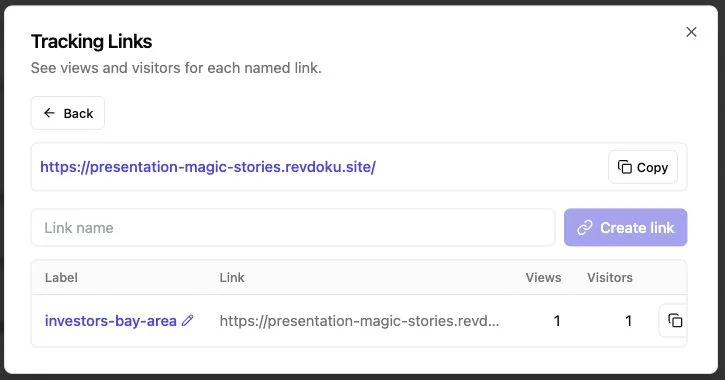
Share the live link. The URL remains stable after updates, so investors need not find a replacement attachment.
-
Monitor open notifications and visitor activity: pages viewed, clicks, and downloads. An email gate can also record leads.
-
Add a built-in feedback or contact form to collect questions beside the shared material without a backend.
The Revdoku sharing workflow is deliberately lightweight. API, CLI, and AI-agent publishing are optional, becoming useful when a script refreshes metrics or an agent repeatedly publishes demo updates. Keep them out of the first room.
Example: A three-person AI startup can place its deck, model, technical note, and static product demo in one bucket. When the founder revises the forecast, the same investor data room for fundraising link shows the update.
Use Fundraising Data Room Analytics During Investor Due Diligence
DocSend’s pre-seed study reports averages of 58 investor contacts and 30 meetings in its investor strategy research. Fundraising data room analytics can prioritize the diligence queue but cannot reveal investor intent.
| Signal | Reasonable Reading | Sensible Next Move |
|---|---|---|
| No open after two business days | Message may be missed or misdirected | Confirm receipt with a short note |
| One quick pass | Initial screening; intent unclear | Follow the agreed cadence |
| Repeat visits across several files | May signal active review or circulation | Offer a concise update or meeting |
| Repeated financial-page views | Assumptions may need explanation | Send an assumptions note or invite questions |
| Download activity | May signal offline review | Do not treat a download as conviction |
| Form submission | Investor made an explicit request | Answer directly and record the response |
Analytics are triage, not a lie detector. Time zones, forwarded links, privacy settings, and open tabs can distort activity. Pair data with what the person said.
Example: If an investor revisits the retention table and model after a partner meeting, send a two-sentence offer for a cohort walkthrough. That beats sending a generic “Are you interested?” email five minutes after an open alert.
Keep the Startup Fundraising Data Room Current and Avoid Version Chaos
A stable fundraising data room link solves only half of version control. Assign a clear owner, reporting dates, and a repeatable update rule. Investors cannot tell whether a deck’s $1.2 million ARR versus the model’s $1.15 million reflects growth, timing, or error.
Use these operating rules:
- Name one owner: One founder or operator approves investor-facing updates.
- Date every file: Put the reporting period in the document and filename.
- Define metrics once: Keep a KPI dictionary for ARR, active user, gross margin, pipeline, and churn.
- Replace the current view cleanly: Update the investor-facing file; archive prior versions internally.
- Log material changes: Briefly log corrections, new reporting periods, changed assumptions, and added files.
- Close old access: Remove or expire access when an investor passes, the round closes, or its purpose ends.
Example: If June revenue was reported at $210,000 and later corrected to $204,000, update the model at the same link, record the correction and date, and tell investors in diligence. Never silently overwrite a number they may have discussed.
Duplicate links, unexplained revisions, empty folders, and inconsistent metric definitions are common. A weekly startup fundraising data room review prevents most.
Revdoku, Cloud Drive, or Dedicated VDR?
The best investor data room for fundraising is the simplest tool meeting the risk and diligence standard. A familiar cloud drive may suffice for a small insider round. Revdoku adds clean external sharing, stable updates, gates, notifications, and visitor analytics. Dedicated virtual data room software suits processes driven by compliance and audit demands.
| Approach | Best Fit | Main Strength | Main Limit |
|---|---|---|---|
| Email attachments | One low-sensitivity introduction | Immediate and familiar | Stale copies, little control, weak visibility |
| Cloud drive | Small raise among known recipients | Familiar folders and collaboration | External presentation, tracking, and link behavior vary |
| Revdoku | Early-stage or founder-led fundraising data room | Fast file or folder publishing, protected stable links, analytics, forms | Not a substitute for compliance-heavy VDR controls |
| Dedicated VDR | Institutional, regulated, cross-border, or M&A-like diligence | Granular permissions, detailed audit administration, enterprise identity and policy options | More setup, administration, and cost |
Here are practical answers:
Final Thoughts on Building a Fundraising Data Room
A fundraising data room succeeds when it clarifies the company and protects sensitive material. The pattern is straightforward:
- Assemble one consistent source for financial, legal, commercial, product, and team material
- Stage access by investor progress
- Protect, monitor, and update the room throughout the raise
For founder-led rounds, Revdoku turns a PDF or folder into a current, protected, trackable link. Start manually, use notifications and visitor analytics for follow-up, and add API or AI automation only when repeated publishing warrants it.
For enterprise, regulated, or compliance-heavy diligence, choose dedicated VDR software early. An investor data room for fundraising builds trust, so its tool should fit the proof investors and obligations demand.
Frequently asked questions
Do I need a fundraising data room before outreach?
Prepare it before outreach; share it in stages.
Should every investor sign an NDA?
Not always; many VCs resist NDAs for initial decks. Ask counsel when trade secrets or contractual duties are involved.
How much should I upload?
Enough to support claims and the current request; volume does not signal readiness.
When should I move to dedicated VDR software?
Move when the lead investor, regulator, customer contract, cyber insurer, or company policy requires controls the lightweight room cannot document.
Avoid enterprise complexity for appearances. Never ignore written compliance requirements to save a few hours.
When should I start building a fundraising data room?
Prepare it before investor outreach so diligence requests do not create a last-minute scramble. Share only the deck or another safe introduction initially, then grant access to supporting documents as investor interest becomes serious.
What if my startup is too early to have every requested document or metric?
Provide the evidence appropriate to your stage and clearly identify anything that does not yet exist. For example, a pre-revenue startup can share spending assumptions, milestones, and design-partner feedback instead of inventing revenue data.
How should I decide which documents an investor can access?
Match access to both the investor’s progress and the sensitivity of the material. Early conversations may require only a deck and demo, while legal records, full contracts, and IP documents generally belong in confirmatory diligence.
How can I protect customer and employee information during diligence?
Redact personal, banking, and customer-confidential details unless they are necessary for the review. Use email or password gates for sensitive files, review permissions regularly, and consult counsel when disclosure obligations or regulated data are involved.
How often should I update the data room during a raise?
Review it at least weekly and whenever a material number, assumption, or document changes. Date every file, maintain consistent metric definitions, and inform active investors about meaningful corrections instead of silently replacing information.
What should I do when analytics show an investor repeatedly viewing documents?
Treat activity as a reason for a relevant follow-up, not proof of investment intent. If an investor revisits the financial model or retention data, offer to explain the assumptions or walk through the figures while respecting the agreed communication cadence.
When is a dedicated virtual data room necessary?
A lightweight sharing platform is often sufficient for an early-stage, founder-led raise. Consider a dedicated VDR when investors, regulators, counterparties, insurers, or internal policies require granular permissions, enterprise identity controls, or detailed audit records.
Related Articles
Data Room Checklist for Due Diligence
Build a secure, decision-ready data room with this checklist for corporate, financial, legal, IP, team, customer, and security records.
Papermark Alternative: Revdoku vs Papermark
Compare Revdoku and Papermark for secure sharing, analytics, data rooms, mixed-file deliverables, self-hosting, and automation.
Best Dropbox DocSend Alternative for Secure Sharing
Compare Revdoku, DocSend, and other secure sharing tools for protected client delivery, document analytics, access control, and pricing.