Data Room Checklist for Due Diligence
Table of Contents
- Data Room Checklist: Start With the Decision
- Scope Your Due Diligence Data Room Checklist
- Corporate Due Diligence Data Room Checklist
- Financial and Tax Due Diligence Documents
- Legal and IP Due Diligence: What to Include in a Data Room
- Team, Employment, and Contractor Due Diligence Documents
- Customer and Commercial Due Diligence Documents
- Virtual Data Room Security and Access Governance Checklist
- Data Room Organization: Operate Without Losing Control
- Final Thoughts on the Due Diligence Data Room Checklist
- Data Room Checklist: Start With the Decision
- Scope Your Due Diligence Data Room Checklist
- Corporate Due Diligence Data Room Checklist
- Financial and Tax Due Diligence Documents
- Legal and IP Due Diligence: What to Include in a Data Room
- Team, Employment, and Contractor Due Diligence Documents
- Customer and Commercial Due Diligence Documents
- Virtual Data Room Security and Access Governance Checklist
- Data Room Organization: Operate Without Losing Control
- Final Thoughts on the Due Diligence Data Room Checklist
Data Room Checklist: Start With the Decision
A data room checklist should simplify a business decision. Yet many become document warehouses: hundreds of files with unclear names, missing dates, and no clear link between requests and answers.
TL;DR: A well-organized virtual data room tells a consistent story and gives buyers, lenders, investors, partners, or advisers evidence to verify its claims. This checklist covers M&A, financing, partnerships, vendor reviews, and other commercial decisions, not only startup fundraising.
Before collecting files, define:
- Decision: the reviewer’s decision
- Scope: covered entities, products, countries, and periods
- Standard: criteria for complete, current, reliable items
This guide provides general information, not legal, tax, accounting, or investment advice. Qualified advisers should tailor it to the transaction and jurisdictions.
Scope Your Due Diligence Data Room Checklist
Data room contents depend on the transaction. Banks may focus on cash flow and collateral; buyers usually investigate ownership, liabilities, contracts, people, intellectual property, and operational risks. Start with the request list, then add material information a reasonable reviewer would expect.
-
Define the perimeter. List each legal entity, business unit, product, country, and review period.
-
Create an index. Assign each request a number, owner, status, due date, and folder or document link.
-
Set a materiality rule. Define which contracts, claims, customers, expenses, and exceptions require disclosure; have counsel confirm the thresholds.
-
Separate facts from explanations. Upload source records with a short note where they could be misunderstood.
-
Stage access. Share lower-risk summaries first; release personal data, source code, customer names, or privileged material only as needed.
Three completed fiscal years is a common starting point, but tax rules, limitation periods, industry regulation, or deal terms may require more. Record unavailable items rather than leave silent gaps. Note who is retrieving each document and when it will arrive.
Corporate Due Diligence Data Room Checklist
Corporate records verify the organization’s existence, ownership claims, and authority for important decisions. Compare the current entity chart with official records, tax filings, bank accounts, and material contracts. Small inconsistencies may reveal larger ownership or approval problems.
| Item | What to Check | Why It Matters |
|---|---|---|
| Formation records | Certificates, articles, bylaws, and amendments | Confirms legal status and governing rules |
| Entity chart | Parents, subsidiaries, branches, and jurisdictions | Defines the actual transaction perimeter |
| Ownership records | Stock ledger, member register, options, warrants, and convertibles | Reveals dilution and competing claims |
| Governance approvals | Board, member, and shareholder minutes or consents | Confirms authorization of major actions |
| Good standing | Current certificates and required registrations | Exposes filing or qualification problems |
| Related parties | Loans, leases, services, and transfers involving insiders | Identifies conflicts and non-market terms |
In an illustrative acquisition, the cap table shows one founder owns 60%, while an unsigned amendment promises a former adviser 8%. The missing signature does not resolve the issue. The seller should provide the draft, related messages, board records, and a factual explanation for counsel.
Assign one person to confirm each entity’s completeness. A corporate folder assembled from unverified spreadsheets is unreliable.
Financial and Tax Due Diligence Documents
Financial due diligence traces reported results to source records. Provide management reports and the evidence needed to reconcile them. Label cash-basis, accrual-basis, unaudited, and adjusted figures clearly.
| Item | What to Check | Why It Matters |
|---|---|---|
| Financial statements | Monthly and annual income statements, balance sheets, and cash flow | Shows performance and financial position |
| General ledger | Detailed entries tied to the statements | Supports reconciliation and anomaly testing |
| Cash and debt | Bank statements, credit agreements, liens, and guarantees | Verifies liquidity and obligations |
| Receivables and payables | Aging reports, write-offs, disputes, and late balances | Tests working-capital quality |
| Revenue quality | Recurring revenue, refunds, discounts, pass-through costs, and deferred revenue | Tests reported sales durability |
| Forecasts | Budget assumptions, pipeline inputs, and prior forecast accuracy | Separates evidence from optimism |
| Tax records | Returns, elections, notices, audits, credits, and payment evidence | Identifies exposure and filing gaps |
Retention periods are not uniform. The IRS says employment tax records should be kept for at least four years, while other records must remain available as long as needed to support income, deductions, or property basis.
In an illustrative agency review, management reports $1.2 million in revenue, but $180,000 is media spend passed through to clients. Include invoices and a reconciliation of gross billings, pass-through costs, net revenue, and gross margin. This prevents disputes about the business’s true size.
Legal and IP Due Diligence: What to Include in a Data Room
Legal and IP review asks what obligations exist and whether the organization owns or controls its assets. Do not bury an unfavorable contract in a generic folder. Link it to the request, note its status, and let the appropriate adviser assess its effect.
| Item | What to Check | Why It Matters |
|---|---|---|
| Material contracts | Signed versions, amendments, renewals, defaults, and change-of-control terms | Defines continuing rights and obligations |
| Claims and disputes | Litigation, demands, investigations, settlements, and threatened claims | Exposes cost and operational risk |
| Licenses and permits | Issuer, scope, renewal date, and transferability | Confirms authority to operate |
| Insurance | Policies, exclusions, claims history, and coverage limits | Identifies potentially covered losses |
| Privacy and regulation | Notices, consents, processing terms, complaints, and regulator correspondence | Tests compliance with applicable duties |
| IP schedule | Patents, trademarks, domains, copyrights, trade secrets, and renewals | Identifies protected assets and deadlines |
| IP provenance | Employee and contractor assignments, licenses, source repositories, and open-source use | Tests ownership and usage rights |
The USPTO records documents affecting patent and trademark ownership, but a registry search is only part of the review. Agreements, inventorship, licenses, and jurisdiction-specific rules still matter.
A consultant may have built a billing module before the company adopted written IP assignments. The invoice alone does not settle ownership. The data room should include the services agreement, source history, correspondence, later assignments, and any third-party code in the module.
Team, Employment, and Contractor Due Diligence Documents
People diligence should identify who performs the work, what they are owed, and any unresolved employment exposure. Begin with summaries; release sensitive personal records only to authorized reviewers for a defined reason.
| Item | What to Check | Why It Matters |
|---|---|---|
| Workforce census | Role, location, status, start date, compensation, and manager | Shows team structure and labor footprint |
| Employment terms | Offer letters, employment agreements, confidentiality terms, and handbook acknowledgments | Confirms agreed rights and restrictions |
| Compensation | Salary, commission, bonus, equity, leave, and accrued obligations | Shows total people cost |
| Contractors | Agreements, invoices, classification analysis, and IP terms | Exposes classification and ownership gaps |
| Benefits and mobility | Benefit plans, retirement obligations, visas, and remote-work locations | Identifies compliance and continuity issues |
| Claims and departures | Complaints, investigations, settlements, and material exit terms | Reveals disputes and retention risk |
Redact Social Security numbers, bank and medical details, home addresses, and unrelated family data. An early census can use employee IDs instead of names. Provide identities later only if the transaction requires them and advisers approve.
Reconcile totals. Reconcile headcount with payroll, contractor payments with the ledger, and promised equity with ownership records.
Customer and Commercial Due Diligence Documents
Customer diligence tests whether revenue can continue after the transaction. Beyond recognizable logos, reviewers need contract terms, concentration, retention, margin, delivery obligations, and evidence the organization may lawfully share the information.
| Item | What to Check | Why It Matters |
|---|---|---|
| Customer schedule | Revenue, margin, tenure, product, region, and contract status | Profiles the customer base |
| Signed agreements | Amendments, service levels, renewals, termination, and assignment clauses | Defines revenue durability |
| Concentration | Top customers by revenue and gross profit over time | Reveals dependence on individual accounts |
| Retention | Churn, expansion, cohort behavior, and calculation methods | Tests relationship stability |
| Pipeline and backlog | Stage definitions, probabilities, signed orders, and delivery capacity | Separates contracted work from forecasts |
| Service history | Credits, complaints, outages, refunds, and support trends | Exposes delivery problems hidden by revenue totals |
An illustrative consultant earns 41% of annual revenue from a client that may terminate on 60 days’ notice. Useful disclosure includes the contract, relationship history, current projects, renewal discussions, account margin, and a sensitivity model for losing that client.
Customer names can often be anonymized initially. Before disclosure, check confidentiality clauses, privacy duties, consent requirements, and clean-team arrangements. If sharing is restricted, explain why and offer an aggregated schedule, adviser-only review, or other lawful substitute.
Virtual Data Room Security and Access Governance Checklist
A due diligence data room concentrates business information, so security belongs within the review. The 2026 Verizon DBIR reports that 48% of breaches involved a third party and 31% began with exploitation of software vulnerabilities. IBM puts the 2025 global average breach cost at $4.44 million.
Use the six NIST Cybersecurity Framework 2.0 functions as a compact review model: Govern, Identify, Protect, Detect, Respond, and Recover.
| Item | Evidence to Include | What the Reviewer Is Testing |
|---|---|---|
| Governance | Policies, risk ownership, assessments, and exceptions | Whether security decisions have accountable owners |
| Asset and data inventory | Systems, vendors, repositories, and data flows | Whether the organization knows what it protects |
| Access controls | MFA, role design, joiner-leaver records, and privileged access reviews | Whether access follows business need |
| Testing and incidents | Assessments, remediation records, incidents, and notifications | Whether weaknesses are found and addressed |
| Third parties | Vendor list, security terms, reviews, and subprocessors | Whether supplier risk is managed |
| Resilience | Backups, recovery tests, response plans, and exercises | Whether operations can recover |
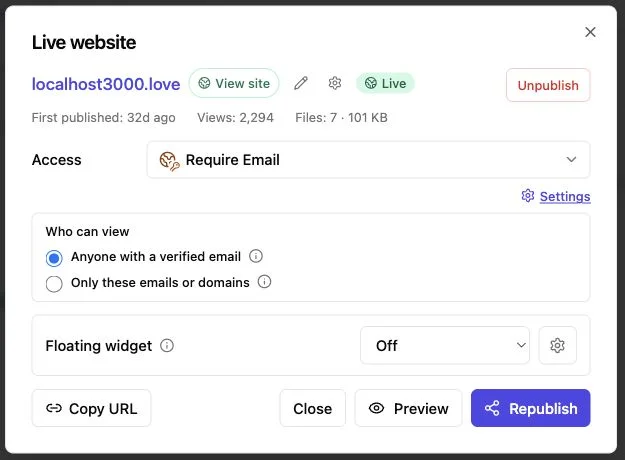
Require named users where practical, least-privilege access, expiration dates, and regular activity reviews. The FTC also recommends MFA, encryption, written vendor requirements, and need-to-know access. Keep secrets, live credentials, private keys, and unrestricted production exports out of general diligence folders.
Data Room Organization: Operate Without Losing Control
Treat the index as a live control record, not a one-time list.
-
Prepare files. Use descriptive names, visible dates, searchable PDFs, and consistent version labels. Remove duplicates and review redactions.
-
Publish in stages. Start with summaries and lower-risk records. Release restricted material after the reviewer, purpose, and permissions are confirmed.
-
Track questions. Log each request, answer, document reference, owner, and unresolved point.
-
Update deliberately. Replace outdated material, retain version history, and notify affected reviewers of material changes.
-
Close the room. Revoke access, export required logs, preserve the record, and apply the retention or deletion plan.
| Approach | Good Fit | Main Limitation |
|---|---|---|
| Email attachments | Very small, low-risk exchanges | Weak version control and forwarding risk |
| Shared drive | Collaborative internal preparation | Permissions and external access can drift |
| Lightweight controlled room | Moderate client, partner, or commercial diligence | May lack formal deal controls |
| Enterprise VDR | Regulated, complex, or high-stakes transactions | Higher cost and setup effort |
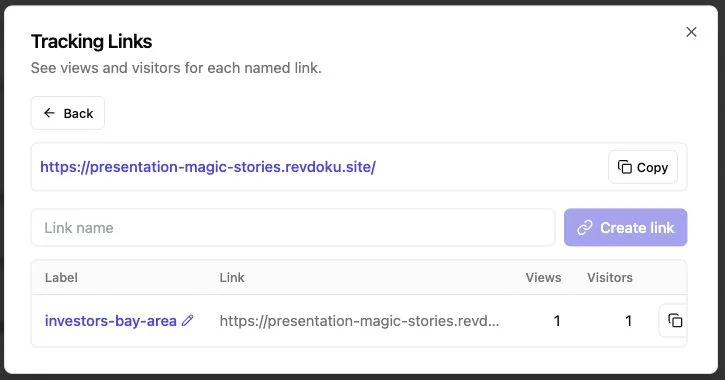
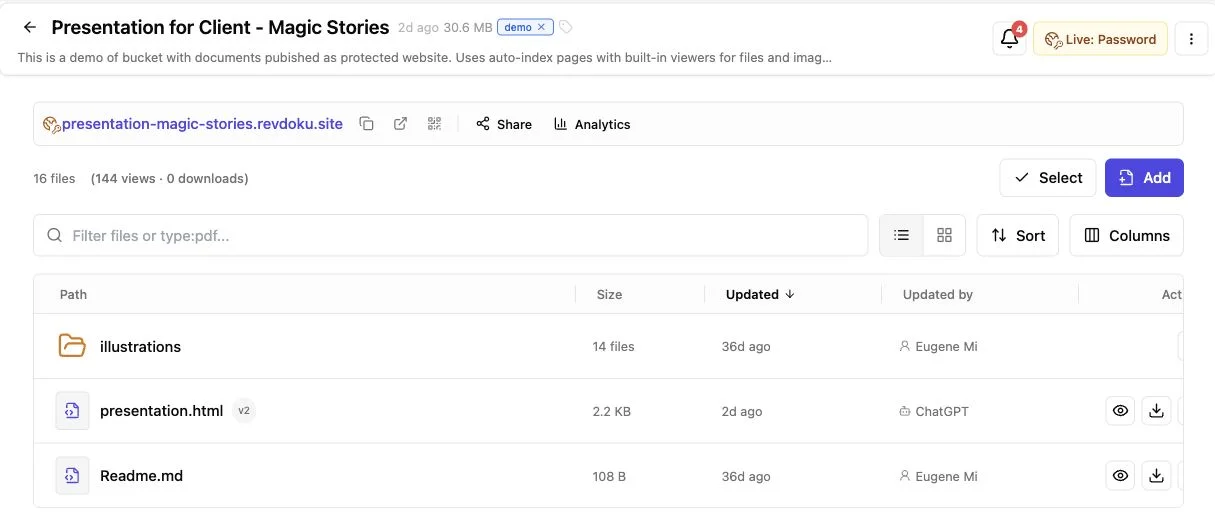
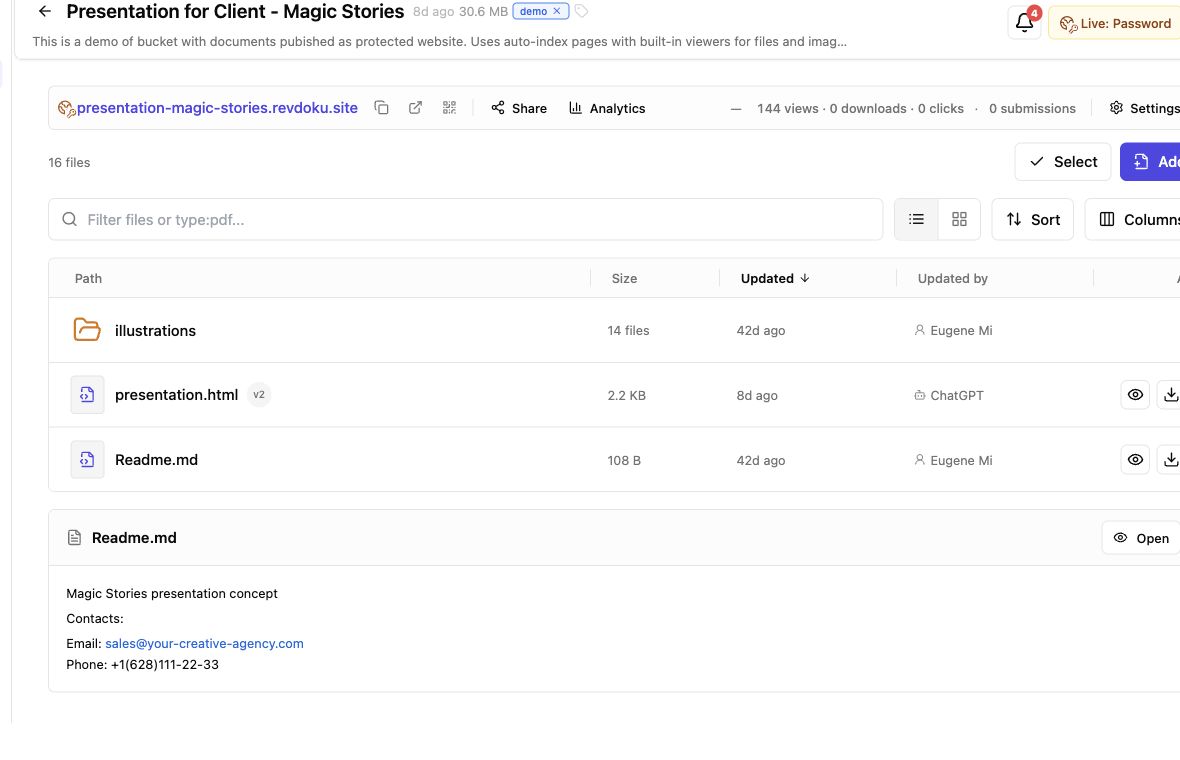
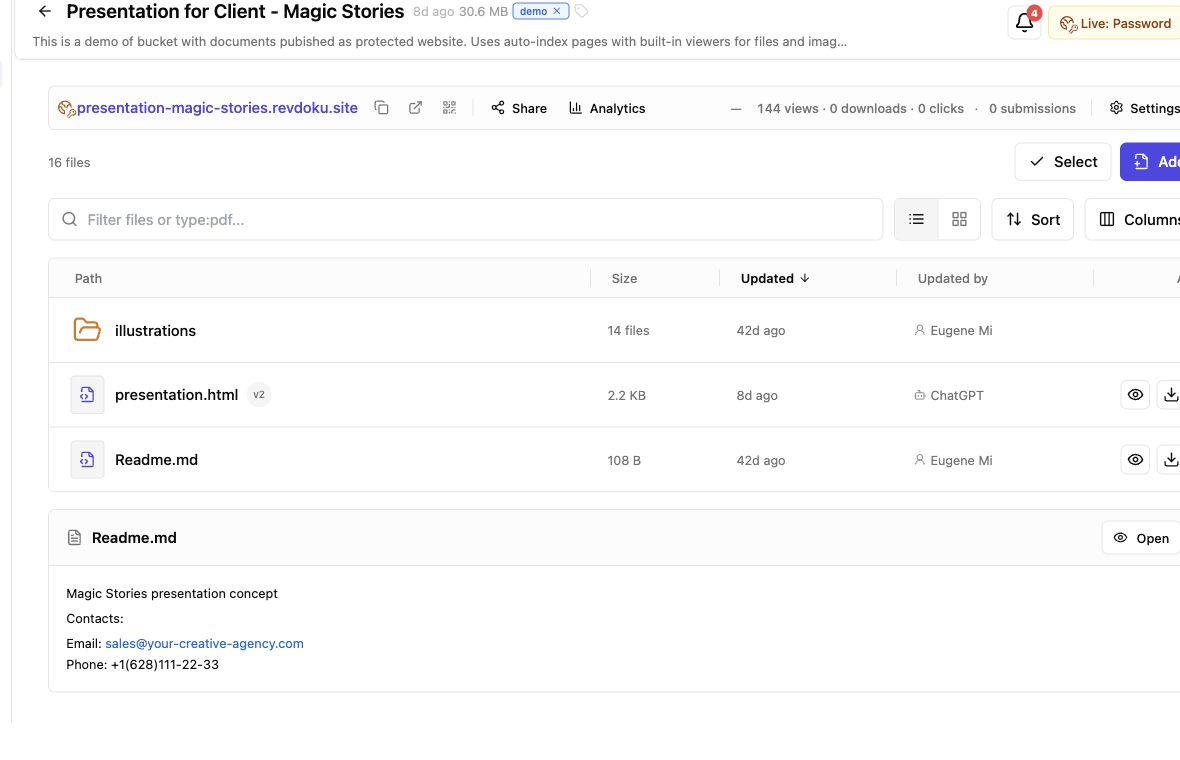
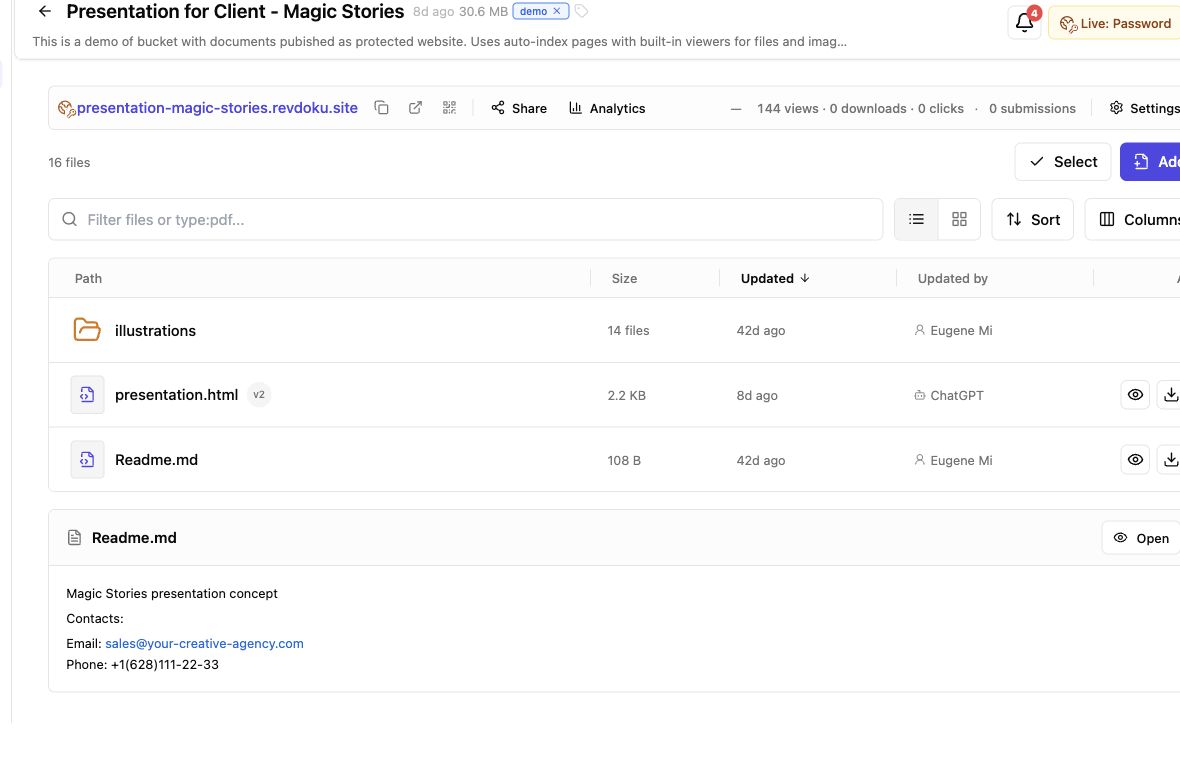
Revdoku can serve as a lightweight room for modest document sets that do not require enterprise deal controls. A user can drag documents, folders, demos, or presentations into a private bucket and share a stable password-protected or email-gated link. Open notifications, visitor activity, lead records, and built-in feedback help small teams manage follow-up. File updates retain the same link.
Reserve public links for non-sensitive material. API, CLI, and AI-agent publishing are optional; manual upload remains straightforward.
Use a full virtual data room for counsel-required document-level entitlements, formal Q&A, immutable audit evidence, advanced watermarking, clean rooms, or specific data-residency controls.
Final Thoughts on the Due Diligence Data Room Checklist
A good checklist links each claim to reliable evidence. It exposes gaps early enough to investigate, correct, or explain.
Follow three principles:
- Include complete source records, not selected screenshots
- Restrict sensitive information according to purpose and reviewer
- Record missing items, exceptions, explanations, and updates openly
Keep the room a controlled working record throughout review. Scope it to the decision, assign each section an owner, and let legal, tax, accounting, privacy, and security advisers adjust it where specialist judgment is needed. This enables a faster review, fewer surprises, and a clearer final decision.
Frequently asked questions
What should I do before uploading documents to a data room?
Define the decision being evaluated, the entities and periods covered, and what qualifies as complete and current evidence. Then create an indexed request list with an owner, status, due date, and document link for every item.
How many years of records should a data room include?
Three completed fiscal years is a common starting point, but the appropriate period depends on the transaction, applicable laws, and adviser requirements. Tax, employment, regulatory, and ownership records may need to cover a longer period.
What should I do if a requested document is missing or incomplete?
Record the gap in the index instead of leaving it unexplained. Identify the responsible person, expected delivery date, available substitute evidence, and any factual context reviewers need to understand the issue.
How should sensitive information be shared during due diligence?
Begin with summaries, anonymized schedules, or redacted documents, then provide detailed records only to authorized reviewers with a defined need. Use staged permissions, expiration dates, MFA, and activity reviews, and never place live credentials or private keys in general diligence folders.
How can I keep the data room organized as questions and documents change?
Use descriptive filenames, visible dates, consistent version labels, and direct links from each request to its supporting evidence. Track questions and updates in the index, preserve version history, and notify affected reviewers when material information changes.
Do I need an enterprise virtual data room?
Not always. A controlled shared room may suit a modest, lower-risk review, while complex or regulated transactions may require document-level permissions, formal Q&A, advanced watermarking, immutable audit records, clean rooms, or data-residency controls.
What should happen when due diligence ends?
Revoke access, export any required activity logs, and preserve the final index and transaction record. Apply the agreed retention or deletion plan so sensitive information does not remain accessible indefinitely.
Related Articles
Fundraising Data Room: A Founder's Guide
Build a secure fundraising data room, stage investor access, organize due diligence files, track engagement, and prevent version chaos.
Papermark Alternative: Revdoku vs Papermark
Compare Revdoku and Papermark for secure sharing, analytics, data rooms, mixed-file deliverables, self-hosting, and automation.
Best Dropbox DocSend Alternative for Secure Sharing
Compare Revdoku, DocSend, and other secure sharing tools for protected client delivery, document analytics, access control, and pricing.