
Essential Resume Screening Checklist for Employers
Table of Contents
- Introduction
- Why Most Resume Screening Processes Fail
- Setting Up Your Pre-Screening Criteria
- Round 1: The Seven-Second Quick Screen
- Round 2: Detailed Resume Review
- Comparative Ranking and Scoring
- Legal Compliance in Resume Screening
- Common Resume Screening Mistakes to Avoid
- Streamlining Resume Screening with Technology
- Key Takeaways
- Introduction
- Resume Screening Checklist for Employers
- Pre-Screening Setup (Before Reviewing Any Resumes)
- Round 1: Quick Screen (7 Seconds Per Resume)
- Round 2: Detailed Review (2-3 Minutes Per Resume)
- Round 3: Comparative Ranking
- Legal Compliance Check
- Why Most Resume Screening Processes Fail
- Setting Up Your Pre-Screening Criteria
- Round 1: The Seven-Second Quick Screen
- Round 2: Detailed Resume Review
- Comparative Ranking and Scoring
- Legal Compliance in Resume Screening
- Common Resume Screening Mistakes to Avoid
- Streamlining Resume Screening with Technology
- Key Takeaways
Introduction
You’re staring at 237 resumes for a single role. Your inbox is flooded. The hiring manager needs three candidates by Friday. Where do you even start?
Many HR teams approach resume screening inconsistently. Standards often shift after reviewing resumes, making deal-breakers negotiable. This inconsistency wastes time, introduces bias, and means you might reject your best candidate while advancing mediocre ones.
This resume screening checklist provides a standardized resume evaluation process to review resumes effectively and fairly. You’ll discover how to set up pre-screening criteria, conduct effective resume screening rounds, and maintain legal compliance throughout the resume evaluation.
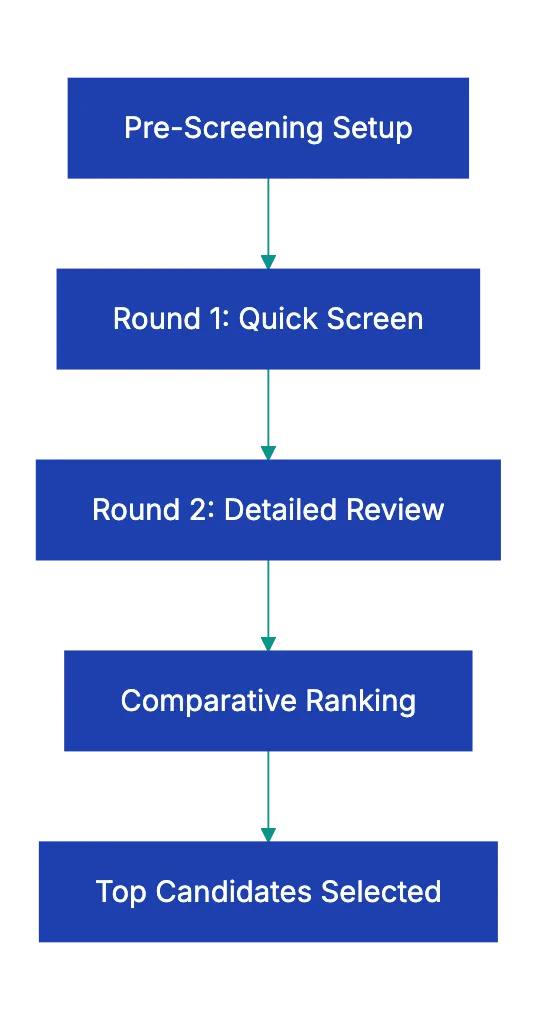
Why Most Resume Screening Processes Fail
Three-Round Screening Approach:

The average corporate job opening receives 250 resumes, according to research from Glassdoor. HR professionals spend an average of 7 seconds on the initial resume scan. That’s barely enough time to read a candidate’s name and current job title, let alone assess their qualifications fairly.
The issue is the lack of a standardized screening process. See resume screening checklist. Without clear criteria established before reviewing applications, hiring teams make inconsistent decisions. A Stanford study found that evaluators who reviewed candidates sequentially (one after another) made dramatically different hiring decisions than those who evaluated the same candidates against fixed criteria.
See standardized resume evaluation process.
This inconsistency creates three major problems. First, it wastes time by re-evaluating what matters. Second, it opens your organization to legal risk if screening decisions can’t be justified with documented, consistent criteria. Third, and most importantly, you miss great candidates because your judgment shifts as you review more applications.
The resume screening checklist approach resolves this by ensuring you define success criteria before starting the resume screening process. This approach saves hours and protects against decision fatigue.
Setting Up Your Pre-Screening Criteria
Before you open a single resume, sit down with the hiring manager and create a job-specific screening checklist. This step defines the quality of your hiring process. Skip it, and you’re just guessing.
Start by separating must-have requirements from nice-to-have qualifications. Must-haves are non-negotiable deal-breakers. If a candidate lacks them, they cannot succeed in the role regardless of other strengths. Nice-to-haves are bonus qualifications that make someone more attractive, but aren’t required.
For a senior accountant role, must-haves might include a CPA license, 5+ years of public accounting experience, and proficiency in specific accounting software. Nice-to-haves could be experience in your industry, management experience, or additional certifications like a CFA.
Share documented criteria with everyone screening. This prevents scope creep where requirements mysteriously expand mid-process because you saw an impressive candidate who had extra qualifications. Stick to your original criteria or formally revise them for all candidates.
Also, define disqualifying factors upfront. These might include missing required licenses, inability to work required hours or locations, or lack of legal work authorization. Be specific and make sure these factors are genuinely job-related, not proxies for protected characteristics.
Round 1: The Seven-Second Quick Screen
Your first pass through resumes should take about 7 seconds per resume screening. You’re not reading carefully. You’re looking for obvious matches or mismatches against your must-have requirements.
Open the resume and immediately scan for your deal-breakers. Does this person have the required degree? The required license? The minimum years of experience? If any must-have is clearly missing, move the resume to the reject pile and move on.
Next, do a formatting and professionalism check. A resume doesn’t need to be beautiful, but it needs to be readable. Automatic red flags include resumes longer than 2 pages for most roles (executives can go to 3), giant headshot photos, illegible fonts smaller than 10 point, or bizarre formatting that suggests the candidate doesn’t understand professional norms.
Glance at the job history timeline. Is the work history relevant to your role? Are there massive unexplained gaps? Note that gaps aren’t automatic disqualifiers, but they should be flagged for follow-up if the candidate advances.
Make a binary decision: advance to Round 2 of the resume screening process or reject. Don’t create a maybe pile. Maybes are usually no’s that waste time in Round 2. Trust your screening criteria. If someone meets the must-haves and has no obvious red flags, they advance. If not, they don’t.
This quick screen should eliminate 60-75% of applications for most roles, leaving you with a manageable pool for detailed review.
Round 2: Detailed Resume Review
Now you’re down to candidates who meet basic requirements. Round 2 separates good candidates from great ones. Spend 2-3 minutes per resume in this phase.
The first thing to check is whether achievements are quantified. Resumes that list responsibilities without results tell you nothing about performance. Compare these two bullets:
Bad: “Managed social media accounts for the company”
Good: “Grew Instagram following from 2,400 to 47,000 in 8 months, generating $180K in attributed sales”
The second candidate provides evidence of results. The first might be great or terrible. You can’t tell. Quantified achievements with numbers, percentages, timeframes, or dollar amounts signal a candidate who thinks about impact, not just tasks.
Next, examine career progression. Does this person’s responsibility and seniority increase over time? Progression doesn’t have to be perfectly linear, but you want to see growth. A candidate who held the same title at five companies over ten years raises questions about ambition and capability.
Evaluate relevance carefully. It’s not just whether someone has done the job before, but whether they’ve solved the specific problems your role needs to solve. A sales manager who grew revenue in a similar market is more relevant than one who managed a larger team in a completely different industry.
Check if the resume is tailored to your specific role in the resume screening checklist. Generic resumes that could apply to any job suggest the candidate isn’t particularly interested in your specific opportunity. Look for mentions of your company, industry-specific terminology, or skills that match with your job description.
Red flags to watch for include very short tenures (less than 12 months) at multiple companies, unexplained demotions in title or responsibility, and inconsistencies in dates or job descriptions. These aren’t automatic disqualifiers, but warrant questions.
Finally, if a cover letter is provided, read it. A thoughtful cover letter that demonstrates understanding of your company and role is a positive signal. A generic template letter adds nothing.
Comparative Ranking and Scoring
After Round 2, you should have a smaller pool of qualified candidates. Now you need to rank them fairly. This is where many screening processes break down because recency bias makes you remember the last few resumes more vividly than the first ones you reviewed.
Create a simple scoring rubric based on your pre-screening criteria. Assign point values to must-haves and nice-to-haves. For example:
| Criteria | Points |
|---|---|
| Required CPA license | Pass/Fail |
| 5+ years experience | Pass/Fail |
| Industry experience | 3 points |
| Management experience | 2 points |
| Quantified achievements | 5 points |
| Career progression | 3 points |
| Tailored resume | 2 points |
Resume Scoring Decision Flow:
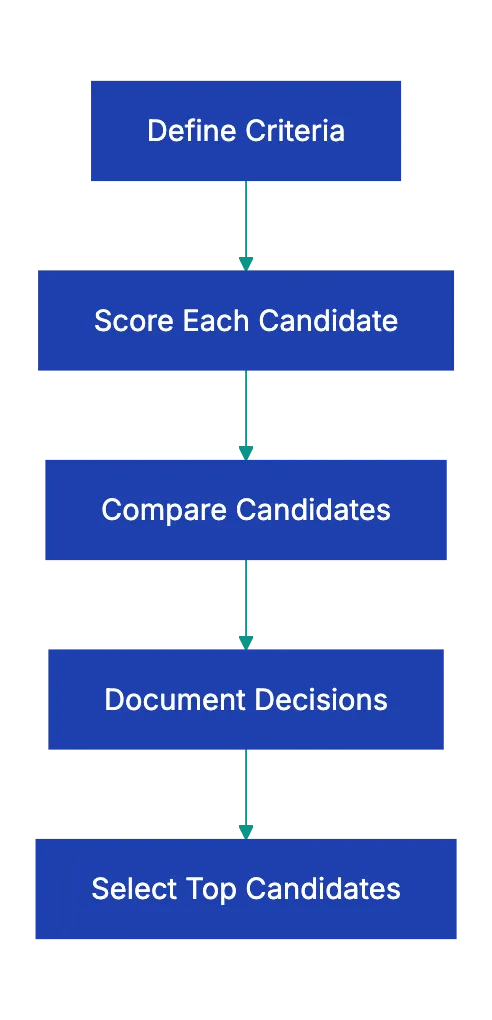
Score each candidate using the same rubric. This forces you to evaluate everyone against identical standards rather than relying on gut feel or imperfect memory.
Document your screening decisions. Note why candidates advanced or were rejected, referencing specific criteria. This documentation serves two purposes. First, it protects you legally if a candidate claims discrimination. Second, it helps you improve your screening process over time by showing which criteria actually predicted job success.
Your goal is to identify the top 5-10 candidates for initial phone screenings. If you’re getting more than that, your criteria might not be selective enough. If you’re getting fewer than 3-5, your must-have requirements might be unrealistic for the market.
Legal Compliance in Resume Screening
Resume screening is heavily regulated. The Equal Employment Opportunity Commission (EEOC) requires employers to retain all job applications and hiring records for at least 1 year from the date of the hiring decisio. Larger employers and federal contractors hvae even longer retention requirements.
More importantly, your screening process must not discriminate based on protected characteristics inclyding age, race, gender, religion, natiional origin, disability, genetic information, or pregnancy. This seems obvious, but discrimination often happens subtly through proxy criteria.
For example, requiring 10+ years of experience wehn 5 years would suffice can diaproportionately exclude younger candidates, creating potential age discirmination issues. Requiring a degree from specific unniversities can create socioeconomic or racial bias. Rejecting candidates with employment gaps can discriminate against women who took parental leave or individuals with disabilities.
THe key is making sure your screening cirteria are genuinely job-related and consistent with business necessity. Can you defend why each requirement is needed for job performance? If not, remove it.
Apply your criteria consistently. You can’t reject one candidate for lacking a qualification while advancing another candidate with the same gap. If you make an exception, document the specific business reason.
Be particularly careful with AI-assisted screening tools. The EEOC has issued guidanc warnin tha autmoated employment decision tolos can perpetuate or increase discrimination if not carefullly validated. If you use software to screen resumes, auddit it regularly to make suure it’s not producing discrimiinatory patterns.
Consult wifh employmen counsel if you’re unsurre whether you screening proocess complies with applicabl laws. The coost of discrimination claims far exceeeds the coost of preventive legal advice.
Common Resume Screening Mistakes to Avoid
Even with a resume review checklist for employers, hiring teams make predictable mistakes. Here are the ones that cause the most problems.
Changing criteria mid-process. You see an impressive candidate who doesn’t quite meet your original requirements, so you decide those requirements weren’t really necessary after all. This isn’t flexibility. It’s inconsistency that creates legal risk and bad hiring decisions.
Focusing on pedigree over performance. Candidates from prestigious companies or universities get extra attention even when their actual achievements don’t justify it. Research from Harvard Business School found that resume reviewers consistently overweight brand-name employers and schools whiel underweighting concrete accomplishments.
Screening for culture fit too earoy. Culture fit is subjective and prone to bias. In resume screening, focus on qualfiications and achievements. Save culture asssesment for interviews where you can evvaluate it more accurately.
Rejecting candidates with employment gaps without investigation. Gaps happen for legitimate reasons: layoffs, family caregiving, education, health issues, or starting a business. Flag gaps for follow-up questions rather than automatic rejection.
Letting one weakness eliminate an otherwise stron candidate. If someone meets 9 out of 10 criteria, consider whether the misssing qualification can be trained or is genuinely needed. The perfect candidate rarely exists.
Reviewing too many resumes in one sitting. After about 20-25 resumes, decision quality deteriorates due to mnetal fatigue. Take breaks. Split larhe applicant pools acrooss multiple sessions.
Not tracking your screening meetrics. If you don’t measure how manu resumes you screen, how many advance to eacch stage, and whcih candidates ultimately succeed, you can’t improv your process.
Streamlining Resume Screening with Technology
The manual resume screening process described above works, but it’s time-consuming when you’re hiring for multiple roles or reviewing hundreds of applications. Technology can help, but use it carefully.
Applicant Tracking Systems (ATS) organiz applications and track candidates through your hiring pipeline. They don’t make screening decisions better, but they make the process mor manageable and ensure compliance documentation. Most ATS platforms include basic keyword matching to flag resumes containing spedific skills or qualifications.
AI-powered resime screening tools go further by attempting to rank candidates based on likelihood of success. These tools can save time, but require careful validation. The EEOC has warned that AI screening tools can discriminate if they’re trained on biased historical data or use criteria that correlate with protected characteristics.
If you use AI screening, treat it as a first-pass filter, not a decision-maker. Have humans review the AI’s recmomendations to catch errors and bias. Regularly audit results by demographic categoyr to identify potential discrimintaion.
A middle-ground approach is using docuemnt review tools to check resumes against your specific job requirements checklist. Upload your screenin criteria, and the toool flags wich canddidates meet which requirements. You still maake the decisions, but the tool handles the tedious verification work.
Key Takeaways
Effective resume screening starts before you read a single resume. Define your muust-have requirements, nice-to-have qualifications, and disqualifying factors in wrriting before reveiwing any applicaations. This prevents criteria drif and ensures consistent evaluation.
Use a mluti-round approach. The quick screen finds obvious mismatches. The detailed review checks quality for qualified candidates. Comparative ranking makes sure you’re evaluating everyone against the same standards.
Document each stage of screening. Note why candidates advanced or were rejected based on specific screening criteria. This protects you legally and helps you refine your screening process over time.
Compliance matters. Apply criteria consistently, avoid screening based on protected characteristics, and retain all applications and screening records for at least one year. When in doubt, consult employment counsel.
The thorough checklist saves hours later. You’ll make better hiring decisions, reduce legal risk, and spend less time second-guessing yourself. Standardize your screening process and you’ll wonder how you ever managed without it.
Revdoku publishes AI-made websites from ChatGPT, Claude, Codex, OpenClaw, and Hermes. Ask your AI tool to create a report, game, chart, document, or landing page, store the files in a Revdoku bucket, publish index.html, and share the live URL.
Update the same bucket later so the public site can keep the same Revdoku link or custom domain.
Frequently Asked Questions
How do I determine my 'must-have' and 'nice-to-have' criteria for a job?
Identify must-have criteria by evaluating the needed qualifications and skills necessary for the role's success. Consider factors such as required education, certifications, and relevant experience. Nice-to-haves can include additional skills or experiences that would improve a candidate's fit, but are not needed for performing the job effectively.
What should I do if two candidates have similar qualifications after screening?
Use a comparative ranking system to score each candidate against the same criteria, focusing on their achievements, career progression, and how well their resumes are tailored to the specific role. This approach helps differentiate candidates based on measurable performance indicators, making sure of a fair evaluation. Also, consider their cover letters for insight into their understanding of the company and role.
How can I avoid bias in the screening process?
Establish clear, job-related criteria before beginning the review process, and apply them consistently to all candidates. Document your decisions to provide a rationale, which helps minimize bias. Consider using blind screening techniques or technology that anonymizes candidate information to focus solely on qualifications.
What common mistakes should I avoid during resume screening?
Avoid changing your criteria mid-process, as this introduces inconsistency and bias. Other pitfalls include overemphasizing candidates' pedigree at the expense of performance, screening for culture fit too early, and dismissing candidates solely based on employment gaps without investigation. Regularly tracking your metrics can also help improve your process over time.
How can technology assist in the resume screening process?
Applicant Tracking Systems (ATS) can help organize applications and ensure compliance, while AI-powered tools can rank candidates based on their likelihood of success. However, these tools should be used as a first filter, complemented by human oversight to catch potential biases. Document review tools can also automate the checking of resumes against specific job requirements, simplifying the initial review phase.
How long should I spend reviewing each resume?
The time spent varies by review stage: about 7 seconds for the initial quick screen and 2-3 minutes for the detailed review of qualified candidates. This approach helps maintain effectiveness and ensures you remain focused on the needed criteria rather than getting bogged down in details during the initial phases.
What legal compliance issues should I be aware of in resume screening?
Make sure that your screening criteria do not discriminate based on protected characteristics, such as age, race, gender, or disability. Document your screening process and retain applications for at least one year to comply with EEOC regulations. Regularly review your criteria and screening tools to identify potential biases and ensure they align with legal standards.
Related Articles

Essential Job Offer Letter Checklist for Candidates
Ensure your job offer letter covers all important details with this comprehensive checklist for candidates and HR teams.

Essential NDA Review Checklist and Tips
Protect your interests with our comprehensive NDA review checklist to spot problematic clauses and negotiate effectively.

Essential Purchase Order Checklist for Buyers
Streamline your purchasing process with our comprehensive checklist to avoid costly PO errors.