
Essential NDA Review Checklist and Tips
NDA review checklist
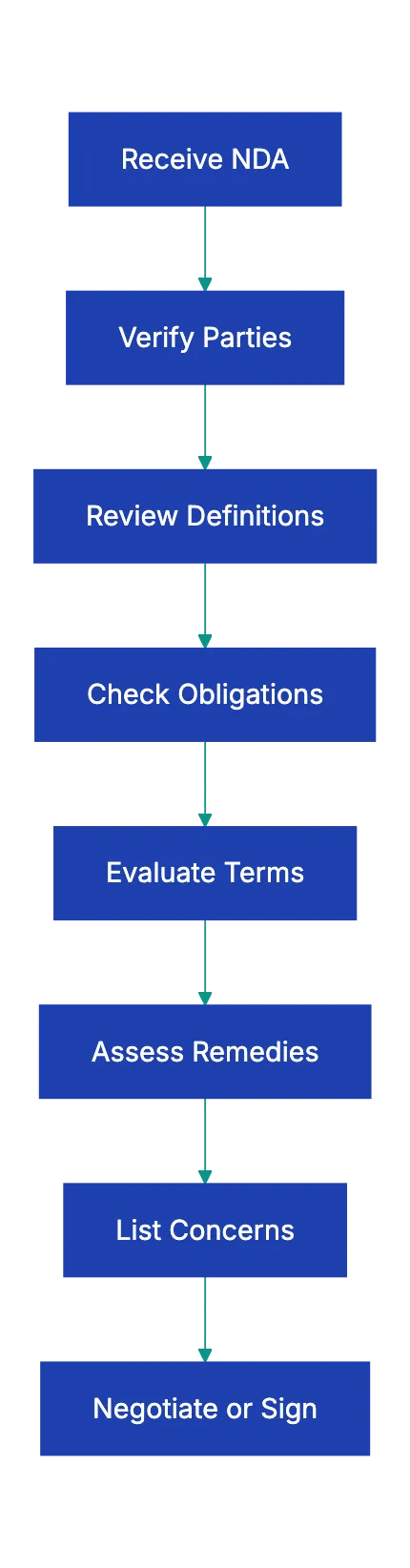
An NDA (non-disclosure agreement) is a contract that limits what you can share or use. Read the full NDA with this checklist before you sign it. Keep a list of each question and each change that you want.
Type, parties and purpose
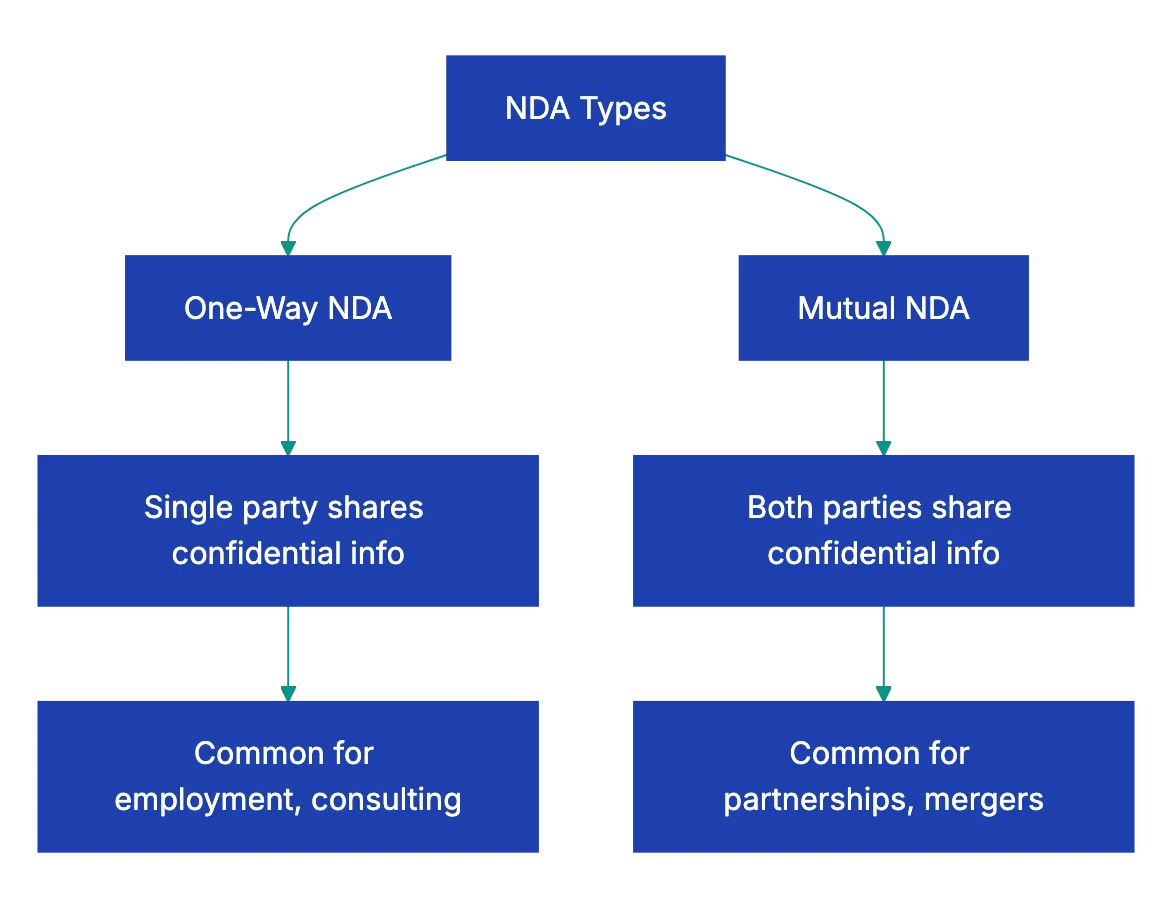
- The NDA is the right type. A one-way NDA protects the information of one party. A mutual NDA protects the information of both parties.
- If the NDA says that it is mutual, the definition of confidential information also covers the information that you share.
- The legal names are correct, and you sign in the right role: as a person or for your company.
- The NDA states a purpose, for example “to evaluate a possible partnership”. It limits the use of the information to that purpose.
Definition of confidential information
- The definition lists categories, such as technical data, product plans, customer lists and prices. Phrases like “all information disclosed” or “any information related to the business” are too broad.
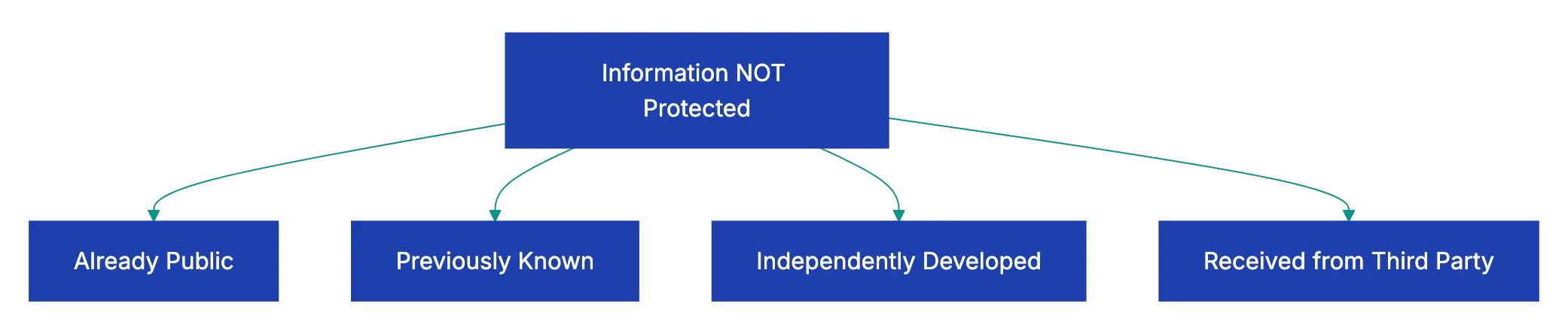
- The NDA has the four standard exclusions. It does not protect information that is already public or that you already knew. It also does not protect information that you develop independently, or information from a third party with the right to share it.
- The NDA says if information must have a “confidential” mark to be protected. It also says how information that you hear in a meeting becomes confidential.
- The NDA does not cover the general skills and experience that you use in your work.
Your duties
- Each duty is clear. Find each “shall not” and “agrees not to”, and make a list of them.
- The NDA names the people that you can share with, such as employees, contractors and advisers who need the information. These people must follow the same duties.
- The security standard is clear and possible for you. “Reasonable care” is clearer than “industry-leading security measures”.
- The NDA allows disclosures that a law or a court order requires.
- At the end, the NDA says what you must return or destroy, and by when. It also says if you can keep copies in backups.
Time
- The NDA states the term (how long the NDA is active) and the survival period (how long the duties continue after the end). Add the two periods. A one-year term with a five-year survival period binds you for six years.
- A duty without an end date applies only to trade secrets, not to all information.
- You can end the NDA with notice, or the NDA ends with the business relationship.
A trade secret is information that has value because others do not know it, and that its owner keeps secret. Most US states do not require a time limit for confidentiality duties. Some courts, for example in Virginia and Florida, required a limited duration, but not for trade secrets (Gordon Feinblatt).
Remedies and disputes
- Liquidated damages (a fixed amount for each breach): the amount, and the definition of a breach.
- Legal fees: if the losing party pays the fees, the rule applies to both parties.
- Governing law and venue: the place for a dispute is a place where you can afford to go to court.
- Assignment: the other party cannot transfer the NDA to a new company without your consent.
Hidden restrictions
- The NDA has no non-compete. Language such as “You will not work for any competitor for two years” is a non-compete, not a confidentiality duty.
- The NDA has no ban on hiring or approaching the staff or clients of the other party, unless you accept it.
- The NDA does not require you to share your own trade secrets or client information, unless the deal needs it.
- The NDA does not transfer the ownership of your ideas or your work to the other party.
A very broad NDA can work like a non-compete. Courts in many parts of the US started to reject confidentiality agreements that work as non-competes (Hrdy and Seaman, Yale Law Journal).
Limits in US law
US law limits some NDA terms. Look for these points:
- Whistleblower immunity. The Defend Trade Secrets Act protects a person who discloses a trade secret in confidence to a government official or a lawyer. The protection applies only to a report or an investigation of a suspected violation of law. An employer must give notice of this immunity in each agreement with an employee about confidential information. Here, “employee” includes contractors and consultants. Without the notice, the employer cannot get attorney fees from that employee (18 U.S.C. 1833(b)). It also cannot get the extra damages for a willful and malicious misuse of a trade secret. These extra damages can be up to twice the actual damages (18 U.S.C. 1836(b)(3)(C)).
- Reports to the SEC. A person can contact the SEC staff about a possible violation of securities law. Nobody can use a confidentiality agreement to stop this contact (17 CFR 240.21F-17).
- Sexual harassment and assault. A nondisclosure clause from before a sexual assault or sexual harassment dispute is not enforceable in court for that dispute. This applies when the conduct allegedly violated federal, tribal or state law (42 U.S.C. 19403).
Red flags and what to ask for
| Clause | What to ask for |
|---|---|
| A non-compete inside the NDA | Remove it |
| A duty without an end date for all information | A fixed period, with a longer period only for trade secrets |
| No standard exclusions | The four standard exclusions |
| Legal fees that only you pay | The losing party pays, whichever party that is |
| A large fixed amount for any disclosure | Remove it, or define a breach narrowly and lower the amount |
| A duty to share your own information | Remove it, or make the NDA mutual |
| A court far away from you | Your state, or a neutral place |
| Assignment without your consent | Your consent, except in a sale of the whole business |
How to ask for changes
You can ask for changes to an NDA. Choose the two or three changes that matter most to you. Explain the business reason for each change, not only the legal concern. Propose replacement wording. For example: “I work with several clients in this industry. Please add the standard exclusion for information that I knew before our work.” If the other party refuses all changes, include that fact in your decision.
Use this checklist with Claude or ChatGPT
You can paste this checklist and the NDA into Claude or ChatGPT. Ask the AI to compare the NDA with each item. The AI can find the clause for each topic, show which items are missing, and explain legal wording in plain language.
Below are an NDA review checklist and an NDA. For each checklist item,
say "covered", "unclear" or "missing", quote the clause that covers it,
and explain in plain English what it means for me as the [receiving /
disclosing] party. Then list the red flags and suggest replacement
wording for each one.

CHECKLIST:
[paste the checklist]

NDA:
[paste the NDA]
Compare each quote from the AI with the NDA before you rely on it. The AI can misread a clause, miss a clause, or quote wording that is not in the NDA.
Read the draft before you upload it. An NDA can make its own terms confidential. Remove names and business details if necessary, and read the data settings of your workspace.
An AI summary is not legal advice. For an NDA that limits your work or carries large damages, a lawyer has the final word.
A docs portal with Ask AI
and support tickets
Connect a repository, or describe your product to start. Each docs site has search, Ask AI, an API console, an MCP server and support tickets.
- Publishes from GitHub on every push
- Works with Mintlify repositories
- API console from your OpenAPI file
- MCP server and llms.txt for AI agents
- Ask AI and support tickets
- Analytics for people and AI agents
Frequently Asked Questions
Does an NDA cover information that the other party shared before the signature?
Read the effective date and the definition of confidential information. If the NDA covers only information shared after the signature, earlier information can fall outside it. If you need cover for earlier disclosures, ask for a clause that includes them. If you shared first, make sure that the NDA also covers your earlier disclosures.
Related Articles

Essential Resume Screening Checklist for Employers
A resume screening checklist for employers: criteria to set first, two review rounds, a scoring table and the US legal rules to follow.

Essential Vendor Agreement Review Checklist
A vendor agreement review checklist: scope, price, SLAs, data and security, liability, exit, IP and disputes, with US and GDPR legal points.

Essential Freelance Contract Review Checklist
A freelance contract review checklist: scope, payment, IP and portfolio rights, termination, liability, non-competes, and what to negotiate.