
Essential Freelance Contract Review Checklist
Table of Contents
- Freelance contract checklist
- Payment terms
- Scope, revisions and change requests
- Intellectual property and portfolio rights
- Timeline and client delays
- Termination
- Liability, indemnification and insurance
- Non-compete, exclusivity and confidentiality
- When you find a problem clause
- Use this checklist with Claude or ChatGPT
Freelance contract checklist
Most client contracts start from a template that a lawyer wrote to protect the client. Go through these clauses before you sign. For each clause, decide if it is acceptable, if it needs a change, or if it is missing.
| Clause | What to look for | Red flag |
|---|---|---|
| Parties | Legal names and mailing addresses of you and the client | No client address, or the wrong legal entity |
| Scope | Deliverables that you can count, and a list of work that is not included | “Marketing materials” or “website design” with no detail |
| Revisions | A set number of revision rounds, then a price for each extra round or hour | No limit on revisions, or no number at all |
| Change requests | A written change, with a price and new dates, for each piece of new work | The client can change the scope by email with no price |
| Fee and payment | Amount, currency, method and due date for each payment | No due date, or payment only “on approval” |
| Deposit and milestones | A part paid up front, and the rest paid at delivered milestones | All payment at the end of a long project |
| Late payment | Interest or a late fee, and your right to stop work | No result when the client pays late |
| IP ownership | Rights go to the client after full payment | Rights go to the client on signature or delivery, before you get paid |
| Portfolio | You can show the work, and the contract states any confidentiality limits | No portfolio right at all |
| Timeline | Your dates and the client’s dates for content, feedback and approvals | Your deadline does not move when the client is late |
| Termination | Both sides can end the contract with notice. You get paid for finished work | Only the client can end the contract, with no payment for finished work |
| Liability | A maximum amount, for example the fees paid under the contract | No limit on your liability |
| Indemnification | Mutual, and limited to the breach of each side | You pay for all client losses, also those from the client’s own materials |
| Non-compete and exclusivity | None, or narrow in topic and time | You cannot work in the client’s industry for a year or more |
| Confidentiality | Real secrets only, with an end date | So broad that you cannot say that you worked for the client |
| Insurance | Required cover that is in proportion to the project | High coverage limits on a small project |
| Disputes | The governing law, and mediation or arbitration before court | A court far away that you cannot afford to travel to |
IP (intellectual property) is the legal right to the work that you make. Indemnification is a promise to pay the other side’s losses from a claim.
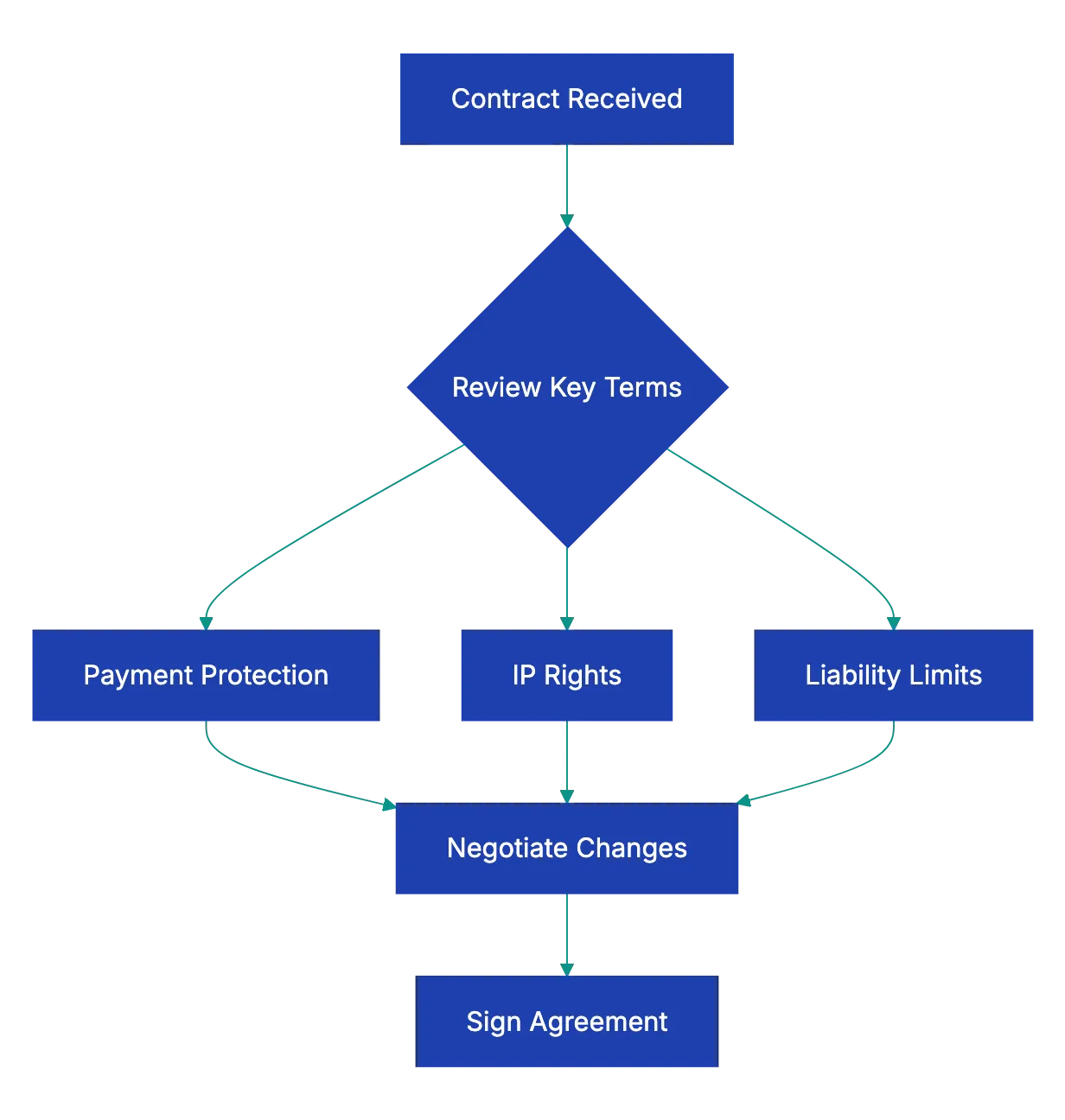
Payment terms
Make sure that the contract states these five things: fee, schedule, payment method, currency and the result of late payment.
- Each payment has a date or a clear trigger, for example “within 14 days of the invoice”.
- A long project has a deposit and milestone payments. You do not pay for the whole project with your own time.
- You agreed to long payment terms (net 30, net 60) on purpose. They are not a default that you missed.
- The contract states the result of late payment. For example, interest or a late fee where local law permits it.
- The contract gives you the right to stop work until the client pays.
- A kill fee states your payment if the client cancels the project before the end.
- The contract lists the expenses that the client pays back, and if they need approval first.
Some places put parts of this into law. In New York City, a freelance contract of $800 or more must be in writing. The $800 includes all work for the same client in 120 days. The contract must state the work, the pay and the payment date. If the contract has no date, the client must pay within 30 days after you finish the work.
New York State extended similar protections to the full state for freelancers who get at least $800. Illinois has a Freelance Worker Protection Act for contracts of $500 or more. Under that law, the contract must be in writing. The payment date must be no later than 30 days after you deliver the work.
Scope, revisions and change requests
Unclear scope is the most frequent cause of unpaid work. Look for deliverables that you can count. For example: “homepage design, five templates for interior pages, mobile layouts, two revision rounds”. Do not accept only “website design”. The contract must also list the work that it does not include. For example, a logo project can exclude brand guidelines and business cards.
Keep revisions and changes apart. A revision adjusts the agreed deliverable (“make the headline larger”). A change adds new work (“add three more pages”). The contract limits revisions by round. Each change needs a written change order with a price and a new date.
Intellectual property and portfolio rights
- Ask for the rights to go to the client on full payment, not on delivery or signature. Until then, the rights stay with you if the client does not pay.
- Make sure that only the final deliverables go to the client. Your tools, templates, code libraries and ideas stay with you.
- Ask for a clause that lets you show the work in your portfolio. The clause can set limits, for example “only after launch”.
- Read the words “work made for hire” with care. The rule for the US is below.
In the US, a work made for hire is a work for which the law treats the client as the author. According to the US Copyright Office, work by an independent contractor is a work made for hire only when two conditions are both true. First, the work is in one of nine categories, for example a contribution to a collective work, a translation or a compilation. Second, both sides sign a written agreement that says so. In other cases, the client usually gets the rights through a written assignment. Find out which method your contract uses and what it covers.
Timeline and client delays
A deadline clause must give your dates and the client’s dates. The client’s dates are for content, feedback and approval. Add a sentence that moves your deadline when the client is late with their part. Without it, three weeks of slow feedback still leave you with the original delivery date.
Termination
- Both sides can end the contract with the same notice period.
- If the client ends the contract, you get paid for all finished work, your expenses and any agreed kill fee.
- The contract states what happens to unfinished work and who owns it.
Liability, indemnification and insurance
These clauses carry the largest financial risk for a business with one person.
- Liability cap: Without a cap, a mistake on a $10,000 project can cost you much more than $10,000. Ask for a cap on your total liability, for example the fees paid under the contract. Some claims, for example a breach of confidentiality, can be outside the cap. Keep the general liability under the cap.
- Indemnification: A promise to pay for your own breach is fair. An example is an image that you used without the rights. A promise to pay for all problems, also those from the client’s materials or decisions, is not fair. Ask for mutual indemnification.
- Insurance: If the client requires liability insurance, find out the price of the required limits before you accept.
Non-compete, exclusivity and confidentiality
A non-compete clause stops you from work for other clients in a field. Freelancers work for many clients, so a broad non-compete can cost more than the project pays. Ask the client to remove it. If the client refuses, make it narrow: one named competitor or product, for a short time. Laws on non-competes are very different between states and countries. Negotiate the clause. Do not expect a court to cancel it for you.
Also look for these clauses:
- Exclusivity, which means no other clients at all
- A clause that gives the client each idea that you mention during the project
- Confidentiality so broad that you cannot list the client
- Automatic renewal with no exit
- A personal guarantee that makes you liable even when you work through a company
When you find a problem clause

- Sort the problems into two groups. Put must-fix items first, for example unlimited liability, a broad non-compete or no payment terms.
- Put nice-to-have changes second, for example stronger portfolio rights or protection against client delays.
- Propose exact new text for each must-fix item. For example: “Change section 8. Limit indemnification to direct breaches of my obligations, with a cap at fees paid.”
- Explain each change in business words. For example: “This clause makes me liable for much more than the project pays.”
- If the client refuses to change a must-fix item, think about declining the project.
- Save the new text that clients accepted. Use it again in the next contract.
Use this checklist with Claude or ChatGPT
Claude or ChatGPT can do a fast first pass. Paste this checklist into the chat. Then attach or paste the contract and ask for a report for each clause:
I am a freelancer. Below is my contract checklist and a contract a client
sent me. For each checklist row, quote the clause that covers it (with its
section number), say whether it is acceptable, needs a change, or is
missing, and suggest replacement wording for anything that needs a change.
List the must-fix items first.
Find each quoted clause in the contract yourself. The AI can read a clause incorrectly, miss a clause or give a section number that does not exist. Remove client names, rates and other confidential details before you upload. Your contract or the data settings of your AI workspace can forbid you to share them. The AI is not a lawyer. For a high-value contract, pay a lawyer to read it before you sign. Do the same for a clause that you do not understand.
A docs portal with Ask AI
and support tickets
Connect a repository, or describe your product to start. Each docs site has search, Ask AI, an API console, an MCP server and support tickets.
- Publishes from GitHub on every push
- Works with Mintlify repositories
- API console from your OpenAPI file
- MCP server and llms.txt for AI agents
- Ask AI and support tickets
- Analytics for people and AI agents
Frequently Asked Questions
Where can I find a model freelance contract?
The New York City Department of Consumer and Worker Protection publishes a model freelance contract with required and optional terms. The Illinois Department of Labor publishes a model contract for its Freelance Worker Protection Act. Both are free. Start from one of them, then change the scope, payment and IP sections for your work.
What can I do if a client in New York City does not pay?
File a complaint with the Department of Consumer and Worker Protection online, by email or through 311. Under the Freelance Isn’t Free Act, you can get double the amount that the client did not pay on time, plus attorneys’ fees and costs. The Navigation Program of the department can help with the court process. The department cannot give legal advice.
Related Articles

Essential Vendor Agreement Review Checklist
A vendor agreement review checklist: scope, price, SLAs, data and security, liability, exit, IP and disputes, with US and GDPR legal points.
Contract Party Reference Count Checklist
Count how often a contract names each party, make sure that the names are consistent, and see which party has the most obligations.

Essential NDA Review Checklist and Tips
An NDA review checklist: parties, the definition of confidential information, duties, time limits, remedies, hidden restrictions and US legal limits.