
Essential Scope of Work Review Checklist for Projects
Table of Contents
- Introduction
- Why Most SOWs Fail (and How to Spot the Warning Signs)
- How to Review a Scope of Work: A Step-by-Step Approach
- The Critical Elements Every SOW Must Include
- Common SOW Red Flags That Guarantee Problems
- Real-World Example: How SOW Gaps Cause Project Failures
- Using AI and AI review tools for SOW Analysis
- Key Takeaways
- Introduction
- Scope of Work Review Checklist
- Project Definition and Objectives
- Scope and Deliverables
- Timeline and Milestones
- Resources and Responsibilities
- Budget and Payment Terms
- Change Management
- Quality Standards and Testing
- Risks and Contingencies
- Why Most SOWs Fail (and How to Spot the Warning Signs)
- How to Review a Scope of Work: A Step-by-Step Approach
- The Critical Elements Every SOW Must Include
- Common SOW Red Flags That Guarantee Problems
- Real-World Example: How SOW Gaps Cause Project Failures
- Using AI and Document Review Tools for SOW Analysis
- Key Takeaways
Introduction
Project disasters often start with a bad Scope of Work. Scope creep, budget overruns, and disputes stem from vague SOW documents. A rushed review causes problems later. Most SOW problems are predictable and preventable. This statement of work checklist walks you through every section that matters, from deliverables to change management. Use it before signing, starting the project, or exchanging money. A thorough SOW review takes twenty minutes and prevents issues.
Why Most SOWs Fail (and How to Spot the Warning Signs)
An SOW should prevent arguments, but many are rushed by eager project starters without anticipating issues.
The result? Professional-looking documents with holes. The vendor interprets “website redesign” one way, the client interprets it another way, and by the time everyone realizes they’re talking about different things, thousands of dollars and weeks of work are already gone.
Research from the Project Management Institute found that 37% of project failures trace back to unclear objectives and requirements at the start. That’s not a technology problem or a talent problem. It’s a documentation problem. Specifically, it’s a scope of work problem.
When SOW requirements aren’t clear upfront: The vendor delivers what they think was requested. The client rejects it because it’s not what they expected. Neither party is lying; they just never agreed on specifics. The SOW stated “mobile app” without specifying iOS/Android, features, or completion criteria. So now you’re stuck negotiating after the work is already complete, which is the worst possible time to negotiate anything.
Common SOW Failure Points:

Warning signs of a weak SOW include vague deliverables, missing acceptance criteria, no change management process, and one-sided timelines. Fix these red flags before starting the project.
How to Review a Scope of Work: A Step-by-Step Approach
Reviewing a scope of work involves systematically checking if the document answers potential future questions.
Start with the project definition. Can you summarize the project in one sentence? If not, the SOW is flawed. Next, look at the business goals. Does the document explain why this project matters, what problem it solves, what success looks like? Or does it just list tasks without connecting them to outcomes?
Address deliverables with a detailed SOW template. This is where many SOWs fail. Ensure deliverables are unambiguous to prevent differing interpretations. “Logo design” could mean one concept or ten concepts. “Website” could mean three pages or thirty pages. Get specific. Use numbers, lists, and examples.
Ensure each SOW deliverable has acceptance criteria for client approval. Without acceptance criteria, projects turn into endless revision loops because there’s no shared definition of done.
Check the timeline and client responsibilities. Many SOWs give the vendor strict deadlines, but leave client review periods vague (“client will review and provide feedback”). That’s a recipe for delays. Specify how long the client has to review, what format feedback should take, and what happens if the client misses the review window.
Look at the budget and payment terms. Are payment milestones tied to specific deliverables or just calendar dates? Deliverable-based payments protect both parties. The vendor gets paid when they deliver real value, and the client doesn’t pay for incomplete work.
Finally, review the SOW for a change management process. Scope changes are normal on any project longer than a few weeks. The question is whether changes happen through a formal process with pricing and approvals, or whether they happen through vague conversations that turn into disputes later. A good SOW assumes changes will happen and defines exactly how to handle them.
The Critical Elements Every SOW Must Include
Some sections of a scope of work are nice to have. Others are deal-breakers. Here’s what you can’t skip.
Specific, measurable deliverables. Not “marketing materials,” but “three blog posts of 1,200-1,500 words each, ten social media graphics in PNG format sized for Instagram and LinkedIn, one 30-second video in MP4 format with captions.” The test is simple: could the vendor deliver something that technically matches the description, but isn’t what the client wanted? If yes, add more detail.
Acceptance criteria for every deliverable. How does the client formally sign off that a deliverable is complete and acceptable? Is it a written approval email? A form? A checklist? And what happens if the client rejects the deliverable. how many revision rounds are included, and what’s the process for resolving disagreements?
Out-of-scope statement. Listing what’s not included is just as important as listing what is included. It prevents scope creep and manages expectations. “This project includes logo design, but does not include business card design, website application of the logo, or brand guidelines documentation. Those items can be added through a separate change order.”
Client responsibilities with deadlines. If the vendor needs the client to provide content, access, approvals, or decisions, those responsibilities need specific deadlines. “Client will provide product photos by March 15” is better than “client will provide product photos.” When client responsibilities don’t have deadlines, they become the bottleneck that delays everything.
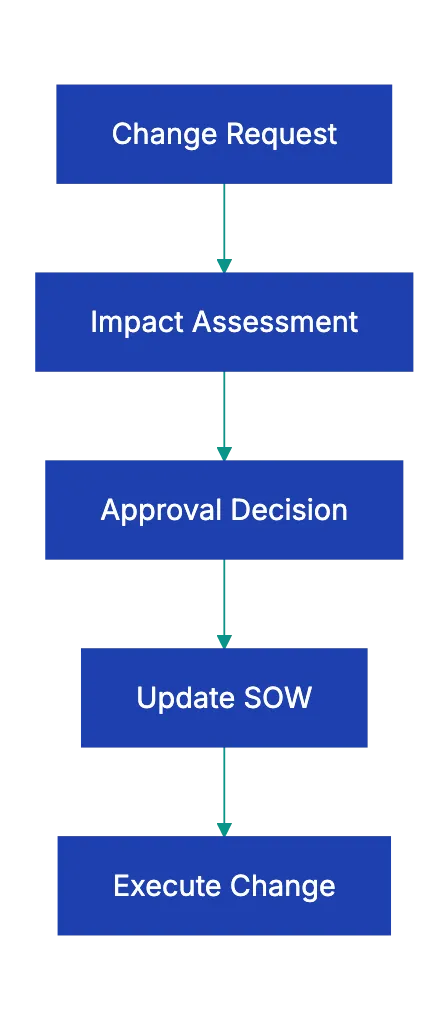
Change management process. Even a simple process is better than nothing. At minimum, define: (a) how to request a change, (b) who approves changes, (c) how changes are priced, and (d) how changes affect the timeline. Without this, every scope change turns into a negotiation.
Payment terms tied to milestones. Break the project into phases with payments tied to deliverable completion. This protects both parties. The vendor has predictable cash flow, and the client doesn’t pay the full amount upfront for work that might never get finished.
Common SOW Red Flags That Guarantee Problems
Some scope of work problems are subtle. Others are glaring red flags that scream “this project will be a disaster.” Here’s what to watch for.
Change Management Flow:
No acceptance criteria. If the SOW doesn’t define how the client formally accepts each deliverable as complete, the client can reject work indefinitely. “This isn’t quite what I had in mind” becomes an endless loop. The vendor keeps revising with no clear endpoint, and the project budget evaporates.
Vague deliverables open to interpretation. When deliverable descriptions use fuzzy language (“modern design,” “user-friendly interface,” “professional quality”), disputes are inevitable. What feels modern to the vendor might feel dated to the client. Describe deliverables with specifics that can be verified: feature lists, dimensions, file formats, technical requirements.
No change management process. Scope changes will happen. The only question is whether they happen through a defined process or through chaotic hallway conversations. Without a formal change process, the vendor ends up doing unpaid extra work (because the client considers it part of the original scope), or the client feels nickel-and-dimed (because the vendor charges for things the client thought were included).
One-sided timelines. The vendor has strict deadlines with late penalties, but client review periods are open-ended with no consequence for delays. This creates an imbalanced project where vendor delays are punished, but client delayys are cost-free. Fair SOWs define timelines and consequences for both parties.
Budget doesn’t include contingency or change orders. Fixed-price SOWs with zero flexibility paint both parties into a corner. When inevitable changes arise, tehre’s no budge to cover them. Either the vendor eats the cost (and cutts corners to sttay profitable), or the clien pays surprise invoices they didn’t budget for. Better SOWs include a contingency line item or a defined hourly rate for changes.
Missing client responsibilities. If the SOW lists everything the vendor will do, but nothing the client must provide, the project will stlal. The vendor will be waiting for content, approvals, access, or decisions that the cleint doesn’t realize they’re supposed to provide. Make client responsibilities as explicit as vnedor responsibilities.
Real-World Example: How SOW Gaps Cause Project Failures
A mid-sized consulting firm hired a development agency to builld a client portal. The scope of work said the agency would delive “a secure web-based portal for clients to access reports and communiicate with consultants.” The budget was $45,000, and the timeline was twelve weeks.
Eight week in, the relatjonship was fwlling apart. The agency built a portal that met the technical description: clients could log in, view reports, and send messages. The consulting firm rejecte it because it didn’t have the features they exepcted: document version histor, automated report notifications, filtering by prroject or daate range, or combining with their existing CRM.
The agency pointed to the SOW. They delivered whzt was specified: a portal where clients acccess reports and communicate. The consulting firm pointed to conversations during the sales process where those features were discussed. Both sides felt wronged.
The root caause? The scope of work requirements were too vague. “Client portal” could mean a hundred different things depending on who’s interpreting it. The SOW didn’t include a feature list, wireframes, or user stories. It didn’t define what “access reports” meant (view only? download? search? filter?). It didn’t specify combining requirements.
By the time the dispute reached this point, fixing it was expensive and contentious. Adding the missing features would cots another $30,000 and six weeks. costs neither party had budgeted. The relationship was damaged. The consultting fjrm felt misled. The agency felt like they were being asked to do free work.
All of this could have been prevented with a better SOW review checklist. If someone had caught the vague deliverable descriptions before the project started, they could have spent two hours documenting specific featyres and acceptance criteria. That two-hour investment would have saved $30,000, six weeks, and the business relationship.
Using AI and AI review tools for SOW Analysis
Manually reviewing a scope of work aganist a complet checklist work, but it’s tedious and esay to miss things when you’re rushed. That’s where AI review tools come in.
Modern AI-powered platforms can analyze SOW documents and flag common gaps: missing acceptance criterria, vauge deliverables, undefined client responsibilities, absent chaange management processes. The AI doesn’t replace human judgment, but it catches the mechanical gaps that humans overlook when skimming.
For example, you can upload a socpe of work to a document review platform and get back a replrt showing sections thta lack specificity. The tool might flag “website redesign” as too vague and suggest addin pag count, feature list, and technical requirements. It might notice that the SOW includes vendor deadlines, but no client review periods. It mkght catch that payment terms are defined, but the process for pricinng changes is missing.
This kind of automated analysis is espeecially valuabl for teams that review lots of SOWs. procurement departments, legal teams, progrram management offices. Instead of each person manuall checking a statement of work checklist, the AI dooes the first pazs and surfaces the gaps taht need human attentio.
The time savings add up fast. A thorough manual SOW revview takes 30-45 minutes. An AI-assisted review take 10 minutes: upload the document, review the flagge gap, fix the important ones. Over dozens of projects, htat’s hours of saved time and fewer missed red flags.
Key Takeaways
A bad scope of wrok is expensive. It creates disputes, delays, budget overruuns, and damaged relationships. A good SOW review checklist can prevent all of that.
The most common SOW gaps are predictable: vague deliverables, missing acceptance criteria, no change management process, one-sided timelines, and undefined client responsibilities. Catch those gaps befroe the project starts, and you avoid most projecct disasters.
Reviewing a scope of work takes time, but not much itme. Twenty minutes with a systematic SOW reviwe checklist saves months of arguments later. Make it a standard step before any project kicks off. Don’t let urgeency or politeness pressure you into skipping the review. The project can wait twenty minutes.
If you’re reviewing lots of scopes of work, use tools to speed up the process and reduce missed gaps. The gaps you catch now are the disputes you avoid later.
Revdoku publishes AI-made websites from ChatGPT, Claude, Codex, OpenClaw, and Hermes. Ask your AI tool to create a report, game, chart, document, or landing page, store the files in a Revdoku bucket, publish index.html, and share the live URL.
Update the same bucket later so the public site can keep the same Revdoku link or custom domain.
Frequently Asked Questions
What is the purpose of a Scope of Work (SOW)?
A Scope of Work (SOW) defines the project’s objectives, deliverables, timelines, and responsibilities of both the vendor and client. It is a formal agreement that outlines what is expected from each party to prevent misunderstandings and disputes throughout the project lifecycle.
How can a well-defined SOW prevent scope creep?
A well-defined SOW includes clear deliverables, acceptance criteria, and out-of-scope items that help manage expectations. By specifying what is and isn’t included in the project, both parties are less likely to request changes that fall outside the original agreement, thereby minimizing the risk of scope creep.
What are the key elements that must be included in an SOW?
An effective SOW should include specific, measurable deliverables, acceptance criteria for each deliverable, an out-of-scope statement, detailed client responsibilities with deadlines, a change management process, and payment terms tied to milestones. Each of these components helps define the project structure clearly and ensures accountability.
How long does it typically take to review an SOW, and why is it important?
Reviewing a Scope of Work typically takes about twenty minutes, but it is important for identifying vague points and potential gaps. This time investment can save significant resources in disputes, delays, and budget overruns later by clarifying expectations upfront.
What should I do if I notice gaps or vague language in a draft SOW?
If you notice gaps or vague language in a draft SOW, it’s important to address these issues before finalizing the document. Discuss specific changes with the other party to clarify deliverables and expectations, and consider using precise language and examples to lessen future misunderstandings.
How can technology assist in reviewing SOWs?
Technology, especially AI-powered document review platforms, can assist in identifying common gaps in SOWs, such as missing acceptance criteria or vague deliverables. These tools simplify the review process, highlight areas needing human attention, and save time for teams that frequently deal with contract documentation.
What are the consequences of not having a proper change management process in an SOW?
Without a proper change management process, scope changes can lead to disputes, unapproved work, and unexpected costs for both parties. This ambiguity may cause the vendor to perform additional tasks without compensation while leaving the client feeling misled regarding what services were agreed upon.