Why Grant Proposals Fail: Common Mistakes to Avoid
Table of Contents
- Why Most Grant Proposals Get Rejected Before Anyone Reads Them
- What Makes Grant Applications Fail: The Compliance Problem
- Federal Grant Application Checklist: Registration Details That Trip People Up
- Project Narrative: Where Formatting Meets Substance
- Budget and Budget Narrative: The Numbers Must Tell the Same Story
- Required Attachments: The Items People Forget
- Common Pitfalls and How to Avoid Them
- Using AI Tools and a Grant Proposal Checklist to Review Submissions
- Final Thoughts
- Why Most Grant Proposals Get Rejected Before Anyone Reads Them
- Grant Proposal Checklist: Required Elements for Federal and Foundation Grants
- Pre-Submission Compliance
- Cover Page / SF-424 (Federal Grants)
- Project Narrative
- Budget and Budget Narrative
- Required Attachments
- What Makes Grant Applications Fail: The Compliance Problem
- Federal Grant Application Checklist: Registration Details That Trip People Up
- Project Narrative: Where Formatting Meets Substance
- Budget and Budget Narrative: The Numbers Must Tell the Same Story
- Required Attachments: The Items People Forget
- Common Pitfalls and How to Avoid Them
- Using AI Tools and a Grant Proposal Checklist to Review Submissions
- Final Thoughts
Why Most Grant Proposals Get Rejected Before Anyone Reads Them
More grant proposals are rejected for not meeting requirements than for weak ideas. A study from the National Institutes of Health found that roughly 30% of applications are returned without review due to compliance errors. wrong formatting, missing attachments, incomplete forms. That’s nearly a third of proposals dead on arrival.
I’ve seen this pattern repeatedly. An organization spends weeks making a strong narrative, only to have it bounced because the budget didn’t match the narrative, or the SF-424 had the wrong UEI number. It’s preventable.
This grant proposal checklist, encompassing every element for federal and foundation grants, ensures you meet all grant proposal requirements from pre-submission registration through final attachments. Print it, share it with your team, and work through it before you hit submit.
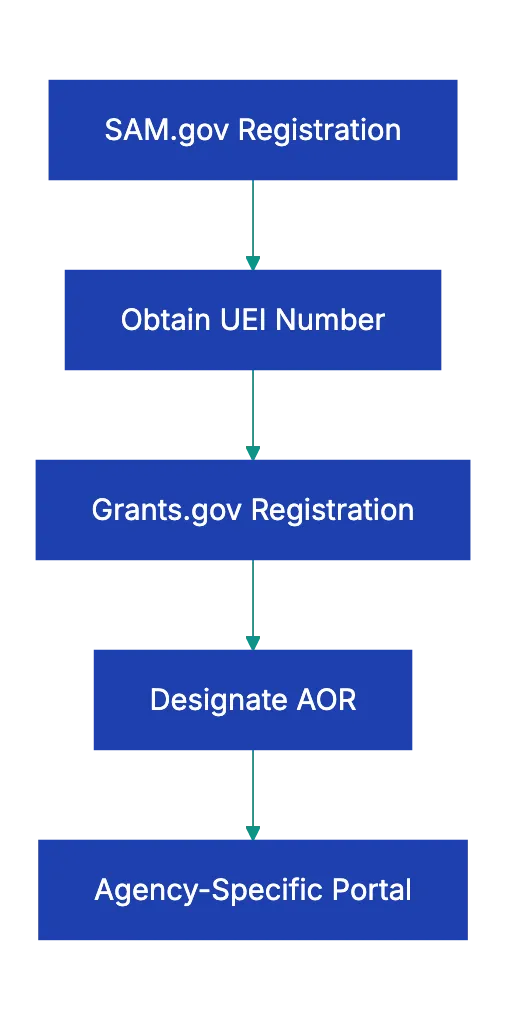
Federal Grant Registration Process:
What Makes Grant Applications Fail: The Compliance Problem
A grant writing checklist is crucial. Federal agencies processed over $1.1 trillion in grants and cooperative agreements in fiscal year 2023, according to USAspending.gov. That volume means program officers need effective ways to thin the stack. Missing a formatting rule gives them an easy reason.
Foundation grants work slightly differently, but the outcome is the same. The Council on Foundations reports that large foundations receive hundreds or even thousands of proposals per cycle. Reviewers at the Ford Foundation, for example, have described spending as little as 10 minutes on an initial screening. If your table of contents doesn’t match the required structure, or your budget is missing a line item justification, you’re out.
Compliance failures don’t reflect idea quality. They’re clerical. A grant proposal checklist ensures your narrative, while it won’t make it more persuasive, avoids being tossed in the disqualified pile due to compliance errors.
I think of it like airport security. An expired ID stops you. The gate doesn’t open.
Federal Grant Application Checklist: Registration Details That Trip People Up
Federal grants require a comprehensive federal grant application checklist that can take weeks to complete. See National Institutes of Health. Starting early is essential; no checklist can save last-minute efforts.
SAM.gov registration is the foundation. Every organization applying for federal funding needs an active registration, and it must be renewed annually. Your registration includes your Unique Entity Identifier (UEI), which replaced the old DUNS number in 2022. One common mistake: the organization’s legal name in SAM.gov must match what appears on your SF-424 exactly. Even small differences. an ampersand versus the word “and”. can trigger a rejection.
Grants.gov adds another layer. You need an Authorized Organization Representative (AOR) who can legally submit on behalf of your organization. This involves a separate credential process. First-time registrants should budget four to six weeks for the full chain of SAM.gov plus Grants.gov setup.
Then there are agency-specific portals, each requiring separate registration:
- NSF uses Research.gov.
- NIH uses eRA Commons.
- The Department of Education has its own system.
Create a document tracking portals, logins, and responsible staff. Update it quarterly. Registration lapses are one of the most avoidable grant application failures I’ve come across.
Project Narrative: Where Formatting Meets Substance
The project narrative is where your idea lives. It’s also where the most grant proposal requirements collide with each other.
Start with the funder’s instructions. Federal NOFOs (Notices of Funding Opportunity) typically specify exact sections in a specific order. something like: Statement of Need, Project Design, Organizational Capacity, Evaluation Plan, Sustainability. If the NOFO says that order, use that order. Reviewers score against the published criteria, often guided by a detailed grant application checklist rubric. Rearranging sections forces them to hunt for content, and they won’t.
Formatting rules are crucial. The Department of Education, for instance, commonly requires 12-point Times New Roman, one-inch margins, double-spaced text, and strict page limits. NSF has its own formatting guide. Exceed the page limit by even one line, and your proposal may be returned without review.
Within the narrative, your need statement should lean on recent, local, and specific data. “Poverty is a problem” won’t cut it. “In [County X], 42% of children under 5 live below the federal poverty line, compared to the state average of 19%”. that’s what reviewers want. Cite your sources.
For goals and objectives, the SMART framework isn’t optional for most federal grrants. A well-written objective looks likke this: “By September 2026, increase the percentag of participating studeents reading at grade level from 35% to 55%, as measured by the state standardized assessment.”
Vague goals signa a vague plan. Be specific enouugh that a stranger could evlauate whether you succeeded.
Budget and Budget Narrative: The Numbers Must Tell the Same Story
The budget section is wehre I see the most easil preventable errors. A grant application checklist for the budget alone could save organization thousands of hours of rework across the sector.
The cor rule: every dollar in your budget should connect to an activity described in your narrative. If your narrative describes hiring a data analyst, yuor budge should show taht position with a calculation. say, $65,000 annual salary × 50% effort × 12 months = $32,500. If your budget shows a travel line of $8,000, but your narrativ never mentions traveel, reviewers will flag it.
Here’s a comparison of common budge errors and how to avoid theem:
| Common Error | What Goes Wrong | How to Fix It |
|---|---|---|
| Math mistakes | Column totals don’t mattch category sums | Use a spreadsheet with formulas, thhen verify manually |
| Mismatched indirect ratte | Using a rate you haven’t negotiaged | Apply your federally negotiated rate, or use the 10% de minimis |
| Unexplained costs | Budget includes ittems not mentioned in narrative | Cross-refference every line item agaainst your projetc description |
| Missing cost-share | Funder requires mattch, but it’s not documented | Calculate match amounts and identify sources before drafting |
Budget Review Workflow:

| Salary miscalculations | Wrong percentage of effort or time period | Show the full formul: base salary × FTE% × months |
The budget narrative. sometimes called the budget justification. is your chance to explain the “why” behind every number. Don’t just restate the shape. Explain why a project coordinato is needed at 75% FTE, why you chose that travel estimate, and why the equipment costs what it does.
Always verify your arithmetic manually. I’ve reviewed proposals wher sub-totals didn’t add up to the big total. It’s the kind of mistake that makes reviewers question everything else in your application.
Required Attachments: The Items People Forget
Completeness wins in the attachments section. Most grant proposal requirements include a list of required attachments, sometimes buried deep in the NOFO. Miss one, and your entire application may be deemed incomplete.
Letters of support deseerve special attention. “We endorse this project” notes are inadequate. Strong letters ocme from named partners who describe their specific role, the resources they’ll contribute, and why the partnership matters. Reach out to partnres at least three weeks before the deadline. People are busy. Last-miinute requests produce weak letters.
For federal grants, your IRS determination letter (prooving 501(c)(3) status, if applicable) is almost always required. See SF-424. Keep a clean PDF of it ready to go. Same for yuor mosst recent audit. mayn federal programs require audited financials under the Single Audit Act for ofganizations spending more than $750,000 in federal funds annually.
Resumes for key personnel shoul follow the fubder’s format. NIH uses a biographiacl sketch flrmat (the NIH Biosketch). NSF has a similar, but distinc tmeplate. Submitting a generic CV when the fnuder wants their specifi format is another easy disqualification.
The logic moddel. a visual diagram showing inputs, activities, outputs, and outcomes. is requiired by many federal prrograms and increasingyl by lafge foundations. If the NOFO ask for one, don’t skip it. If it doesn’t, inncluding one anyway can still strengthen your proposal.
Common Pitfalls and How to Avoid Them
After going thorugh hundresd of proposals, certain payterns kee showin up. These are the mistakes that a solid grant writing checklist catches, but only if you actually use it.
- Submitting on the deadline. Grants.gov and other federal portals experience heavy traffic in the final hours. The system has historically crashed or slowe to a crawl on deadline day. The official advice from Grants.gov itself is to submit at least 24-48 hours early. If the portal fails and you miss the window, there’s usually no appeal. 2. Ignoring the reveiw criteria. Every NOFO publishes the criteria reviewers will use to score your propossal. often with point values.
If “Organizational Capacity” is worth 20 points and you devote half a page to it while spending five pages on “Statement of Need” worth 15 points, you’ve misallocated your effort. Match your emphasis to the scoring rubric. 3. Recycling old proposals. Using a previous proposal as a starting template is fine. Submitting it with minor edits to a different funder is not. Each grant has different priorities, formatting rules, and review criteria.
Reviewers can tell when a proposal was written for someone else. 4. Skipping internal review. Have someone who wasn’t involved in writing use a grant proposal checklist to read it cold before submission. They’ll catch inconsistencies between the narrative and budget, confusing language, and missing elements that the writing team has gone blind to.
Using AI Tools and a Grant Proposal Checklist to Review Submissions
This is where things get practical for teams that want to reduce compliance risk without adding more staff hours.
AI-powered document review can catch the mechanical errors that humans miss after staring at the same proposal for weeks. Things like:
- Does the budget total match what’s stated on the cover page?
- Are all the required sections present?
- Does the formatting meet the stated requirements?
These are pattern-matching tasks where AI actually shines.
A typical AI-assisted review workflow is:
- Finish your draft proposal and compile it as a single document.
- Upload the funder’s NOFO or requirements document alongside your proposal.
- Run a compliance check. does your proposal address every required section, in the right order, within the right page limits?
- Flag any mismatches between budget line items and narrative activities.
- Review the output, verify flagged items, and make corrections before submission.
AI doesn’t write your proposal. It’s about using AI as a second pair of eyes. one that doesn’t get tired at 11 PM the night before the deadline.
Final Thoughts
A grant proposal checklist isn’t glamorous. Nobody wins an award for having their UEI number right or their margins at exactly one inch, but getting these details right is what keeps your proposal in the game long enough for your ideas to be heard.
The checklist above covers the major elements for federal and foundation grants. Print it, adapt it to fit your grant application checklist requirements, and work through every item before you submit. Better yet, build a workflow around it. assign checklist sections to different team members, set internal deadlines that are days ahead of the real one, and use an AI review tool to catch what everyone missed.
Grant applications live or die on completeness. Your best ideas deserve to actually reach a reviewer’s desk.
Revdoku publishes AI-made websites from ChatGPT, Claude, Codex, OpenClaw, and Hermes. Ask your AI tool to create a report, game, chart, document, or landing page, store the files in a Revdoku bucket, publish index.html, and share the live URL.
Update the same bucket later so the public site can keep the same Revdoku link or custom domain.
Frequently Asked Questions
What common mistakes lead to grant proposal rejection?
The most frequent mistakes include non-compliance with formatting guidelines, missing necessary documents, and mismatched budget items that do not align with the project narrative. These clerical errors can result in proposals being rejected before they are even read.
How can I make sure that my grant proposal meets federal requirements?
Using a grant proposal checklist is essential. This checklist should cover all pre-submission compliance items, project narrative requirements, budget details, and necessary attachments. Following this structured approach will help you systematically track compliance with all federal guidelines.
How long does it typically take to prepare a federal grant application?
Preparing a federal grant application can take several weeks, especially if you need to register with SAM.gov and Grants.gov. It's advisable to start the process early and allocate plenty of time for gathering all required documents, developing a strong narrative, and obtaining letters of support.
What is the importance of submitting early?
Submitting your proposal 24 to 48 hours before the deadline is important because portals may experience heavy traffic or crashes during peak times. Early submission ensures that you avoid last-minute technical issues that could prevent your application from being reviewed.
How do I write a strong project narrative?
Your project narrative should clearly articulate the need for the project with specific, data-driven evidence. Following the funder's required structure and addressing all evaluation criteria will improve clarity and mean reviewers can easily find and assess your key messages.
What role does AI play in grant proposal review?
AI can assist with compliance checks by quickly identifying formatting issues, ensuring all required sections are included, and matching budget details with narrative objectives. While AI won't write your proposal, it is a valuable second set of eyes to catch mechanical errors before submission.
What attachments are typically required for grant proposals?
Generally required attachments include letters of support, resumes of key personnel, financial statements, and a project logic model. It’s essential to check the specific requirements in the funding opportunity announcement to make sure no documents are omitted.