Pitch Deck Tracking and Investor Analytics
Table of Contents
- Pitch deck tracking and investor analytics without the data-room overhead
- What pitch deck tracking can and cannot tell you
- Secure pitch deck sharing options for founders
- Choose access modes to share a pitch deck securely
- A practical pitch deck tracking workflow
- Track investor engagement without overstating identity
- Use pitch deck tracking and investor analytics to follow up at the right time
- Four ways founders can track investor engagement
- Pitch Deck Viewer Analytics Pitfalls
- A simpler way to share a pitch deck securely, learn, and follow up
- Pitch deck tracking and investor analytics without the data-room overhead
- What pitch deck tracking can and cannot tell you
- Secure pitch deck sharing options for founders
- Choose access modes to share a pitch deck securely
- A practical pitch deck tracking workflow
- Track investor engagement without overstating identity
- Use pitch deck tracking and investor analytics to follow up at the right time
- Four ways founders can track investor engagement
- Pitch Deck Viewer Analytics Pitfalls
- A simpler way to share a pitch deck securely, learn, and follow up
Pitch deck tracking and investor analytics without the data-room overhead
You send your pitch deck. Silence follows. Did the investor open it? Did they reach the financial slides? Did a partner return, or is the PDF unnoticed in an inbox?
Pitch deck tracking answers practical questions:
- Has someone opened the protected link?
- Which pages received attention?
- Did the visitor click, download, or return?
- When would a follow-up be useful rather than annoying?
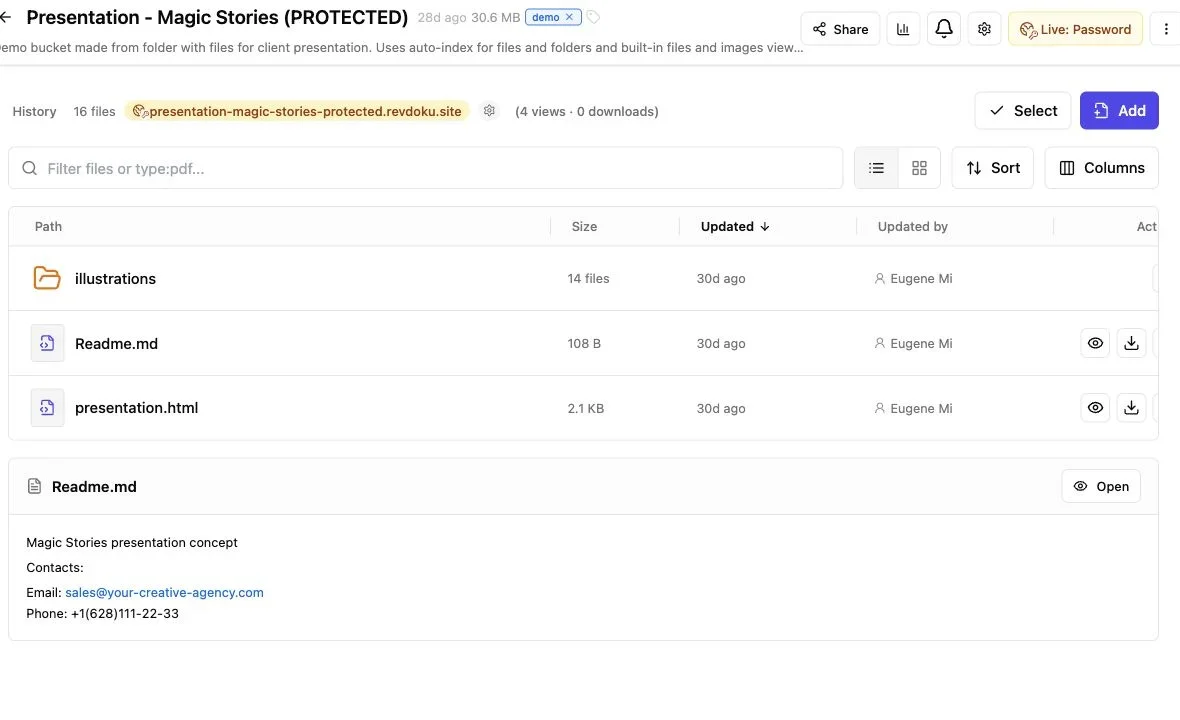
TL;DR: Revdoku gives founders secure pitch deck sharing and pitch deck viewer analytics without enterprise data-room overhead. Drop a PDF or folder into a private bucket, choose an access mode, and send a website-like link. Then track investor engagement without setting up an enterprise virtual data room. The link stays active as the deck changes, so investors see the current version without another inbox attachment.
What pitch deck tracking can and cannot tell you
Pitch deck tracking records observable actions around a shared deck, reducing post-send guesswork without reading an investor’s mind. A five-minute session may indicate careful reading, an interruption, or an idle browser tab.
Useful signals include:
- Opens: whether a protected link was accessed
- Pages viewed: which deck sections were viewed
- Repeat visits: whether a visitor returned
- Clicks: whether someone followed demo, product, or contact links
- Downloads: whether someone saved the deck offline
These signals matter because deck reviews are brief. DocSend reports that investors spend an average of about 2 minutes and 42 seconds reviewing a pitch deck. That is enough to form an opinion, but rarely to study every claim.
Use pitch deck tracking to spot patterns, not manufacture certainty. Several known visitors reaching the market, traction, and financial pages is a useful signal. One anonymous first-page open means little. Read investor analytics honestly.
Secure pitch deck sharing options for founders
VDRs make sense for due diligence involving contracts, financial records, access groups, or formal audit requirements. They can be excessive for sending a 15-page deck to a few investors.
| Approach | Access experience | Tracking and updates | Best fit |
|---|---|---|---|
| Email attachment | Familiar, but inbox-bound | Minimal viewing data; old copies keep circulating | Informal introductions with low sensitivity |
| Cloud-drive link | Opens a generic file viewer | Stable link and basic controls; page-level insight may be limited | Simple file exchange |
| Revdoku link | Lightweight, website-like presentation | Protected opens, per-visitor activity, leads, clicks, downloads, and in-place updates | Fundraising decks, proposals, demos, and client work |
| Enterprise VDR | Structured portal with formal permissions | Detailed administration and audit features | Legal, financial, or late-stage due diligence |
Revdoku lets you share a pitch deck securely through an experience closer to a private website than a corporate records system. When deeper due diligence begins, move sensitive legal and financial material to a dedicated VDR.
Choose access modes to share a pitch deck securely
Each gate trades greater control and identity data for potentially fewer opens. Choose based on the referral source and material sensitivity.
| Access mode | Good use | What you learn | Important limit |
|---|---|---|---|
| Public link | Demo days, public fundraising pages, and broad outreach | Aggregate opens, page activity, clicks, and downloads | Visitors may remain anonymous |
| Password-protected link | Warm introductions or small known groups | Activity behind the shared password | Forwardable passwords do not prove identity |
| Verified Email link | Direct outreach requiring lead capture | Activity can be linked to an OTP-verified address | Inbox verification does not prove legal identity or investment authority |
A practical access policy:
- Use public access for broadly circulated decks.
- Use a password for known audiences when one shared secret is enough.
- Use Verified Email to record leads and engagement by verified address.
- Exclude highly sensitive customer lists, legal documents, and detailed financial records from early-stage decks.
No access mode prevents screenshots or determined copying; secure sharing reduces casual exposure, controls entry, and reveals activity. It does not provide perfect digital rights management.
A practical pitch deck tracking workflow
No code is required. The process is simple: add dashboard files, protect the link, and send it.
-
Prepare the investor-facing material. Keep the main deck focused: add only helpful product screenshots, a demo, or supporting documents to the same presentation bucket, and remove internal comments and hidden spreadsheet tabs before uploading.
-
Drop in the PDF or folder. Upload the deck, or a folder packaging the deck, live demo, and supporting material as a small website, to a private Revdoku bucket.
-
Select an access mode. Match Public, Password, or Verified Email access to the material’s sensitivity and introduction source, then test the link in a private browser window.
-
Send one stable link. Use one URL in direct email, accelerator portals, or investor updates, avoiding files named final, final-2, and really-final.
-
Update without resending. Revise linked traction, pricing, or fundraising details; returning investors see the current deliverable.
Collect investor questions through built-in feedback and contact forms, no custom backend required. If publishing becomes repetitive, optional AI agents, the API, and the CLI can automate updates.
Track investor engagement without overstating identity
Identity is commonly misunderstood in pitch deck viewer analytics. Analytics can connect events to a visitor or submitted lead, but confidence depends on the access method.
| Signal | Reasonable inference | What it does not prove |
|---|---|---|
| Verified email | Someone completed the one-time-code step for that inbox before viewing | The named person personally viewed every page |
| Password access | The visitor knew or received the password | The visitor was the original recipient |
| Repeat session | A visitor or browser returned | A partner meeting took place |
| Demo-link click | The linked resource attracted attention | The visitor liked the product |
| Download event | A copy was saved | What happened during offline reading |
Public links offer reach but may produce anonymous sessions.
Password links limit casual access, but recipients can share the password. Verified Email improves lead capture by confirming inbox access, while still falling short of legal identity proofing.
Downloaded decks can travel by email without further page analytics. Several people may share one screen. One person may open the link on two devices. Therefore, say the link was opened or this visitor returned instead of claiming a specific investment partner studied a particular slide.
This restraint strengthens credibility. It also makes follow-ups less invasive.
Use pitch deck tracking and investor analytics to follow up at the right time
Open notifications help when they change your next step. They should not trigger a breathless email after every view.
Sales-lead research offers an imperfect comparison. A Harvard Business Review study covering 1.25 million leads found that companies responding within an hour were nearly seven times more likely to qualify a lead than companies waiting even one hour longer. Investors are not sales leads, but the lesson holds: context fades, making timely replies easier to act on.
Use a measured sequence:
-
Respond quickly to requested material. Send the requested protected link while the conversation is fresh.
-
Watch for meaningful activity. A full-deck view, return visit, demo click, or download outweighs a brief first-page open.
-
Follow up with relevance. Reference the conversation, a milestone, or likely question, never the visitor’s 38 seconds on slide eight.
-
Respect weak signals. One short open does not justify daily messages; without a reply, keep your usual cadence.
Pitch deck tracking is a timing aid. The message still needs a purpose.
Four ways founders can track investor engagement
These composite examples illustrate the workflow. The numbers are illustrative, not customer results.
-
A seed founder uses Verified Email. She sends 20 warm contacts a stable link: 14 verify addresses and open it, six reach the final slide, and three return within two days. She prioritizes returning visitors while keeping the others on her normal follow-up schedule.
-
A technical startup shares a deck and demo together. The team puts the PDF, browser demo, and short architecture note in one private bucket. Eight of 18 visitors click the demo, showing more interest in the product than the dense technology slide, which the founders simplify in the next version.
-
An accelerator company updates one link. After demo day, the founders add revised pricing and a month of revenue data to the existing deliverable rather than send another attachment. The same URL remains with 11 earlier visitors; four return after the milestone announcement.
-
A conference speaker uses a public link. A QR code generates 90 anonymous opens. Because public tracking cannot identify visitors, the founder adds a contact form beside the deck; eight people submit details and become identifiable leads.
In each case, results come from matching access, analytics, and follow-up to the situation.
Pitch Deck Viewer Analytics Pitfalls
Misused analytics create false confidence. Describe what the data records without reading intent into every event.
| Pitfall | Why it causes trouble | Better approach |
|---|---|---|
| Gating every deck | Cold visitors may leave before viewing | Use public access when reach matters more than identity |
| Treating views as investment intent | Opens may be brief, accidental, or delegated | Combine activity with replies, meetings, and direct questions |
| Sharing sensitive records too early | A deck link can still be forwarded or captured | Reserve detailed records for controlled due diligence |
| Resending a new file after each edit | Multiple versions circulate at once | Update the stable link and note material changes |
| Using an enterprise VDR for first contact | Setup and navigation can slow a simple review | Start with a lightweight protected presentation |
| Mentioning exact viewing behavior | The follow-up can feel like surveillance | Use analytics internally to choose timing and subject matter |
Founders also ask:
A simpler way to share a pitch deck securely, learn, and follow up
Pitch deck tracking should remove uncertainty without becoming a second job. Revdoku lets founders drop a deck or folder into a private bucket, choose Public, Password, or Verified Email access, and send one stable link. Protected-link notifications and visitor analytics track investor engagement, while clicks, downloads, lead capture, and contact forms add context.
Remember three principles:
- Treat activity as evidence of behavior, not proof of intent.
- Match the access gate to the sensitivity of the material.
- Update the existing link so every returning visitor sees the current deck.
That is often enough for early fundraising. Share a pitch deck securely, learn what happens afterward, and time follow-ups better. If formal due diligence follows, move sensitive records into the system built for that stage.
Frequently asked questions
Can a recipient forward the link?
Yes. Password or Verified Email gates add friction, and Verified Email adds attribution, but neither can prevent forwarding.
Can tracking continue after a download?
You can record the download, but offline reading usually falls outside web analytics.
Should the deck allow anonymous access?
It depends on the campaign: public access favors reach; Verified Email favors lead capture.
When is a VDR appropriate?
Use one when formal due diligence demands document groups, strict permissions, or detailed audit administration.
Revdoku is a lighter, website-like layer for sharing and learning before the records-room stage.
Which access mode should I use for my pitch deck?
Use a public link when broad reach matters most, a password for a small known audience, and an email gate when lead recording is important. Choose the least restrictive option that still matches the deck’s sensitivity.
How should I interpret a short or partial deck view?
Treat it as a weak behavioral signal, not evidence of rejection or interest. Look for stronger patterns such as return visits, full-deck views, downloads, demo clicks, and direct replies before changing your follow-up strategy.
When should I follow up after an investor opens the deck?
Follow up when the activity is meaningful and you have a relevant reason to write, such as answering a likely question or sharing a milestone. Avoid mentioning exact viewing details, which can feel intrusive, and keep your normal cadence after a brief isolated open.
Can pitch deck analytics confirm which investor viewed each slide?
Not with certainty. Email gates, passwords, and visitor sessions can improve attribution, but links and credentials may be shared, and multiple people may use the same screen or device.
What happens to tracking if an investor downloads the deck?
The download event can be recorded, but subsequent offline reading generally cannot be tracked. The downloaded copy may also be forwarded, so keep highly sensitive records out of an early-stage fundraising deck.
Can I update the pitch deck without sending a new link?
Yes. Updating the files behind a stable link lets returning investors see the current version and prevents multiple outdated attachments from circulating. If the changes are significant, briefly notify recipients about what was updated.
When should I move from a tracked deck link to a virtual data room?
Use a lightweight tracked link for introductions, early conversations, demos, and routine updates. Move to a dedicated VDR when formal due diligence requires sensitive legal or financial documents, granular permissions, document groups, or detailed audit controls.