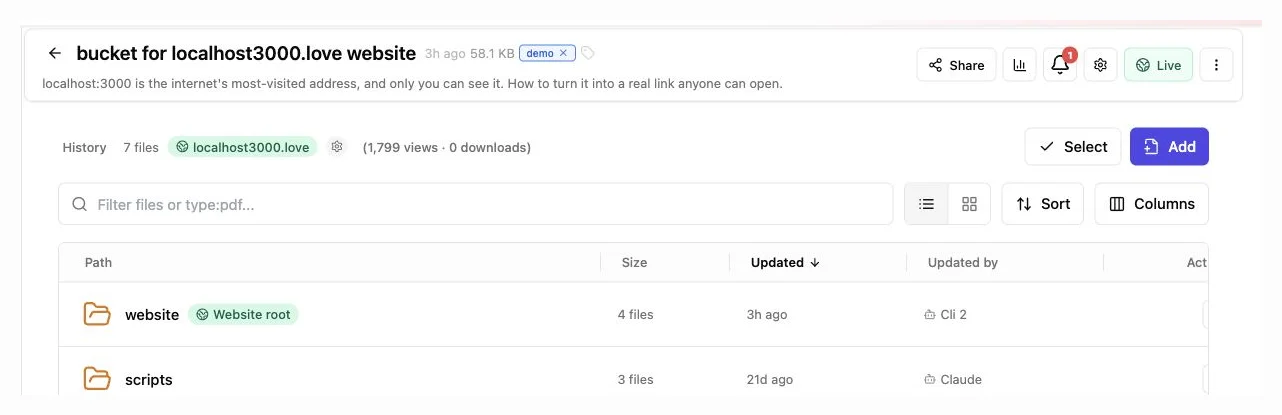
Password Protect a Static Website Safely
Table of Contents
- Password Protect a Static Website Without False Confidence
- What Static Site Password Protection Actually Protects
- Why Client-Side-Only Static Site Authentication Is Weak
- Five Ways to Password Protect a Static Website
- When Host-Level Static Site Password Protection Is the Right Choice
- When a Private Client Link with Revdoku Is Enough
- Choosing the Right Static Site Authentication for Each Project
- Static Site Password Protection Best Practices
- Static Site Password Protection Pitfalls
- Final Thoughts
- Ask ChatGPT to check the access mode
- Password Protect a Static Website Without False Confidence
- What Static Site Password Protection Actually Protects
- Why Client-Side-Only Static Site Authentication Is Weak
- Five Ways to Password Protect a Static Website
- When Host-Level Static Site Password Protection Is the Right Choice
- When a Private Client Link with Revdoku Is Enough
- Choosing the Right Static Site Authentication for Each Project
- Static Site Password Protection Best Practices
- Static Site Password Protection Pitfalls
- Final Thoughts
- Ask ChatGPT to check the access mode
Password Protect a Static Website Without False Confidence
Password-protecting a static website requires something outside HTML to decide who receives its files. Yet many tutorials use a JavaScript password form to hide the page and call it done. The page looks locked, but its contents remain public.
The right method depends on the content and cost of a leak. A launch teaser differs from a financial dashboard or client data room. TL;DR: Real protection checks access before sending files; use a host, identity provider, or protected publishing service suited to the risk.
- Why client-side gates provide weak static site password protection
- When host-level authentication or an identity provider fits
- When a protected Revdoku review link is the simpler answer
- How to test whether your files are truly behind the gate
What Static Site Password Protection Actually Protects
A static site contains HTML, CSS, JavaScript, images, and PDFs. It may lack an application server for authentication. Static describes the build, not how requests are served. A web server, edge network, or publishing service can reject unauthorized requests before returning files.
| Protection goal | Suitable control | Typical use |
|---|---|---|
| Discourage casual early viewing | Client-side prompt or obscure preview URL | Low-risk launch teaser |
| Require a shared secret before files load | Host or edge password gate | Staging site or short review |
| Identify each visitor | Email verification or individual account | Proposal, deck, or client deliverable |
| Apply company identity policies | SSO or identity-aware proxy | Internal tools and employee portals |
| Restrict highly sensitive records | Full application authorization | Health, financial, or regulated data |
Access control must cover every protected asset, including direct PDF, image, JavaScript, and download URLs. It also fails closed. OWASP recommends denying access by default and checking permission on every request.
A password gate controls access to a protected website. It cannot stop authorized visitors from taking screenshots, saving files, or forwarding information. When that matters, add contracts, watermarks, individual identity, or a controlled document system.
Why Client-Side-Only Static Site Authentication Is Weak
Tutorials often store a password, hash, or success condition in JavaScript. The browser downloads it before deciding whether to reveal the page.
Visitors can inspect source, disable the script, request protected assets directly, or alter page state in developer tools.
Failure paths include:
- The password may appear as plain text in the JavaScript bundle.
- A bundled hash can be copied and guessed offline without rate limits.
- The downloaded response may already contain hidden HTML.
- PDFs, images, and JSON may remain directly accessible.
- Search engines or link scanners may bypass the form.
MITRE classifies this design problem as CWE-602: Client-Side Enforcement of Server-Side Security. Its advice is direct: security checks performed by the client must also be enforced by the server.
One exception exists. You can pre-encrypt content, then decrypt it in the browser with a key never shipped with the site. That can preserve confidentiality but complicates key distribution, caching, recovery, accessibility, and updates. You are then building an authentication and encryption product. For most client work, server-side or edge gates are safer and cheaper.
Example: A founder may use a JavaScript prompt to discourage accidental viewing of a harmless launch announcement. I would not use it for unreleased pricing, a proposal, customer information, or source files.
Five Ways to Password Protect a Static Website
Static site authentication options vary in enforcement, visitor friction, and owner data.
| Approach | Where access is checked | Visitor identity | Best fit | Main limitation |
|---|---|---|---|---|
| JavaScript prompt | Inside the downloaded page | Usually none | Low-risk deterrence | Files are already public |
| HTTP Basic Auth | Web server or reverse proxy | Shared or named credentials | Small self-hosted previews | Plain browser prompt and manual account work |
| Hosting-platform protection | Hosting provider edge | Shared password or platform account | Existing preview deployments | Features and scope depend on the plan |
| Identity-aware proxy | Edge proxy connected to an IdP | Individual identity | Internal tools and sensitive demos | More policy and account setup |
| Revdoku protected publishing | Publishing service gate | Password access or verified email | Client-facing files, demos, and presentations | Not a substitute for custom application authorization |
Several mainstream hosts control access before serving files. Netlify documents shared-password and team-login protection, while Vercel provides deployment authentication and plan-dependent password protection. Eligible GitHub Enterprise Cloud organizations can publish private Pages sites, but visitors need repository read access, often awkward for clients. GitHub explains those limits in its Pages access-control documentation.
Balance visitor experience with technical strength. Clients should not need developer accounts to read proposals.
When Host-Level Static Site Password Protection Is the Right Choice
Host-level protection works when the deployment platform offers suitable access controls. Authentication occurs before the origin returns index.html or related assets. This preserves the build, domain, deployment pipeline, and preview workflow.
-
Define protected scope. Cover production, preview, and old deployment URLs, plus assets and download paths containing private material.
-
Select the access model. Use a shared password for a short, low-risk review. Use named users, one-time codes, SSO, or an identity-aware proxy for revocation and attribution.
-
Require HTTPS: HTTP Basic credentials are Base64-encoded, not encrypted. MDN warns that Basic authentication needs HTTPS/TLS to prevent interception.
-
Test externally. In a private window, request the home page, a nested route, a PDF, and a copied asset URL.
-
Plan for automation. Monitoring, screenshots, and end-to-end tests may require narrowly scoped service or bypass credentials.
Agency example: An agency using a Netlify or Vercel preview pipeline can enable deployment protection for client acceptance. This keeps code review and preview deployment together.
Internal example: A finance dashboard should use an access proxy with individual identity, not a password sent through chat. Cloudflare Access, for example, acts as an identity-aware proxy and checks protected web requests against access policies.
When a Private Client Link with Revdoku Is Enough
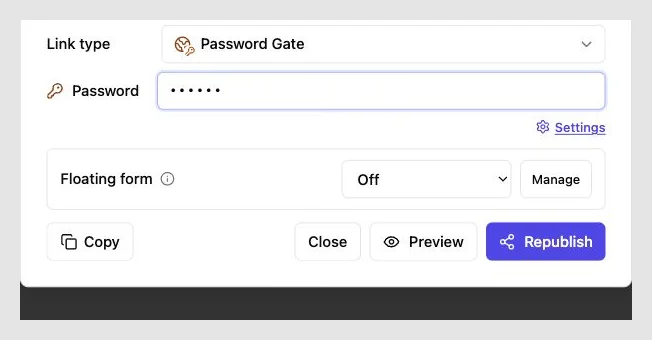
Sometimes you do not need a private application. You need a private link for a proposal, PDF, presentation, report, or static demo, plus open tracking, responses, and later replacement. Revdoku serves that workflow.
- Create or open a private Revdoku bucket.
- Add a PDF or static-site folder.
- Publish a public, password-protected, or verified-email link.
- Enable notifications for successful protected entry.
- Review activity and update the bucket as work changes.
According to the Revdoku product documentation, buckets store static assets and versions, protected websites use a separate password gate, and republishing the same bucket retains its URL. The current product page describes per-visitor records for pages viewed, links clicked, and files downloaded. It also supports password access, one-time-code email access, email or domain allowlists, and visitor feedback.
Freelancer example: Send a password-protected proposal on Monday. After the client enters and reads the pricing page, the notification gives you a better follow-up reason than a blind Tuesday email.
Consultant example: Publish a weekly research report at one link and replace its files each Friday. An AI agent, API, or CLI can automate updates but is unnecessary for the initial drag-and-drop workflow.
Choosing the Right Static Site Authentication for Each Project
My rule: use the lightest control that withstands the likely threat. Do not build an account system for a disposable mockup. Do not send regulated records through a shared review password merely for convenience.
- Choose a client-side prompt only when disclosure causes little or no harm and the gate is clearly a deterrent.
- Choose host-level protection when you manage the deployment and need one gate for all site files.
- Choose verified email or individual accounts to identify entrants, revoke individuals, or separate client activity.
- Choose an identity-aware proxy for company SSO, group policies, device rules, or employee offboarding.
- Choose a protected Revdoku link for a client-facing document, deck, demo, report, or static bundle when review activity matters.
- Choose a custom authenticated application for user-specific data or permissions.
Product studio example: An agency sharing the same prototype with five client stakeholders could use Revdoku Verified Email. This yields clearer visitor records than a shared password while retaining a normal browser-link experience.
A draft homepage, sales forecast, and database export can all be static yet carry different risks. Static describes the delivery format, not the sensitivity.
Static Site Password Protection Best Practices
A few operating habits prevent most embarrassing leaks. Treat the gate as part of publishing, not an afterthought once the link is sent.
| Item | What to Check | Why It Matters |
|---|---|---|
| Password length | Use a unique passphrase of at least 15 characters | NIST sets 15 characters as the minimum for single-factor passwords |
| Transport | Confirm every protected URL uses HTTPS | A password cannot protect traffic sent in clear text |
| Asset coverage | Test HTML, PDFs, images, JSON, and downloads directly | Protecting only the home page leaves side doors open |
| Client separation | Use a different secret or gate for each project | One forwarded password should not expose other work |
| Revocation | Know how to change access or take the link offline | Client teams and project scopes change |
| Logged-out test | Retest after every deployment or configuration edit | Protection can disappear through a scope mistake |
| Data collection | Record only the visitor data needed for follow-up | Access analytics create their own privacy duties |
NIST SP 800-63B requires at least 15 characters for a single-factor password and advises against arbitrary periodic changes. Change a shared password after possible forwarding, a stakeholder’s departure, or the review’s end.
Avoid home-built authentication backends. The 2026 Verizon DBIR reports that vulnerability exploitation initiated 31% of breaches. Custom server code requires patching, monitoring, rate limiting, and review. A maintained host or publishing gate reduces that burden.
Static Site Password Protection Pitfalls
Most failures occur around the gate.
- Protecting
/while leaving/files/proposal.pdfpublic - Sending a broad group the password with the link
- Treating an unlisted or obscure URL as authentication
- Using
robots.txtas access control when compliant crawlers may only avoid indexing - Leaving old previews online after review
- Collecting emails without identifying the recipient
Final Thoughts
Proper static site password protection blocks files before they reach the browser. A JavaScript prompt may deter accidental visitors but cannot provide real access control.
- Use host or edge protection for deployments.
- Use individual identity for sensitive systems.
- Use Revdoku for private client links with password protection, tracking, feedback, and same-URL updates.
Test direct assets while logged out. This five-minute check catches the most common mistake: a locked-looking home page fronting public files. The best method matches the risk, covers every relevant request, and stays simple enough to use correctly.
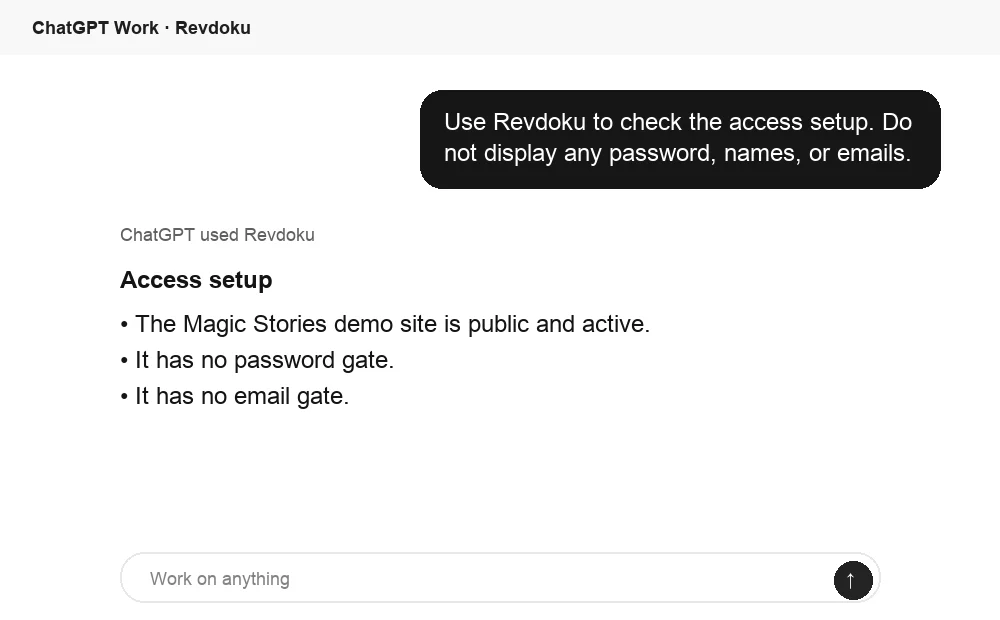
Ask ChatGPT to check the access mode
Before sharing, ChatGPT can ask Revdoku what access mode is active for the bucket. Use this to confirm whether the link is public, password protected, or email gated.
Frequently asked questions
Can password protection hide my source code?
Pre-delivery enforcement can block unauthorized downloads. Authorized visitors can inspect and save received HTML, CSS, or JavaScript. Static site password protection is access control, not digital rights management.
Is one shared password enough for a client review?
Often, yes. A password protected website suits a short, moderately sensitive review for a small, trusted audience. Use a long, unique secret and change it if it may be forwarded. For reliable attribution, use verified email or named accounts; a shared password cannot identify the user.
Does Revdoku replace SSO or application authorization?
No. Revdoku protected publishing suits client deliverables and static reviews. Systems with user-specific records, regulated data, or role-based actions need stronger identity and authorization. Revdoku lists enterprise controls and SSO as separately arranged capabilities on its security page, so confirm contractual requirements before using it for higher-risk material.
Can I collect feedback without building a backend?
For a Revdoku-published link, yes. Its hosted form workflow supports feedback and contact submissions attached to the bucket, with submission notifications.
How can I verify that every file is actually protected?
Open a private browsing window and request the homepage, nested routes, PDFs, images, JSON files, and copied download URLs directly. Each protected resource should require authentication before any content is returned.
When is a shared password appropriate?
A shared password is usually sufficient for a short, moderately sensitive review involving a small, trusted group. Use a unique passphrase of at least 15 characters and replace or revoke it when the review ends or forwarding is suspected.
When should I use verified email or individual accounts instead?
Use individual identity when you need to know who accessed the content, revoke one person without affecting others, or maintain an audit trail. SSO or an identity-aware proxy is a better fit when company policies, groups, devices, or employee offboarding must control access.
Does an unlisted URL or robots.txt keep a static site private?
No. Anyone who receives or discovers the URL can open it, and robots.txt only asks compliant crawlers not to index specified paths. Neither option prevents the server from returning files to an unauthorized requester.
What should I do with old previews after a review ends?
Disable them, remove their protected files, or revoke their credentials as part of project closeout. Also check alternate domains and previous deployment URLs, since an outdated preview can remain accessible even after the current site is secured.
Will password protection prevent recipients from copying or sharing content?
No. It controls who can initially receive the files, but an authorized visitor can still save them, take screenshots, or forward information. For valuable material, consider individual access, watermarks, contractual restrictions, or a controlled document platform.
Which protection method is best for highly sensitive or user-specific data?
Use a properly authenticated application with server-side authorization for regulated records, account-specific data, or role-based actions. A shared website password or protected publishing link is designed for controlled distribution, not granular permissions.
Related Articles
GitHub Pages Password Protection and Privacy
Learn why private repositories do not protect Pages sites and compare secure access options for internal teams and external clients.
How to Password Protect a Vercel Deployment
Learn how to secure Vercel deployments with password protection, authentication, trusted access, or protected Revdoku hosting.
How to Password Protect a Website Made with Claude
Learn how to export, secure, publish, and test a Claude-made website using password protection or verified-email access.