
The Ultimate Contract Review Checklist for Business Owners
Table of Contents
The 20-point contract review checklist
Use these 20 points before you sign a business contract. They apply to vendor agreements, service contracts, freelance agreements, and most other business deals. For each point, the table gives what to look for and the problem that you get if you miss it.
Most contract terms fall into three main groups: money, time and exit, and protection. The tables below split them into smaller groups.
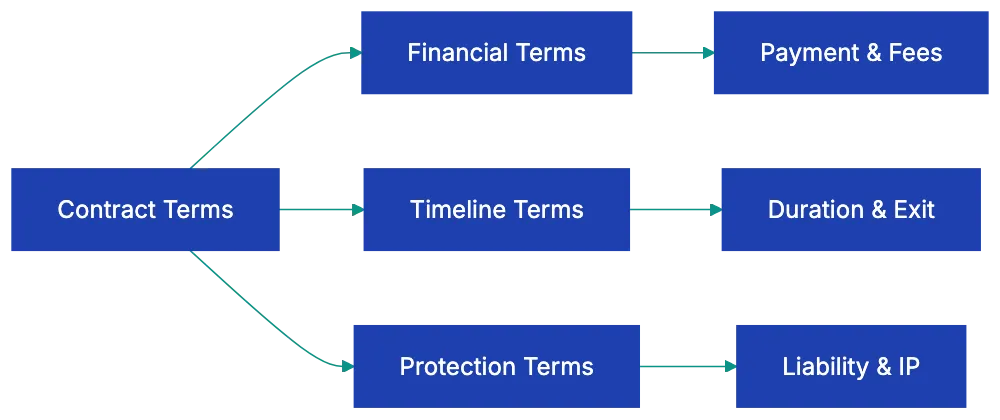
Parties, dates, and scope
| # | Look for | If you miss it |
|---|---|---|
| 1 | Parties. The full legal name of each party, the entity type, and the address. An LLC appears as “ABC Company, LLC”, not “ABC Company”. | A wrong name can make the contract hard to enforce. It can also make you personally responsible for a company obligation. |
| 2 | Effective date and term. The start date and the length of the contract: one year, month to month, or no end date. | You do not know when your obligations start or stop. |
| 3 | Scope and deliverables. A specific description of the work, for example “20 hours of financial consulting each month” or “the app features in Exhibit A”. | Vague words such as “marketing support” cause arguments about what is included and what costs extra. |
Money
| # | Look for | If you miss it |
|---|---|---|
| 4 | Payment terms. The amount, the due date (for example net 30, which means 30 days after the invoice), the payment method, the currency, and late fees. | You get cash flow problems and billing disputes. |
| 5 | Extra fees and price increases. Setup fees, processing fees, administrative charges, and clauses that let the other party raise prices each year or at its own choice. | The real cost becomes higher than your budget. |
Time and exit
| # | Look for | If you miss it |
|---|---|---|
| 6 | Termination. How each party can end the contract, the notice period, and termination fees. Termination for convenience means that a party can end the contract without a reason. | You stay in a contract with no exit, or you pay a large fee to leave early. |
| 7 | Auto-renewal. An auto-renewal clause renews the contract unless you cancel in a set window before the end date. | You miss the window and must pay for another full term. |
| 8 | Notice. How formal notices, such as a termination notice, must be sent: certified mail, email to a named contact, or another method. | Your cancellation email does not count as notice, and you miss the termination window. |
Protection
| # | Look for | If you miss it |
|---|---|---|
| 9 | Liability cap. A liability cap is the maximum amount that one party can claim from the other. Make sure that a cap exists and that it applies to both parties. | You accept unlimited liability for a problem. |
| 10 | Indemnification. In an indemnification clause, one party agrees to pay the legal costs and damages of the other party. Make sure that it covers only events that you control. | You pay for losses that you did not cause. |
| 11 | Warranties. The promises about the product or the service, and how long they last. | The product is sold “as is”, and you have no remedy if it does not work. |
| 12 | Insurance. The types of insurance that each party must have, and the coverage amounts. | You must buy insurance that you do not have, or the other party has no insurance when its mistake damages you. |
| 13 | Force majeure. A force majeure clause excuses a party after events outside its control, such as natural disasters or wars. Look at the events listed and what happens to payments. | You continue to pay while the other party cannot deliver, or the reverse. |
Rights and restrictions
| # | Look for | If you miss it |
|---|---|---|
| 14 | Intellectual property (IP). Who owns the work that the contract creates: code, designs, text, or inventions. Make sure that the contract says if ownership transfers on payment or if the creator keeps it and gives a license. | You pay for custom work that the vendor owns. Or, as a contractor, you cannot use your usual methods for other clients. |
| 15 | Non-compete and non-solicitation. A non-compete limits the work that you can do after the contract ends. A non-solicitation clause stops you from hiring their staff or taking their clients. Look at the scope, the area, and the duration. | You cannot work in your field for a long time, or you get sued for one hire. |
| 16 | Confidentiality. What information is confidential, how long the duty lasts, and the exceptions for public information. | You break the contract by accident, or you cannot use general knowledge from the work. |
| 17 | Assignment and subcontracting. If a party can transfer the contract to another company or give the work to a third party. | A company that you did not choose takes over the contract, or a subcontractor does the work. |
Disputes and final details
| # | Look for | If you miss it |
|---|---|---|
| 18 | Dispute resolution and governing law. Litigation (a court case), arbitration (a private, binding decision outside court), or mediation (a non-binding talk with a third party). Also the state or country whose courts and laws apply. | You must resolve a dispute far from home, under laws that you do not know, at a cost higher than the contract value. |
| 19 | Entire agreement clause. This clause says that the written contract replaces all earlier talks, emails, and verbal promises. | A promise from the negotiation is not in the contract, and you cannot enforce it. |
| 20 | Signatures, blanks, and exhibits. Each signature block has a printed name, a title, and a date. The signer has authority to bind the company. The contract has no empty blanks or “to be determined” items, and each exhibit is attached. | A person without authority signs, or the other party fills in a blank later. |
How to review a contract
Follow these steps for each contract:
- Read the full contract once without notes. Learn the main deal first.
- Read it again with the checklist. Mark each section that is unclear or bad for you.
- Read each exhibit and attachment. Exhibits can change the main terms.
- Find the definitions section. A defined term can change the meaning of a clause.
- If a term is unclear, look it up or ask the other party to explain it in plain words. If they cannot explain it clearly, treat that as a warning sign.
- For a large contract, write a one-page summary: amounts, dates, termination rights, renewal window, and liability cap.
- Put the renewal and termination dates in your calendar.
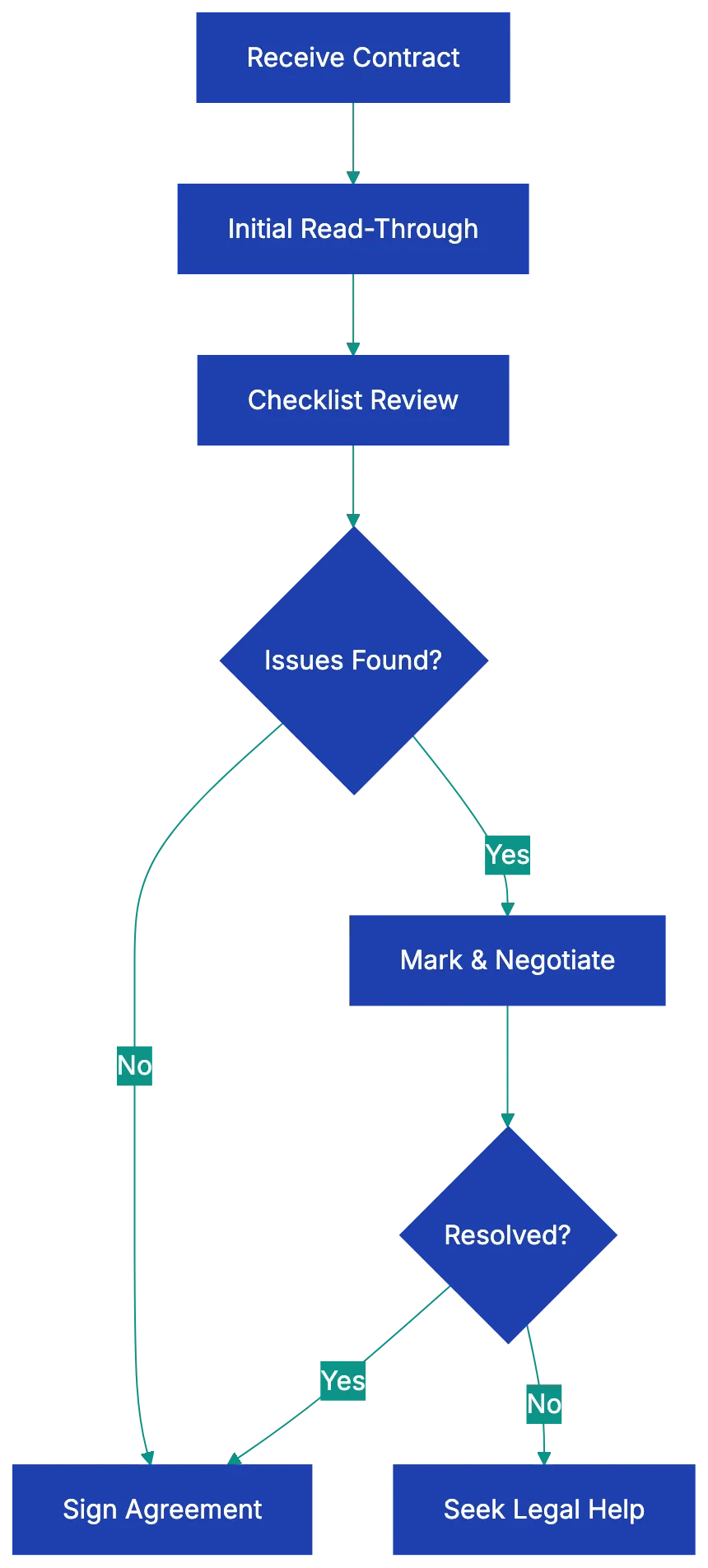
If you find a bad term, mark it and ask for a change. Most business contracts are open to some negotiation. A “standard” contract is standard for the company that wrote it, and its lawyers wrote it to protect that company. Select the terms that matter to you. A request to change every clause slows the deal and can harm the relationship.
Mistakes to avoid
Avoid these common mistakes:
- You skip the review because the contract is “standard”.
- You read only the first pages. Payment, liability, and renewal terms are often in the middle or in the attachments.
- You sign with blanks or “to be determined” items in the contract.
- You trust a verbal promise that is not in the contract. An entire agreement clause makes it hard to enforce.
- You do not note the renewal date, and the contract renews automatically.
Where to look first for each contract type
| Contract type | Look first at |
|---|---|
| Vendor or supplier agreement | Payment terms, service levels, termination, liability cap |
| Employment agreement | Non-compete, IP assignment, severance, equity vesting |
| Partnership or operating agreement | Profit split, management authority, capital contributions, exit terms |
| Office or equipment lease | Renewal, rent increases, maintenance duties, default |
| Non-disclosure agreement (NDA) | What is confidential, duration, exceptions |
| Independent contractor agreement | IP ownership, payment, deliverables, the contractor status of the worker |
Rules for non-competes are different in each state. For example, California law makes most employee non-compete clauses void. California Business and Professions Code section 16600.1 also makes it unlawful to put one in an employment contract.
When to ask a lawyer
A checklist helps you find problems. It does not replace legal advice. Ask a lawyer to review the contract in these cases:
- Employment agreements with a non-compete, an equity grant, or unusual terms.
- Partnership agreements and operating agreements for a new business.
- Real estate contracts and long-term leases.
- Any contract where you personally guarantee business debts.
- Any contract with a large amount of money or high liability.
If you sign contracts often, a business lawyer who knows your company can review new contracts fast. Your own template for common deals also helps. When the other party signs your template, you negotiate from your terms, not theirs.
Use this checklist with Claude or ChatGPT
Claude or ChatGPT can go through the 20 points with you and list what is missing:
- Read the confidentiality clause before you upload the contract. Some contracts do not permit you to share the text with third parties.
- Remove or replace names, prices, and account numbers that you do not want to share.
- Paste the checklist and the contract text into the chat, or attach the PDF.
- Ask the model to go through each point and quote the clause that it used.
Here is my 20-point contract review checklist and a services agreement.
I am the client. For each point, say whether the contract covers it, quote the
clause and section number, and flag terms that are one-sided against me.
Then list the points the contract does not cover and questions I can ask.
Use the answer as a first review only. The model can miss a clause, misread a definition, or quote text that is not in the contract. Find each quoted clause in the contract before you act on it. Before you upload a contract, read the data settings of your workspace. For a contract with high value or high risk, ask a lawyer before you sign.
A docs portal with Ask AI
and support tickets
Connect a repository, or describe your product to start. Each docs site has search, Ask AI, an API console, an MCP server and support tickets.
- Publishes from GitHub on every push
- Works with Mintlify repositories
- API console from your OpenAPI file
- MCP server and llms.txt for AI agents
- Ask AI and support tickets
- Analytics for people and AI agents
Related Articles

Essential Resume Screening Checklist for Employers
A resume screening checklist for employers: criteria to set first, two review rounds, a scoring table and the US legal rules to follow.

Essential Vendor Agreement Review Checklist
A vendor agreement review checklist: scope, price, SLAs, data and security, liability, exit, IP and disputes, with US and GDPR legal points.

Essential Freelance Contract Review Checklist
A freelance contract review checklist: scope, payment, IP and portfolio rights, termination, liability, non-competes, and what to negotiate.