
Essential Purchase Order Checklist for Buyers
Table of Contents
- Introduction
- Understanding Purchase Order Requirements
- Critical Fields Every Purchase Order Checklist Must Include
- Common Purchase Order Mistakes and How to Avoid Them
- Purchase Order Format Best Practices
- Verification Steps Before Sending Your PO
- How Automated PO Review Reduces Errors
- Real-World Purchase Order Scenarios
- When to Use Different Purchase Order Types
- Key Takeaways
- Introduction
- Purchase Order Requirements Checklist
- Header Information
- Line Item Details
- Totals and Financial Terms
- Delivery and Shipping Requirements
- Terms, Conditions, and Compliance
- Understanding Purchase Order Requirements
- Critical Fields Every Purchase Order Checklist Must Include
- Common Purchase Order Mistakes and How to Avoid Them
- Purchase Order Format Best Practices
- Verification Steps Before Sending Your PO
- How Automated PO Review Reduces Errors
- Real-World Purchase Order Scenarios
- When to Use Different Purchase Order Types
- Key Takeaways
Introduction
A purchase order is a legally binding contract between buyer and supplier. Missing information causes delays, wrong shipments, and disputes. According to procurement research, nearly 40% of purchase order errors stem from incomplete or inaccurate information at the time of issuance. A checklist saves time, prevents mistakes, and protects your business.
This guide covers purchase order requirements, the complete PE checklist, verification steps before sending, and common pitfalls that trip up even experienced buyers.
Copy this checklist and paste it into Revdoku’s Generate Checklist to review your documents automatically:
Purchase Order Checklist for Buyers

You are a senior accounts payable specialist reviewing financial documents for completeness, accuracy, and regulatory compliance. Check each requirement independently and flag every issue.

- PO number is unique and follows sequential numbering system
- PO date reflects actual issue date (not future or past dated)
- Buyer company name matches legal business name exactly
- Complete buyer address
- Buyer contact person name and title listed clearly
- Buyer contact email and phone number verified
- Vendor/supplier legal business name spelled correctly
- Complete vendor address with all contact details
- Ship-to address specified (if different from buyer address)
- Bill-to address confirmed for invoicing
- Payment terms clearly stated (Net 30, Net 60, etc.)
- Each item has unique item number or SKU from vendor catalog
- Detailed description to prevent confusion
- Quantity specified for each line item
- Unit   of measure stated (each, dozen, case, box, hour, etc.)
- Unit price matches most recent vendor quote or agreement
- Extended  price calculated correctly (quantity × unit price)
- Tax applied per line item if required by jurisdiction
- All line items reviewed for duplicate entries
- Subtotal of all line items calculated accurately
- Shipping and handling charges included if applicable
- All applicable taxes added and rate confirmed
- Total PO amount matches authorized budget
- Currency specified (important for international orders)
- Discount terms documented if negotiated
- PO amount within approval threshold or  properly authorized
- Delivery date or required-by date clearly specified
- Shipping method stated (ground, air, freight, etc.)
- Carrier preference noted if required
- **FOB** terms defined (shipping point vs destination)
- Expedite requirements flagged if urgent delivery needed
- Special packaging or labeling instructions included
- Inspection and acceptance terms documented
- Warranty requirements specified
- Return policy  and defect handling procedure stated
- Insurance requirements for shipping noted
- Governing law and jurisdiction identified
- Quality specifications or certifications required (ISO, organic, etc.)
- Blanket PO release schedule attached if applicable
- Vendor quote number referenced for price verification
Understanding Purchase Order Requirements
A purchase order requests goods or services and becomes binding on acceptance. The purchase order format must record enough detail that both parties understand exactly what’s being ordered, at what price, and under what conditions. Think of it as a commercial agreement in document form.
The legal weight of a PO means every field matters. See purchase order is a legally binding contract. If your purchase order states a delivery date of March 15 and the vendor ships on April 2, you have grounds to reject the shipment or negotiate compensation. If the PO lists the wrong ship-to address and the product arrives at your closed warehouse instead of the new facility, that’s your error to fix and your cost to bear.
Purchase order requirements vary slightly by industry. A manufacturing company ordering raw materials needs detailed specifications about grade, dimensions, and certifications. A consulting firm issuing a PO for professional services focuses on deliverables, hourly rates, and not-to-exceed amounts. Retail buyers need SKUs, color codes, and size breakdowns. The core elements remain consistent: who, what, how much, when, and where.
Requirements depend on internal controls. Organizations with strong procurement governance require budget codes, project numbers, approver signatures, and department allocations. See procurement research. Smaller businesses might keep it simpler, but still need the needed commercial terms locked down.
Critical Fields Every Purchase Order Checklist Must Include
Purchase Order Processing Flow:
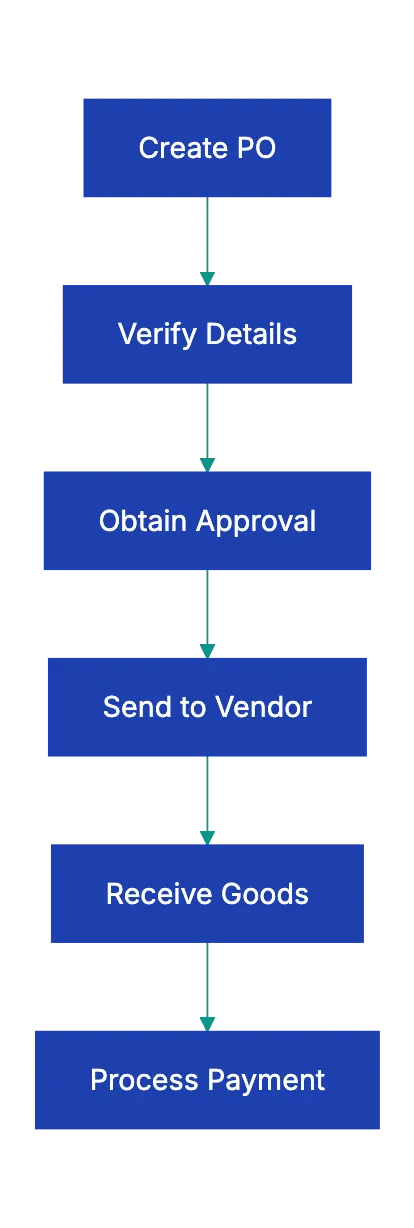
The header section identifies the parties and establishes the framework. Your PO number must be unique within your system. Many companies use sequential numbering (PO-2024-001, PO-2024-002) or incorporate department codes (IT-PO-1234, MKT-PO-5678). Whatever system you choose, consistency matters because this number becomes the reference for receiving, invoicing, and payment.
Buyer and vendor information seems obvious, but errors here cause surprising headaches. Use the exact legal business name as it appears on tax documents and contracts. A vendor doing business as “ABC Services” might be legally registered as “ABC Professional Services, LLC.” The legal name matters for tax reporting and dispute resolution. Include complete addresses, not just city and state.
Payment terms belong in the header because they govern the entire transaction. Net 30 means payment within 30 days of invoice date. Net 60 gives you 60 days. Some vendors offer early payment discounts like “2/10 Net 30,” which means take a 2% discount if you pay within 10 days, otherwise full payment is due in 30 days. Document these terms explicitly so invoices get processed correctly.
Line items are crucial. Each line needs an item identifier (vendor SKU, manufacturer part number, or your internal item code), a complete description, quantity, unit of measure, unit price, and extended total. Descriptions must be specific for correct receipt. “Office supplies” is too vague. “Stapler, Swingline 747, black, business model” works better.
Common Purchase Order Mistakes and How to Avoid Them
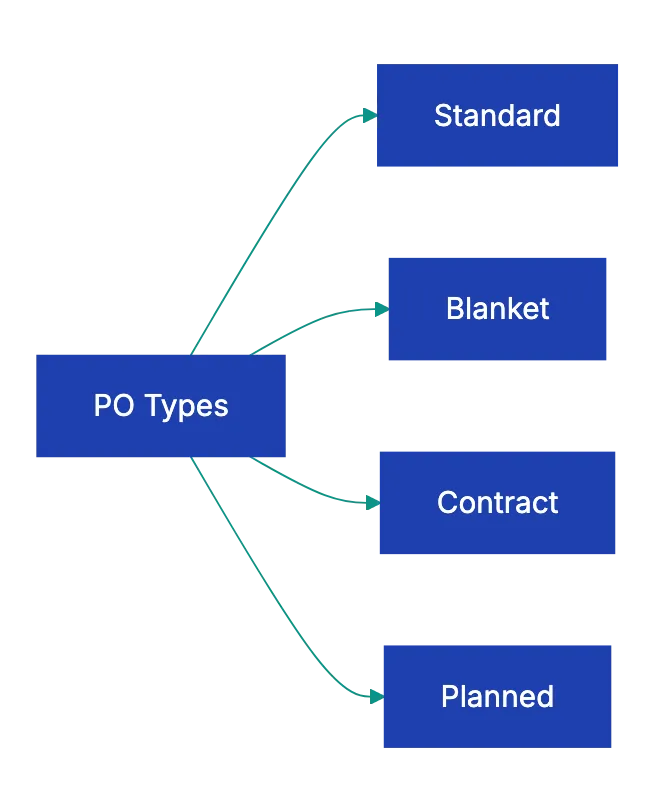
Purchase Order Types Comparison:
Vague descriptions cause many errors. A buyer orders “copy paper” without specifying weight, brightness, or package size. The vendor ships 20-pound economy paper when the buyer expected 24-pound premium stock. Both parties followed the PO as written, but the wrong product arrived. Specificity prevents this: “Copy paper, 8.5x11, 24lb, 92 brightness, 10 reams per case.”
Wrong ship-to addresses create expensive messes. Companies with multiple locations must verify the ship-to address on every PO. This becomes especially important during office moves, warehouse consolidations, or project-based work where material ship to temporary job sitees. A constructino company once received $40,000 in specialty equuipment at their main offfice instead of the job site three states away. The re-shipping cost and projevt delay hit the bottom line hard.
Outdated pricing from expired quotes costs buyers money they shouldn’t spend. Vendor quotes typically include validity periods: “Pricing valid for 30 days” or “Prices subject to change without notice.” If you issue a PO three months after receiving a quote, the vendor might accept the PO, but invoice at current pricing, which could be higher. Always confirm pricing immediately before issuing the PO.
Missing delivery dates tell the vendor you don’t care when it arrives. Without a required-by date, the vendor ships at their convenience, which might be next week or next quarter. Even if you have flexibility, specify a date. It creates accountability and gives you recourse if delivery drags on unreasonably.
Math errors in extended pricing suggest carelessness and create reconciliation headaches. If you order 144 units at $3.50 each, the line total should be $504.00. If your PO shows $5,040.00 (decimal error) or $500.00 (rough estimate), receiving and accounts payable waste time tracking down the discrepancy. Most modern purchasing systems calculate extensions automatically, but manual POs require careful review.
Purchase Order Format Best Practices
Standardization simplifies processes. Create a purchase order template that includes all required fields in a logical sequence. Header information at the top, line items in a table format in the middle, totals and terms at the bottom. Once everyone uses the same format, vendors know where to find information, receiving clerks process orders faster, and audits go smoother.
Your purchase order template should match your business processes. If your accounting system requires cost center codes for budget tracking, add a field for that. If quality control needs specific inspection criteria, create space for those requirements. If you frequently ship to customer locations, include fieelds for ultimate consignee information. The template should record what you need, not just generic fields.
Digital purchase orders beat paper in almost every scenario. Digital POs route through approval workflows automatically, populate from vendor catalogs to reduce errors, archive searchably for compliance, and integrate with receivnig and accoounts payable systems. Even small businesses benefi fro basic digital PO toosl that maintain history and prevent lost documents.
Version control matteers wehn changse happen. If you issu PO-2024-100 and then need to add items or change quantities, issue PO-2024-100 Rev A rather tnan a completely new PO number. Document what changde and when. Get venfor acknowledgment of the reivsion. This creates a clear audi trail and prevents confusion aboout whicch version is current.
Numbering systems should scaale with your business. A company izsuing 50 POs annually can use simple sequential numbers. A company issuing thousands needs a more robust system that indorporates year, department, or loccation codees. Whatever sytsem you choose, make it systematic and don’t skip numbers or reuse PO numbers, even for voided orders.
Verification Steps Before Sending Your PO
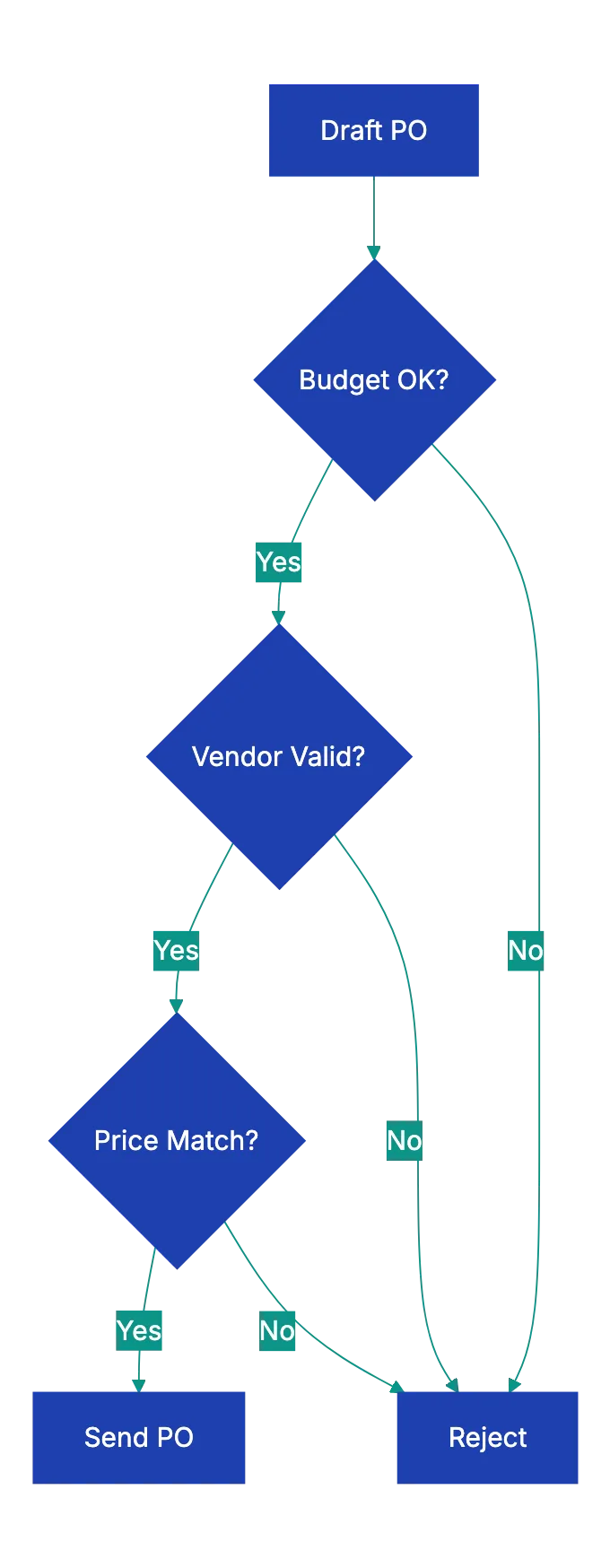
Before sending any PO, work through fibe verification steps:
- Budget authorization: verify that funds exist and are approved. Many organizations require manwger approval for POs oveer certain thresholds — $500, $5,000, or $50,000 depending on employee level
- Vendor verification: confirm the vendor’s legal name, address, and tax ID against your vendor master file. Be alert to impersonation schemes; a quick phone call verifies legitimacy
- Price verification: pull the vendor’s quote or contract pricing schedule and match unit prices to agreed rates. If prices have changed, get vendor confirmation before sending
- Math accuracy: check that quantities × unit prices = line totals, that line totals sum to the subtotal, and that shipping + tax + subtotal = PO total
- Delivery requriements: verify the ship-to address, confirm the required-by date is realistic, and note any specia deliveyr instructions (dock delivery, liftgate required, signature required)
How Automated PO Review Reduces Errors
Manual PO review takes time and misses pattern. See purchase order errors. A buyer reviewing their own work might overlook the same mistake repeatedly. They might mis tha vendor ABC always requires 14 days lead time, but the PO gvies them 7 days. They might not notice taht the ship-to address is an old locaiton thaat closed las year.
Automation catches what humans miss. AI-powered document review tokls like Revdoku can chec POs agaibst templates, flag misssing requuired fields, veeify that totals calculat correctly, comppare prricing agains historical orders with the same vendor, and alert you to unusual tsrms or condtiions. The system doesn’t get tired or disrtacted.
Compliance requirements become easier to enforc. If your industry requires specific certifications, quality standardds, or documentation for certain purchases, automated revieew can make sure those requiremenst appear on evrey relevant PO. A medical devic distributor might need FDA registration numbers on every PO. A food service compan migh nee food safwty certifications. The systeem checks compkiance automatically.
Pre-Send Verification Workflow:
Historical comparison identifies anomalies. If you tpyically order 1,000 units of item XYZ at $12.50 per unit and suddenly a PO shows 10,000 units at $125.00 per unit, that’s wort flagging. It might be intentional or it might be a decimal point error. Automated systems spot these outliers instantly.
Workflow routing gets smarter with automation. Based on PO amount, vendor category, or department, the system routes POs to appropriate approvers automatically. Orders under $1,000 might auto-approve. Orders between $1,000 and $10,000 route to a department manager. Orders over $10,000 require VP approval. The system enforces policy without manual intervention.
Real-World Purchase Order Scenarios
A manufacturing company issued a PO for custom steel components with detailed specifications, but forgot to include the required delivery date. The vendor, backlogged with other orders, scheduled production for eight weeks out. The buyer expected delivery in trhee weeks based on verbal conversations, but had no recourse since the PO didn’t specify a date. Production delays cost the manufacturer $180,000 in missed customer commitments.
Now they require delivery dates on every PO and verify vendor acknowledgment of those dates.
A nonprofit organization issued a PO to the wrong vendor due to similar company names. They intended to order from “Community Printing Services,” but sent the PO to “Community Print Solutions” instead. The wrong vendor, eager for business, accepted the PO and delivered the order. Payment went to the wrong company, and the intended vendor never received the purchase order or payment. The mistake requirde months to unwind legally.
Now the organization verifies vendor tax ID numbers before sending POs.
A retail buyer issued a blanket PO for seasonal merchandise, but didn’t specify release dates or quantities per shipment. The vendor shipped the entire order at once, overwhelming warehouse capacity and creating cash flow problems. The buyer expected weekly shipments over two months. The PO didn’t document that expectation, so the vendor followed standard practice and shipped complete. Now all blanket POs include a detailed release schedule as an attachment.
An engineering firm issued a PO for consulting services with a not-to-exceed amount, but no hourly rate breakdown or deliverable milestones. The vendor billed hours freely until hitting the cap, but delivered only 60% of expected work. Because the PO didn’t specify deliverables or hourly rates, the firm had limited recourse. They paid the full amount and got incomplete work. Now all service POs specify hourly rates, estimated hours by task, and clear deliverables tied to payment milestones.
When to Use Different Purchase Order Types
Standard purchase orders work for one-time purchases of specific items with defined quantities and delivery dates. You need 500 printed brochures by March 1st. You issue a standard PO with item description, quantity, unit price, delivery date, and ship-to address. Once the vendor delivers and you pay, the PO closes.
Blanket purchase orders cover recurring purchases over a period. Instead of issuing 12 separate POs for monthly office supply orders, you issue one blanket PO authorizing up to $5,000 in purchases over 12 months. Each month the vendor ships what you need and invoices against the blanket PO. This reduces administrative work for both parties. Blanket POs need clear terms about ordering procedures, invoice schedules, and how releases get authorized.
Contract purchase orders reference contractual agreements. If you’ve negotiated a detailed contract with a vendor covering pricing, terms, warranties, and conditions, your PO might simply reference that contract and specify the current order details: quantity, delivery date, ship-to location. The contract governs the relationship; the PO triggers a specific transaction under those terms.
Planned purchase orders work for long-lead items with staged deliveries. A company ordering manufacturing equipment might issue a PO with a deposit due on order, partial payment on delivery, and final payment after installation and testing. The PO documents the entire transaction arc with payment tied to milestones. This protects both parties by linking payment to performance.
Key Takeaways
A complete checklist prevents mistakes and disputes. Every PO needs accurate header information identifying buyer and vendor, detailed line items with specific descriptions and pricing, clear financial totals and terms, and explicit delivery requirements and conditions. Missing information causes wrong shipments, payment delays, and strained vendor relationships.
Verification before sending takes minutes, but saves hours of cleanup work later. Check budget authorization, confirm vendor details, verify pricing against quotes, review math accuracy, and validate delivery requirements. These simple steps catch errors while they’re easy to fix.
Standardized purchase order formats improve consistency and reduce errors. Create templates that match your business needs, use systematic numbering, maintain version control for changes, and transition to digital POs when possible for better workflow and compliance.
Before sending your next purchase order, upload it to Revdoku and check it against a complete PO requirements checklist. Automated verification catches missing fields, math errors, and compliance issues before they cause fulfillment problems or payment disputes. Make sure to understand what should be on a purchase order and verify using a purchase order template. Prevention is faster and cheaper than correction.
Find more review checklists at revdoku.com/checklists — each one is ready to copy and use in the app.
Frequently Asked Questions
What is a purchase order and why is it important?
A purchase order (PO) is a formal agreement issued by a buyer to a seller, detailing the types and quantities of goods or services being requested. It serves as a contract that defines the terms of the transaction, helping to prevent misunderstandings, errors, and disputes over orders, pricing, and delivery.
What are common mistakes to avoid when creating a purchase order?
Common mistakes include vague item descriptions, incorrect ship-to addresses, outdated pricing, and missing delivery dates. It's essential to provide precise details and review the PO thoroughly to mitigate risks such as receiving the wrong products or incurring additional costs.
How can I ensure my purchase order is accurate before sending it?
Follow a verification process that includes budget authorization, vendor verification, price checking, math accuracy, and delivery requirements. This thorough review can catch potential errors before they lead to disputes or delays in the ordering process.
What elements should be included in a purchase order?
A purchase order should include unique header information (PO number, dates, buyer and vendor details), specific line items (item description, quantity, unit price), financial totals (subtotal, taxes, total amount), and delivery requirements (shipping method and addresses). Each of these components plays a critical role in ensuring the transaction goes smoothly.
What are the benefits of using automated purchase order systems?
Automated systems reduce errors by flagging missing fields and verifying compliance with templates and pricing agreements. They help streamline the approval process, enforce organizational policies, and can easily track historical orders, which enhances overall efficiency in procurement operations.
When should I use different types of purchase orders?
Use standard purchase orders for one-time purchases, blanket purchase orders for recurring needs over a set period, contract purchase orders to reference contractual agreements, and planned purchase orders for long-lead items with staged deliveries. Each type is suited to specific purchasing situations to optimize the procurement process.
How do I create a standardized purchase order template?
Begin by outlining essential fields according to your business needs, ensuring a logical sequence that includes header information, line items, totals, and terms. Incorporate any specific requirements related to your scaling needs, digitalize the template for efficiency, and ensure all team members utilize the same format for consistency.
Related Articles

Essential NDA Review Checklist and Tips
Protect your interests with our comprehensive NDA review checklist to spot problematic clauses and negotiate effectively.
Enhancing Document Review with AI Checklists
Discover how AI and checklists revolutionize document review for accuracy and efficiency across various industries.

The Ultimate Contract Review Checklist for Business Owners
Protect yourself with this comprehensive 20-point contract review checklist before signing any agreement.