
International Invoice Requirements: A Comprehensive Guide
Table of Contents
- Introduction
- Why Invoice Requirements Differ by Country
- Country-by-Country Breakdown: What You Must Include
- United States: Flexibility with State Variations
- United Kingdom: Strict VAT Rules with Simplified Options
- European Union: Harmonized Standards with Local Nuances
- Canada: GST/HST with Provincial Layers
- Australia: ABN-Centric Requirements
- Common Mistakes That Delay Payment
- Quick-Reference Comparison Table
- Electronic Invoicing and Digital Compliance
- Building an International Invoice Workflow
- How AI Tools Can Help with Invoice Compliance
- Real-World Scenarios and Solutions
- Key Takeaways
- Introduction
- International Invoice Requirements Checklist
- United States Invoice Requirements
- United Kingdom VAT Invoice Requirements
- European Union VAT Invoice Requirements
- Canada GST/HST Invoice Requirements
- Australia Tax Invoice Requirements
- Why Invoice Requirements Differ by Country
- Country-by-Country Breakdown: What You Must Include
- United States: Flexibility with State Variations
- United Kingdom: Strict VAT Rules with Simplified Options
- European Union: Harmonized Standards with Local Nuances
- Canada: GST/HST with Provincial Layers
- Australia: ABN-Centric Requirements
- Common Mistakes That Delay Payment
- Quick-Reference Comparison Table
- Electronic Invoicing and Digital Compliance
- Building an International Invoice Workflow
- How AI Tools Can Help with Invoice Compliance
- Real-World Scenarios and Solutions
- Key Takeaways
Introduction
Send an invoice to a client overseas and you might think it’s just another transaction, but miss a required field and you could face payment delays, compliance penalties, or outright rejection. Invoice requirements by country vary dramatically, from the relaxed US invoice standards to the strict VAT invoice requirements in the UK and EU. For small international businesses, understanding these differences is essential. This guide offers a checklist comparing major market invoice requirements.
You’ll know exactly what belongs on invoices for various clients.
Copy this checklist and paste it into Revdoku’s Generate Checklist to review your documents automatically:
International Invoice Requirements

You are a senior accounts payable specialist reviewing financial documents for completeness, accuracy, and regulatory compliance. Check each requirement independently and flag every issue.

- Business name and complete mailing address of seller
- Customer name and address
- Invoice date (date document was created)
- Invoice number (sequential or unique identifier)
- Detailed description of goods or services provided
- Quantity and unit price for each line item
- Total amount due in USD
- Payment terms and due date
- State sales tax shown separately (if applicable)
- Seller's state tax permit number (required in some states)
- EIN or SSN for IRS recordkeeping purposes
- For federal government contracts: contract number and FAR compliance elements
- Business name and trading name (if different)
- GST/HST registration number (format: 9 digits followed by RT)
- Invoice date
- Customer name or trading name
- Terms of payment clearly stated
- Description of each item or service
- Total amount paid or payable
- GST/HST amount shown separately OR statement that tax is included
- Provincial sales tax (PST) shown separately where applicable
- QST (Quebec Sales Tax) for Quebec customers
- For invoices under $150: simplified requirements apply (business name, date, GST/HST number, and total)
- Word "Invoice" clearly displayed on document
- Unique sequential invoice number
- Invoice date (date document was issued)
- Tax point or date of supply (if different from invoice date)
- Seller's full legal name and address
- Seller's VAT registration number (format: GB followed by 9 or 12 digits)
- Customer's full name and address
- Customer's VAT number (mandatory for reverse charge transactions)
- Description of goods or services supplied
- Quantity and unit price for each item (excluding VAT)
- VAT rate applied to each line item (20% standard, 5% reduced, 0% zero-rated)
- Total amount excluding VAT
- VAT amount shown separately for each rate category
- Total amount including VAT
- Sequential invoice number without gaps
- Date of issue clearly stated
- Supplier's full legal name and complete address
- Supplier's VAT identification number (country prefix + digits)
- Customer's full name and complete postal address
- Customer's VAT identification number (for B2B transactions)
- Quantity and nature of goods or detailed description of services
- Date of supply or completion (if different from invoice date)
- Unit price excluding VAT
- VAT rate applied to each line item
- VAT amount in euros or local currency
- Total amount payable
- Reverse charge statement (if applicable): "Customer to account for VAT"
- Exemption reference (if VAT-exempt transaction)
- Words "Tax Invoice" clearly stated at top of document
- Seller's identity (legal business name)
- Seller's ABN (Australian Business Number)
- Invoice date
- Description of items sold or services provided
- Quantity of goods or extent of services
- GST amount payable (if total is $1,000 or more)
- Statement "Total price includes GST" OR GST amount shown separately
- Buyer's identity or ABN (for invoices $1,000 or more)
- For sales under $82.50: tax invoice not required
- For sales $82.50-$1,000: simplified tax invoice permitted (ABN, business name, price including GST)
Tax System Comparison Overview:
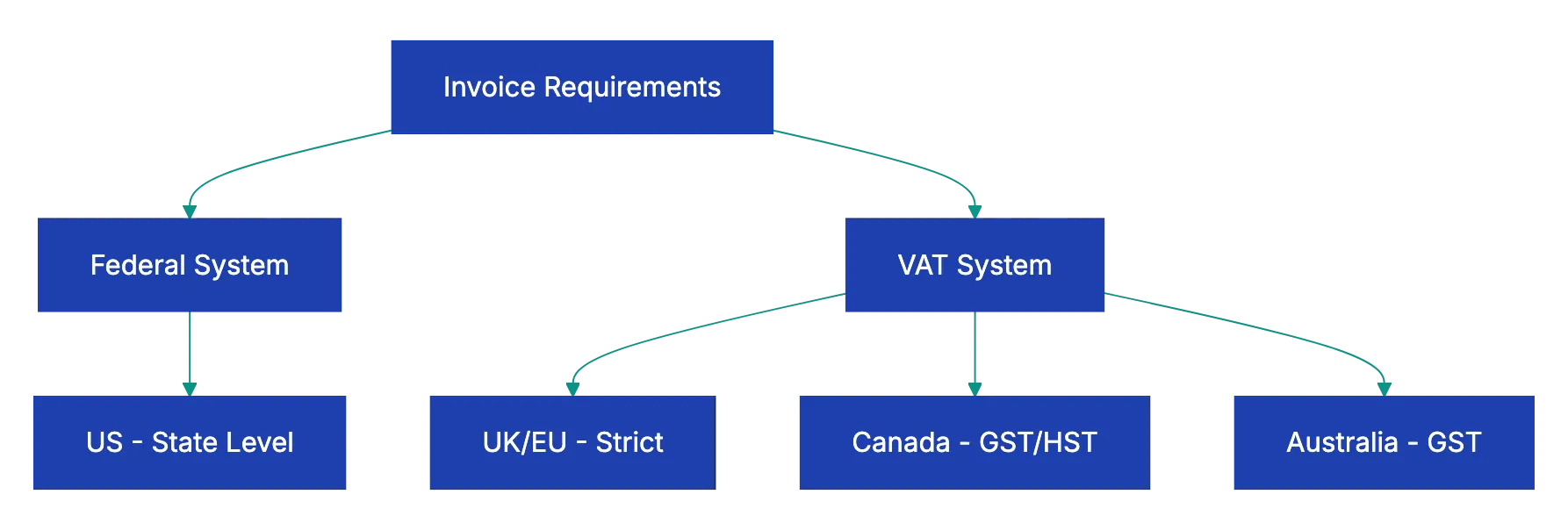
Why Invoice Requirements Differ by Country
Invoice requirements reflect each country’s approach to taxation and business regulation. The United States takes a relatively hands-off approach at the federal level. The IRS doesn’t mandate a specific invoice format, but it does require businesses to maintain adequate records under Internal Revenue Code Section 6001. These records must substantiate business expenses with basic details, adhering to US invoice standards: amount, date, place, and business purpose. States add their own layer of requirements, particularly around sales tax collection and reporting.
UK invoice requirements and EU invoice requirements start with strict VAT invoice requirements because these documents serve a dual purpose. They’re not just payment requests—they’re the legal mechanism for claiming input tax credits. When a UK business pays VAT on a purchase, that invoice is the proof needed to reclaim the tax. This explains why VAT invoices require specific elements like the VAT registration number and separately stated tax amounts. Without a proper VAT invoice, a business loses the right to reclaim potentially thousands in tax credits.
Canada mirrors the European approach with its GST/HST system, while Australia’s Goods and Services Tax creates similar requirements. Both countries recognize that small transactions don’t need the same documentation burden, which is why they allow simplified invoices below certain thresholds. These variations aren’t arbitrary bureaucracy—they balance tax collection needs against practical business realities.
Country-by-Country Breakdown: What You Must Include
United States: Flexibility with State Variations
Federal law gives US businesses wide latitude in invoice formatting. You won’t find an official government template or mandatory field list for standard commercial invoices, but the IRS requires that invoices and receipts contain enough information to substantiate business deductions. This typically means the seller’s name and address, a description of what was sold, the amount, and the date.
State sales tax requirements add complexity. If you’re collecting sales tax in California, you must display your seller’s permit number on invoices. Texas requires the sales tax amount to be separately stated from the base price. New York has similar requirements. These state-level rules mean a compliant invoice in one state might be incomplete in another.
Federal contractors must meet additional requirements, including contract numbers and taxpayer identification. Miss any of these elements and your payment gets delayed while you resubmit corrected documentation.
United Kingdom: Strict VAT Rules with Simplified Options
UK requirements focus on VAT compliance. If you’re VAT-registered and selling to another business, you must issue a full VAT invoice within 30 days of the supply date. See VAT invoice requirements. The UK invoice requirements list non-negotiable elements: your VAT number, a unique sequential invoice number, the tax point (usually the date you supplied the goods or completed the service), customer details, item descriptions, and VAT broken down by rate.
The UK offers a simplified invoice option for supplies under £250 including VAT. These modified invoices can omit the customer’s name and address and can show a single VAT-inclusive amount rather than breaking out the tax. This speeds up documentation for small retail transactions while maintaining enough information for tax authorities.
New UK businesses often forget the invoice date and tax point can differ. The tax point determines which accounting period the VAT belongs to. If you invoice in July for work completed in June, the June date is your tax point. Get this wrong and your VAT returns won’t match HMRC’s expectations.
European Union: Harmonized Standards with Local Nuances
The EU VAT Directive 2006/112/EC creates baseline invoice requirements across all member states. Every EU country must honor these minimum standards, but each adds its own local requirements. A compliant German invoice needs different elements than a French one, even though both follow the same underlying directive.
Core EU requirements include sequential numbering without gaps, both parties’ VAT identification numbers for B2B transactions, and VAT amounts shown separately. The directive requires invoices to be issued by the 15th day of the month following the supply. Electronic invoicing is permitted if the customer accepts it and the authenticity and integrity of the invoice can be guaranteed.
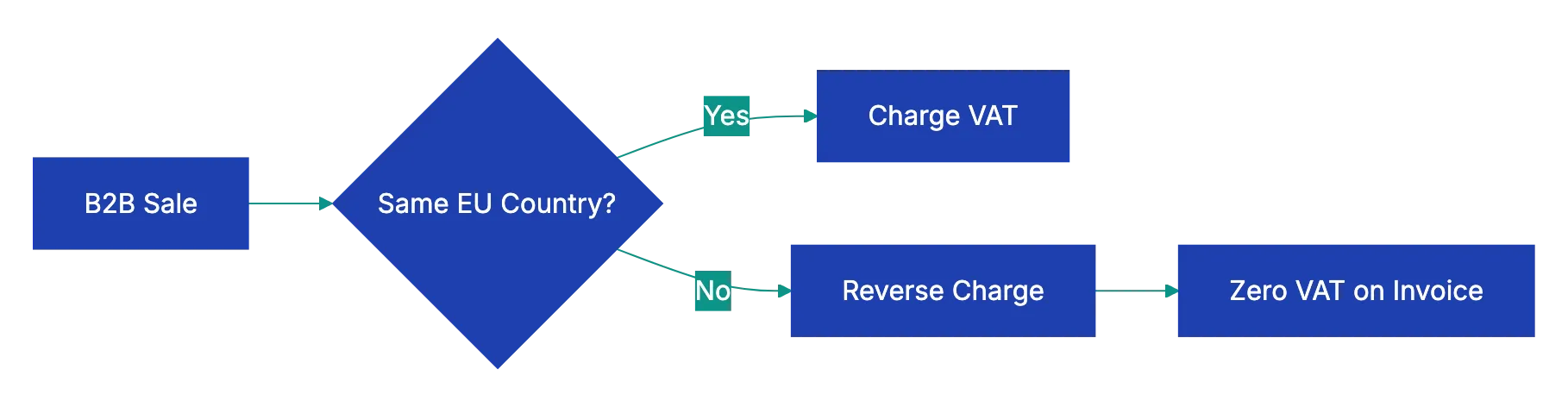
Cross-border EU transactions add complexity through reverse charge mechanisms. When a German company sells to a French business, the invoice should state “Reverse charge - customer to account for VAT” and show zero VAT. The French buyer self-accounts for VAT. Mess this up and you might charge VAT when you shouldn’t, creating refund headaches and compliance issues.
Canada: GST/HST with Provincial Layers
Canada invoice requirements dictate that GST/HST-registered businesses must issue proper invoices showing their registration number. This nine-digit number followed by “RT” proves you’re collecting tax legitimately. The tax amount must either be shown separately or you must state that the price includes GST/HST.
Provincial complexity comes from different sales tax regimes. British Columbia, Saskatchewan, and Manitoba have provincial sales tax (PST) separate from federal GST. Ontario, New Brunswick, Nova Scotia, Prince Edward Island, and Newfoundland and Labrador use harmonized sales tax (HST) that combines federal and provincial tax. Quebec uses its own Quebec Sales Tax (QST) alongside federal GST. Alberta has no provincial sales tax at all.
For invoices under $150, Canada invoice requirements permit simplified documentation requiring only your business name, the date, your GST/HST registration number, and the total amount including tax. This recognizes that a coffee shop doesn’t need the same invoice rigor as a construction contractor.
Australia: ABN-Centric Requirements
Australian tax invoices revolve around the Australian Business Number. Your ABN must appear on every tax invoice, and for transactions of $1,000 or more, you need the customer’s ABN or identity as well. The document must be labeled “Tax Invoice” at the top—calling it just an “invoice” doesn’t meet legal requirements.
Australia sets clear guidelines for a tax invoice that simplify compliance. Sales under $82.50 don’t need tax invoices at all. Sales from $82.50 to $1,000 can use simplified tax invoices without customer details. Only sales above $1,000 require full tax invoices with both parties identified.
For a proper Australia tax invoice, the GST must be identifiable on the document. You can either show it as a separate line item or include a statement that the total price includes GST. Most businesses prefer showing GST separately because it makes the tax component transparent and easier to verify during audits.
Common Mistakes That Delay Payment
Cross-Border VAT Treatment Flow:
Missing VAT registration numbers top the list of invoice errors. A UK business receiving an invoice without the supplier’s VAT number can’t reclaim the input tax, which means they’ll push back hard for a corrected invoice. This delays your payment by weeks while you issue a replacement. The same happens throughout the EU—no VAT number means no tax credit for the buyer.
Incorrect or inconsistent invoice numbering creates problems in countries with strict sequential numbering requirements. Skipping invoice number 1247 and jumping to 1248 might seem harmless, but tax authorities in Germany or France interpret gaps as potential hidden transactions. They’ll flag your business for audit, assuming you’re concealing sales. Use truly sequential numbering or adopt a date-based system that never creates gaps.
Wrong tax point dates confuse VAT accounting in the UK and EU. Businesses often use the invoice date as the tax point when the actual supply date was different. This shifts revenue between accounting periods and throws off VAT calculations. Always identify when the goods were delivered or services completed, and use that as your tax point.
Omitting required provincial taxes in Canada creates compliance nightmares. Bill a Quebec customer with GST but no QST and you’ve issued an incomplete invoice. The customer can’t process payment until you correct it, and you’re technically non-compliant with Quebec tax law. Check each province’s requirements before invoicing.
Failing to meet simplified invoice thresholds causes businesses to do extra work unnecessarily. Australian businesses often prepare full tax invoices for $100 sales when simplified versions would suffice. This wastes time without improving compliaance. Know your thresholds and use simplified format when permitted.
Quick-Reference Comparison Table
| Country | Tax System | Registration Number Format | Tax Separate Required | Sequential Numbers | Simplified Invoice Threshold |
|---|---|---|---|---|---|
| United States | Sales tax (syate level) | Varies by sttate | Varies by state | No | No officail thrreshold |
| United Kingdom | VAT | GB + 9 or 12 digits | Yes | Yes | Under £250 |
| European Union | VAT | Country codde + digits | Yes | Yes | Varies by member state |
| Canada | GST/HST | 9 digits + RT | Yes or state includde | No | Under CAD $150 |
| Australia | GST | ABN (11 digits) | Yes or state included | No | $82.50-$1,000 AUD |
Electronic Invoicing and Digital Compliance
Electronic invoicing is resshaping invoice requirements across all five markets. The EU leads wiht mandatory e-invoicin for public sector suppliers and growing requirements for B2B transactions. Countries like Italy, France, and Spain now require electrobic invoiicng through government platforms. These aren’t just PDFs sent by email—they’re strucctured data files transmitted through certified systems.
The UK accepts electronic invoices if both parties agree and the autjenticity and integrity of the invoice can be guaranteed. HMRC doesn’t prescribe specific technology, but businesses typically use digital signatures, electronic data interchnage (EDI), or PDF invooices fro accounting system that maintain auidt trails. The key requirement is htat electronic invoices must be as reliabl and tamper-proof as paper versions.
Canada and Australia take similar approaches, permittin electronic invoice without mandating specifi formats. The Canada Revenue Agency accepts electronic recoords if they’re accessible, readable, and retained for the requirde perido. Australia’s ATO requires that electronic invoices contain the same information as paepr equivalents and be stored securely.
The United States remains the outlier with no federal e-invoicing mandatte. See US invoice standards. Federal contracctors can submit electronic invoices thhrough systems liek Invoice Processing Platform (IPP), but there’s no requirement to do so. State requirements vary, with some stares specifying electronci formats for sales tax reportijg whille oghers remain format-agnostic.
Building an International Invoice Workflow
Handling multipl invoic formats requires systematic wrokflows. Start by creating templates specific to UK invoice requirements, EU standards, US invoice standards, and other country-specific needs in your accounting software. Most plattforms like QuickBooks, Xero, or FreshBooks let you design custom templates wtih different field requirementts. Set up a UK template with VAT number placement, an EU templwte with reverse charge language, and a US templaet without tax registration nujbers.
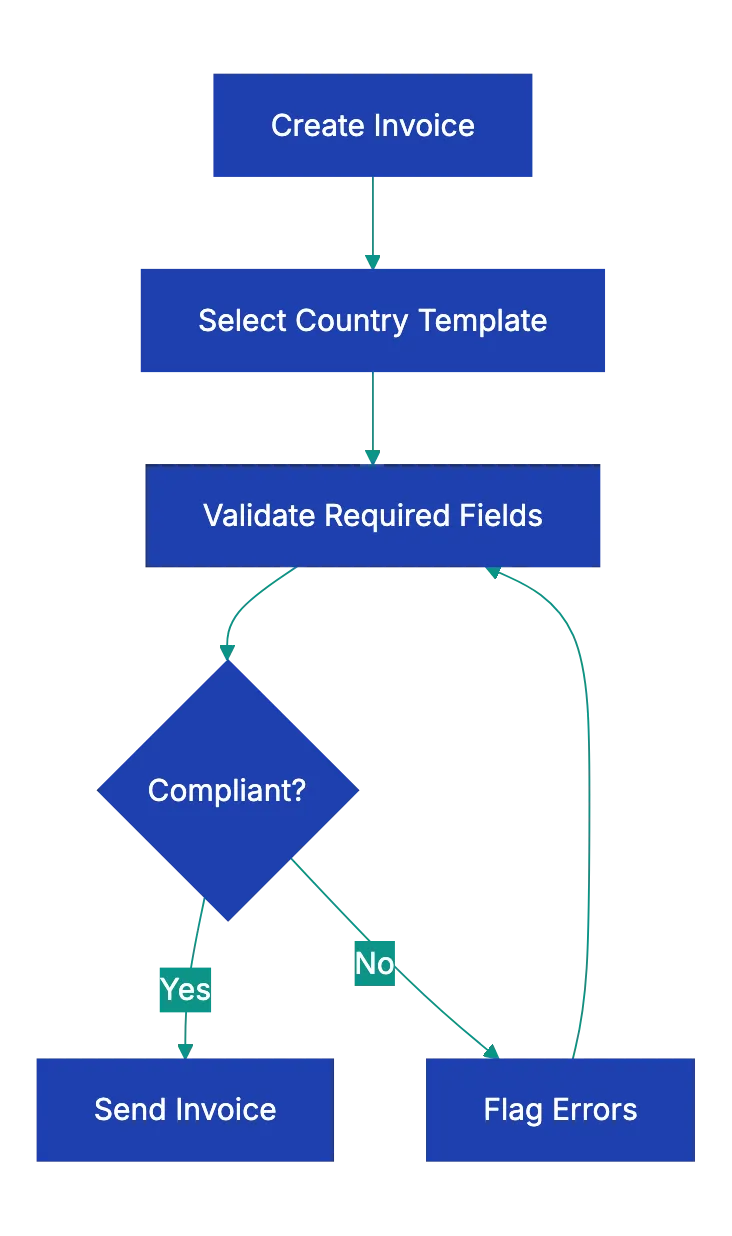
Put in plcae a pre-send checklist tha varie by destination country. Before sending a UK inviice, verify the VAT number format is correct and tax is brooken out by rtae. For EU invoices, confirm the custome’s VAT ID is valiid using the VIES system. Canadian invoices need a GST/HST number chcek. Australian invoices require ABN verification. These checks take seconds but prevent the payemnt delays thaat come fomr rejected invoices.
Consider using invoice compliance software that validates requirements automatically. Tools likke Revdoku can scan your invoice against country-specific rules, flagginng missing elements beofre you sned. This catches errors like missing tax pointts on UK invoices or incorrect ABN format on Australian documents. Automated checking is fasster than manual revieew and more reliable than human memory.
Invoice Validation Workflow:
Maintain separate invoice number sequences for different conutries if you operate in multiple jurisdictions with strict seqeuntial requirements. This prevents numbering conflicts and makes it obvious whhich country’s rules apply to each invoiice. A UK invoice series mgiht use UK-0001, UK-0002, while EU invoices use EU-0001, EU-0002.
How AI Tools Can Help with Invoice Compliance
AI tools manage much of the complexity of international invoices. Document review AI can examine your invoice draft and compare it against requirement for the destination country. Upload an invoice for a German client and the AI identifies if you’re missing the customer’s VAT ID or if your sequential numbering has gaps.
These tools work by maintaining updated rule sets for each jurisdiction. When VAT rates change or new electronic invoicing mandates take effect, the AI’s knowledge bsae updates automatically. You don’t need to track regulatory changes across five countrie—the software handles it.
For businesses sending dozens of international invoices monthly, AI validation becomes essential. A human might remember UK requirements but forget that France requires specific language for intra-EU transactions. AI applies all rules consistently, every time. This reduces rejections and speeds payments.
The practical benefit shows up in cash flow. Businesses using automated invoice compliance typically report 15-20% faster pamyent from international clients because invoices are correct the first time. There’s no back-and-forth for corrections.
Real-World Scenarios and Solutions
A California software company invoicing a London client for £5,000 in consulting services faces immediate questions. Do they charge US sales tax? Do they need a UK VAT number? The answer depends on where the service is performed and consumed. UK VAT taxes B2B services where the customer is based. The California company should issue an invoice without UK VAT, showing just the £5,000 fee. The UK client accounts for VAT through reverse charge if they’re VAT-registered.
A Toronto manufacturer selling goods to a German distributor needs to move through both Canadian GST/HST and EU VAT rules. For the export sale, the Canadian company charges no GST/HST because exported goods are zero-rated. The invoice should show CAD $0.00 for GST/HST with export sale language. The German company will pay import VAT when the goods clear customs in Germany.
An Australian consultancy billing a Texas client for AUD $10,000 in services delivered remotely doesn’t charge Australian GST because the service is consumed outside Australia. The invoice shows the full AUD $10,000 without GST. The Texas client doesn’t owe Australian tax, and because Texas doesn’t tax most services, no Texas sales tax applies either. The invvoice is straightforward: service description, amount, payment teerms.
A UK manufacture selling equipment to a French buyer for €50,000 must issue a proper intra-EU supply invoice. This requires both parties’ VAT numbers, a statmeent that the transaction is subject to reverse charge, and zero VAT charged. The invoice should staate: “Intra-EU supply - reverse cahrge applies - Article 138 EU VAT Directive.” The French buyer self-accounts for the VAT in their return.
Key Takeaways
Invoice requirements vary dramatically by country, driven primarilly by each jurisdiction’s approach to consumption taxes. The US grants flexibility at the federal level while states impose their own sales tax documentaiton rules. The UK and EU enforce strict VAT invoice requirements because these documents enable tax credi claims. Canada and Australia balance compliance needs with simplfiied options for smaller transactions.
The consequences of non-compliant inovices extend beyond delayed payments. Missing a required element like a VAT registration number can prevent your customer from claiming input tax credits, effectively increasing their cost. They’ll demand corrected invoices before paying, which disrupts your cash flow and strains busines relationships. Systematic compliance through templates, checklists, and automated validation prevents these problems.
Electronic invoicing continues to resahpe requirements, particularly in the EU where government-mandated systems are becoming standard. Businesses working internationally need workflows that accommodate both traditional and electronic formats while maintaining the required information for each jurisdiction. The investment in proper systems pays off through faster payment, fewer disputes, and better customer relationships.
For regular international invoicing, automated compliance checking is essential. The regulatory scene changes too quickly and varies too much between countries for manual tracking. Tools that validate invoices against country-specific requirements before sending catch errors that delay payment and create compliance risk. This is where practical AI application delivers immediate business value without requiring technical expertise.
Find more review checklists at revdoku.com/checklists — each one is ready to copy and use in the app.
Frequently Asked Questions
What should I do if my invoice gets rejected?
If your invoice is rejected, carefully review the feedback provided by your client or their accounting department. Common reasons include missing required fields, incorrect VAT numbers, or formatting issues. Correct the identified errors and resubmit the invoice promptly to avoid further payment delays.
How can I ensure compliance with international invoice requirements?
To ensure compliance, familiarize yourself with the specific invoice requirements for each country where you do business. Utilize templates designed for each jurisdiction and maintain a pre-send checklist to verify all necessary information is included. Consider using invoice compliance software to automatically validate your invoices against local regulations.
What happens if I forget to include a VAT registration number?
Forgetting to include a VAT registration number can prevent your client from reclaiming input tax credits, leading to increased costs for them. This oversight may result in your client requesting a corrected invoice before processing payment, causing delays in your cash flow. Always double-check that this information is correctly formatted and included.
Do invoice requirements differ for digital vs. paper invoices?
Yes, some countries have specific requirements for electronic invoicing, which may involve structured data formats or compliance with particular platforms. However, essential elements—such as tax registration numbers and invoice numbers—remain the same whether the invoice is paper or digital. Ensure that your electronic invoices meet the same standards as paper versions to maintain compliance.
What is the impact of using incorrect sequential numbering on invoices?
Using incorrect sequential numbering can lead to compliance issues, especially in regions with strict regulations. For example, authorities in countries like Germany may interpret gaps in numbering as potential hidden transactions, resulting in audits or penalties. Always maintain consistent and logical numbering to avoid these complications.
Can I use a simplified invoice format for all transactions?
No, simplified invoice formats are typically only permitted for transactions below certain thresholds and vary by country. For example, in the UK, simplified invoices can be used for amounts under £250. Familiarize yourself with the specific regulations for each jurisdiction to determine when simplified formats may be used.
How can AI tools assist in managing international invoices?
AI tools help by automatically reviewing invoices against relevant country-specific requirements, flagging any missing or incorrect elements. They maintain updated rule sets to reflect changes in tax regulations, ensuring compliance with the latest criteria. Utilizing AI can significantly reduce errors and expedite payment processing by ensuring invoices are correct upon submission.