
Business Proposal Review Checklist
Table of Contents
- Why Most Proposals Fail Before Anyone Reads Them
- Business Proposal Review Checklist
- What Each Section Covers
- RFP Compliance: The First Filter
- Cover Letter: Your First Impression
- Scope of Work: Getting Specific
- Pricing: Making Numbers Clear
- Qualifications: Proving Delivery Capability
- Terms and Conditions
- Common Mistakes That Get You Rejected
- Review Workflows That Improve Win Rates
- Different Proposal Types Need Different Depth
- Why Most Proposals Fail Before Anyone Reads Them
- Your Complete Business Proposal Checklist
- Understanding What Makes a Complete Proposal
- RFP Compliance Check: The First Filter
- Cover Letter and Executive Summary: Your First Impression
- Scope of Work: Getting Specific About Deliverables
- Pricing Structure: Making Your Numbers Clear
- Qualifications: Proving You Can Deliver
- Terms and Conditions: Protecting Both Parties
- Common Proposal Mistakes That Get You Rejected
- How Proposal Review Workflows Improve Win Rates
- Using Technology to Catch Proposal Gaps
- What to Include in Different Proposal Types
- Final Thoughts
Why Most Proposals Fail Before Anyone Reads Them
You spent hours on your business proposal — outlining the approach, detailing pricing, showing your experience. Then you submitted and never heard back.
Most proposals get rejected not because of bad ideas, but because they’re missing key elements. A procurement officer reviewing twenty RFP responses doesn’t have time to guess what you meant or chase down missing information. They move to the next proposal that answered their questions.
This business proposal checklist covers every section your proposal needs before you submit. Copy the checklist below and paste it into Revdoku to review your proposal automatically.
Business Proposal Review Checklist
Copy this checklist and paste it into Revdoku’s Generate Checklist to review your proposal:
Business Proposal Review

You are a procurement specialist evaluating business proposals for completeness, RFP compliance, pricing accuracy, and professional quality. Review each requirement independently and flag every gap you find.

- Verify the proposal addresses every question and requirement in the RFP. Check that the format follows the exact section order requested, the page count meets or stays under the limit, the submission is in the required file format, and all requested attachments are included: certificates, licenses, insurance proof, reference letters, and separate pricing document if required. Flag each missing element.
- Check the cover letter or executive summary: verify it is addressed to the correct person with proper name and title, clearly states what is being proposed in the first paragraph, references the RFP number or project name, shows key differentiators in 1-2 sentences, stays within one page, and includes contact information. Flag each missing element.
- Verify the scope of work describes deliverables in specific measurable terms, includes a realistic timeline with specific dates or durations, identifies milestones, divides responsibilities between proposer and client, explicitly states assumptions and exclusions, and documents a change order process. Flag each missing element.
- Check pricing: verify all costs are itemized rather than lump sum, payment terms and schedule are specified, expenses and reimbursables are addressed, pricing validity period is stated, optional or add-on services are separately identified, and currency is specified for international work. Independently multiply each quantity by its unit price and verify the stated amount. Sum all line items and compare to the stated total. Flag each math error and each missing element.
- Verify qualifications include 2-3 relevant case studies with specific measurable results, team member bios with relevant experience for the proposed work, at least three references with complete contact information (name, title, company, phone, email), and all required certifications and insurance documentation. Flag each missing element.
- Check terms and conditions: verify warranty or guarantee terms are stated, contract type is clearly identified (fixed-price, T&M, or retainer), IP ownership is addressed, a confidentiality provision is included, termination terms are specified, liability limitations are stated, and a dispute resolution process is included. Flag each missing element.
- Perform final quality check: proofread for typos and formatting inconsistencies, verify page numbers are correct, confirm the table of contents matches actual sections, test all links and references, verify the company and project names are correct throughout, confirm no placeholder text or comments remain, and verify the document exports correctly in the required format. Flag each issue found.
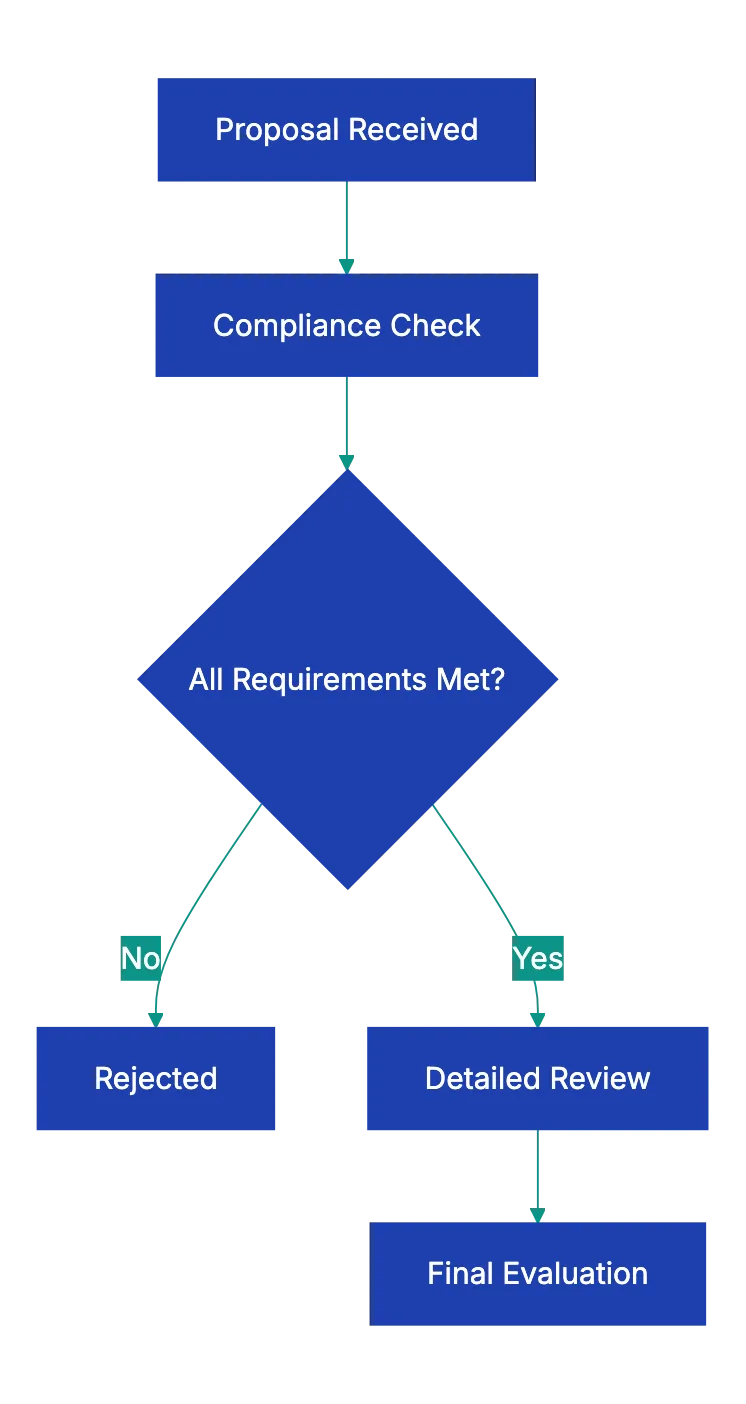
Proposal Evaluation Process:
What Each Section Covers
RFP Compliance: The First Filter
Many organizations use compliance as a screening tool, automatically rejecting non-compliant proposals before evaluating merit. This tells the buyer whether you can follow instructions — which predicts whether you’ll follow project requirements.
Read the RFP twice. First to understand the project. Second to note every requirement, question, format specification, and deadline.
Create a spreadsheet mapping each RFP requirement to where you addressed it. Some RFPs have thirty or forty specific questions buried across different sections. Miss one and you’re out.
Going over the page limit suggests you can’t edit or prioritize. Sending a Word doc when they asked for PDF shows you don’t read carefully.
Cover Letter: Your First Impression
The executive summary is often the only section decision-makers read in full. It needs to work hard in a small space.
Address it to the right person with correct name and title. State your proposal in one clear sentence: “We propose to design and implement a new customer onboarding system that reduces activation time from 14 days to 3 days.”
Reference the RFP number so it doesn’t feel generic. Show your key differentiators — not your company history, but why you specifically are the right choice. Keep it to one page.
Scope of Work: Getting Specific
The scope section is where most misunderstandings and project failures originate. Vague scope leads to scope creep and missed expectations.
Don’t write “improve website performance.” Write “reduce page load time to under 2 seconds on mobile devices and achieve a Lighthouse score of 90 or higher.”
Include specific dates or durations, not “approximately two months.” Spell out what you need from the client and when — most projects stall because the client didn’t provide something you assumed they would. Document a change order process for scope changes.
Pricing: Making Numbers Clear
Pricing confusion kills deals even when your price is competitive. Break down labor, materials, licenses, and expenses so buyers understand what they’re paying for.
Specify payment terms: Net 30? Fifty percent upfront? Monthly retainer? Address who pays for travel. State how long the quote is valid — typically 30 to 90 days.
Double-check every calculation. If your hourly rate times hours doesn’t equal your total, you look careless. Use a pricing table showing item, quantity, unit price, and total.
Qualifications: Proving Delivery Capability
Don’t just list clients. Describe a similar project, the challenge, your approach, and the measurable result. “We reduced their customer support ticket volume by 43 percent in six months” beats “They loved working with us.”
Include who will actually do the work. Provide at least three references with full contact details. Include current certification and insurance documentation.
Terms and Conditions
Terms determine what happens when things don’t go as planned. Specify the contract type: fixed-price means you absorb overruns, time-and-materials means they pay actual hours, retainer means ongoing relationship.
Address IP ownership, confidentiality, termination terms, liability limitations, and dispute resolution. If using a template, make sure it fits the specific project.
Key Proposal Components:

Common Mistakes That Get You Rejected
Generic content is the most common failure. If they can’t tell you wrote this specifically for them, you’ve already lost. Using “your company” instead of their actual name signals mass production.
Missing the deadline is automatic disqualification. 3:15 PM when the deadline was 3:00 PM doesn’t count as close enough.
Not answering all questions gets you rejected in most procurement processes. They ask specific questions to evaluate you fairly against competitors.
Math errors undermine confidence in your financial management. If you can’t add correctly in the proposal, how will you manage their budget?
Typos and formatting inconsistencies suggest carelessness. One typo might survive, but five in three pages will not.
Review Workflows That Improve Win Rates
Have someone who didn’t write the proposal review it against the checklist. Fresh eyes catch things you’re too close to see.
Build in review time. If the deadline is Friday, have a complete draft by Tuesday for Wednesday and Thursday revisions.
Upload your proposal to Revdoku to check it against requirements automatically. It catches compliance gaps, formatting inconsistencies, and calculation errors faster than manual review — so your human reviewers can focus on strategy and persuasiveness.
Different Proposal Types Need Different Depth
A two-page website redesign proposal doesn’t need the same formality as a hundred-page government RFP response.
For informal proposals, you still need scope, pricing, timeline, and terms — just in a simpler structure. For formal RFP responses, include everything in this checklist plus any additional government-specific requirements.
The core principle stays the same: answer every question the buyer has and remove every reason they might say no.
Find more review checklists at revdoku.com/checklists — each one is ready to copy and use in the app.
Frequently Asked Questions
What are the consequences of submitting a non-compliant proposal?
Submitting a non-compliant proposal often results in automatic disqualification. Buyers use compliance as a screening tool to determine if you can follow instructions, which is critical for project success. Missing required elements can lead procurement officers to reject your proposal without evaluating its content.
How can I ensure my proposal stands out from the competition?
To make your proposal stand out, customize it specifically for the client by addressing their unique needs and using their terminology. Clearly articulate your key differentiators in the cover letter and ensure all elements, especially the scope of work and qualifications, are detailed and compelling. Providing relevant case studies with quantifiable results can further enhance your position.
What should I do if I miss the proposal submission deadline?
If you miss the submission deadline, there's typically no recourse for submitting late, as most organizations strictly enforce their deadlines. Ensure you build in extra time when planning your proposal preparation to avoid last-minute issues. Consider reaching out to the organization for future opportunities or to ask if extensions are ever granted, but understand that this is rarely the case.
How can I manage scope creep in my proposals?
To manage scope creep, clearly define your deliverables, timelines, and responsibilities within the scope of work section. Explicitly state any assumptions and exclusions to prevent misunderstandings later. Additionally, include a documented change order process that outlines how scope changes will be handled to minimize friction or surprise costs.
What common mistakes should I avoid in my business proposal?
Avoid generic content that lacks personalization, failing to follow the specific RFP format, and not answering all presented questions. Typos and formatting inconsistencies can also undermine your credibility. Lastly, ensure your pricing calculations are accurate and itemized to avoid confusion and demonstrate financial management competence.
How can technology improve the proposal review process?
Technology can streamline the proposal review process by using document review tools that automatically check for compliance, formatting issues, and missing sections. These tools can provide quicker results than manual reviews and help identify common errors, allowing your human reviewers to focus on content quality and strategy. Implementing technology can lead to consistently higher quality proposals and improved win rates.
What are the differences in proposal structure for various types of clients?
Proposal structure can vary significantly based on the client type and project complexity. Informal proposals for small businesses may suffice with a simple statement of work, while formal RFP responses for government agencies require adherence to everything on the checklist, including detailed qualifications and documentation. Adjust your proposal's level of detail and formalities according to client expectations and project requirements.