
Comprehensive Expense Report Approval Checklist
The expense report approval checklist
Use the same sections in the same order for every report. Keep the expense policy of your company open next to the report. The policy sets the limits, the categories and the deadlines. This checklist compares the report with the policy.
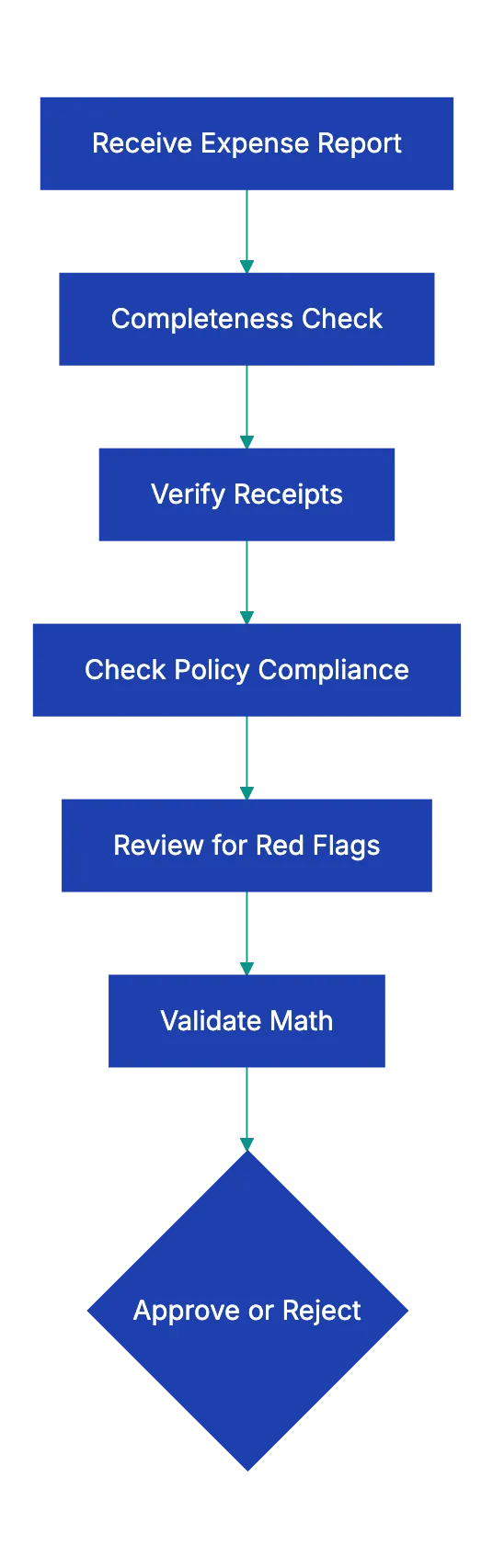
1. Completeness
- The report shows the employee name, the department or cost center, the report period and the submission date.
- Every line has a date, an amount, a currency, a vendor, a category and a business purpose.
- The report arrived before the deadline in your policy.
- The report does not contain your own expenses or the expenses of your manager.
Some US employers have an accountable plan (a reimbursement plan that meets IRS rules). For these plans, the IRS gives time limits that count as reasonable. An accounting within 60 days after the expense is on time. The return of an excess advance within 120 days is on time (IRS Publication 463). An advance is money that the employee gets before the expense.
2. Receipts
For US tax records, the IRS generally requires receipts or other documentary evidence for all lodging. It also requires them for any other expense of $75 or more (IRS Publication 463). Your policy can set a lower limit.
- A receipt is attached for every line that needs one under your policy.
- The amount, date and vendor on the receipt match the line. Look for a subtotal claimed instead of the total with tip, and the reverse.
- Meals and hotel stays have itemized receipts, not only a card slip.
- The receipt is readable, belongs to this employee and shows no signs of editing.
The IRS describes what makes a hotel receipt or a restaurant receipt adequate:
| Receipt | The IRS considers it adequate when it shows |
|---|---|
| Hotel | The name and location of the hotel, the dates of the stay, and separate amounts for lodging, meals and phone calls |
| Restaurant | The name and location of the restaurant, the number of people served, and the date and amount |
3. Business purpose
- The purpose is specific. Write “Dinner with Sarah Chen, Acme Corp, about the Q2 renewal”, not “Client dinner”.
- Meals and events list the attendees, their companies and their business relationship.
- The dates fit the trip or the event. For example, the report has no meals on days at home, and it explains weekend charges.
4. Policy
- Each line is within its limit, such as the hotel rate per night, the meal allowance, the airfare class and the rental car class.
- Each line is in a category that the policy reimburses. Look closely at minibar charges, personal entertainment, traffic fines and upgrades.
- Pre-approval exists where the policy requires it, for example for travel, conferences and larger purchases.
- Mileage claims show the dates, the start and end points, the purpose, the distance and the rate of your policy.
- The report claims nothing twice. Look for items that the company already paid through a corporate card, a travel desk or an advance.
5. Math
- The lines add up to the report total.
- Foreign currency amounts use the exchange rate and the date that your policy sets.
- The report subtracts advances and corporate card charges correctly.
6. Red flags
A red flag is a pattern that needs a question before approval. A red flag does not prove fraud.
- Several round amounts ($50, $100), especially for meals
- Amounts slightly below an approval limit or a receipt limit, or one purchase split into several lines
- The same receipt or amount on this report and on an earlier report
- Receipts that look different from other receipts of the same vendor, or that look edited
- Tips well above the usual tips of the employee or the team
- Expenses on weekends, holidays or vacation days with no explanation
- A vendor that does not match the category, or a vendor with a personal link to the employee
- Missing receipts that occur again and again for the same person
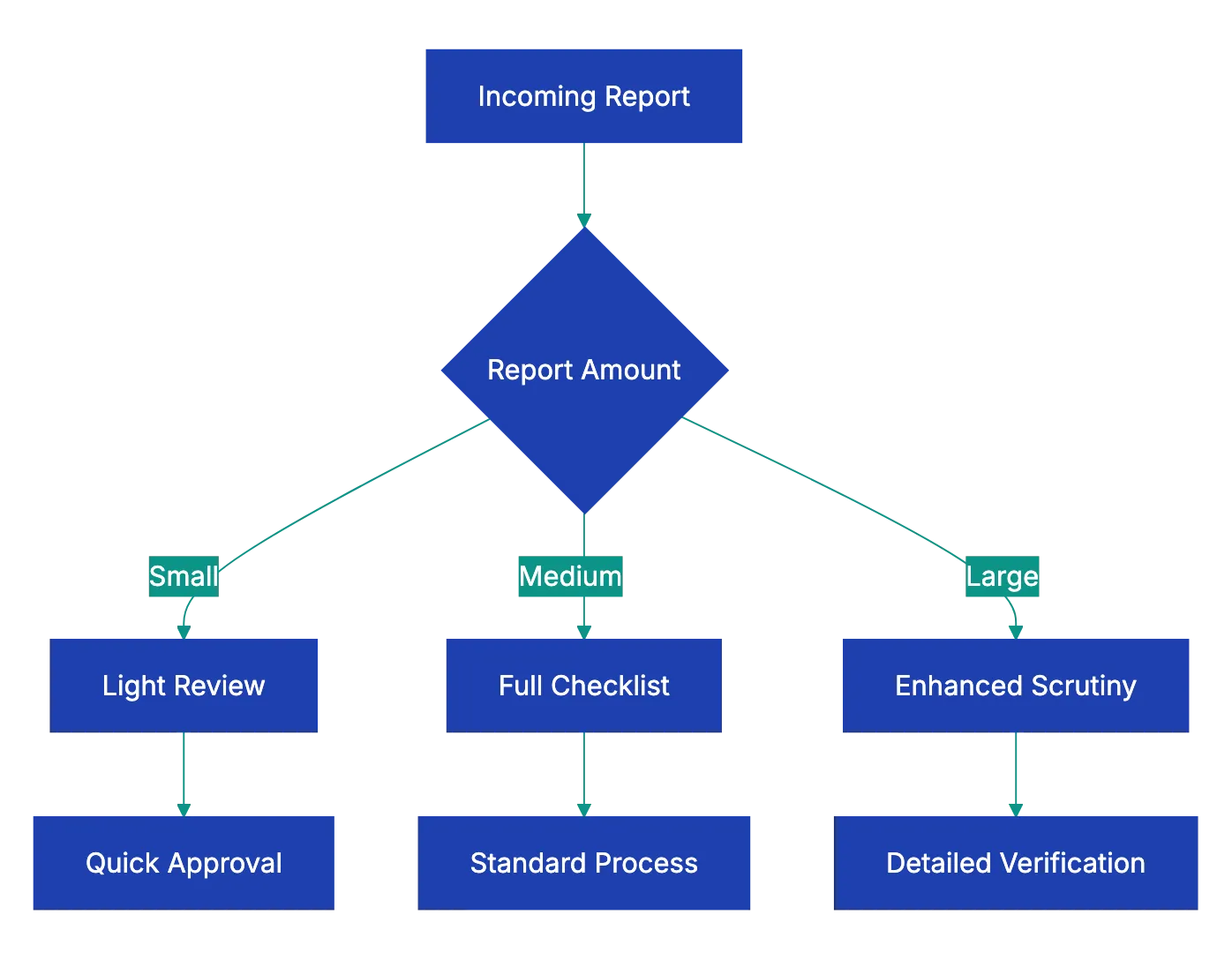
Match the depth of review to the risk
Not every coffee receipt needs the full checklist. A practical approach is to use three levels, based on the report total and the history of the employee:
| Level | When to use it | What to do |
|---|---|---|
| Light review | Small reports | Make sure that the receipts are present, the math is correct and each line has a purpose. |
| Full checklist | The normal range | Use all six sections. |
| Detailed review | Large reports, new employees, many missing receipts, earlier problems | Use all six sections. Also compare the report with earlier reports, look up the vendors and talk to the manager of the employee. |
Set the amounts for each level yourself, because they depend on your company. Also pick some small reports at random for a full review. Then everyone knows that someone reads the reports.
When you find a problem
Match your action to the type of problem:
- If the employee made an honest mistake, send the report back with a specific note. For example: “Line 4: the receipt shows $86.40, the report shows $96.40.”
- If an expense is outside the policy but can have a good reason, ask the manager of the employee. Record the decision on the report.
- If an employee breaks the policy again and again, tell the manager of the employee. Your job is to find and record the problem, not to discipline anyone.
- If you suspect fraud, stop the approval and keep copies of everything. Report it to your finance lead, HR or internal audit, as your policy says. Do not confront the employee yourself.
Keep a list of the reasons for each rejection. If the same reason occurs again and again, change the form or the policy. An example is a missing business purpose.
Use this checklist with Claude or ChatGPT
You can paste this checklist into Claude or ChatGPT, together with the policy sections, the report lines and the receipts. The receipts can be images or text. Ask the AI to compare every line with the checklist and the policy. The AI is good at slow, repetitive work. It compares amounts and dates, finds duplicates and lists missing items.
Below are an expense report checklist, our expense policy, an expense
report and its receipts. Check every report line against the checklist
and the policy. List each problem with the line number, the checklist
item, and what the receipt or policy actually says. List missing
receipts and missing information separately. Do not approve or reject
the report. I will decide.

CHECKLIST:
[paste the checklist]

POLICY:
[paste the policy sections]

REPORT AND RECEIPTS:
[paste or attach]
Compare each finding with the receipt before you send a report back. The AI can misread a receipt or miss a problem.
Remove card numbers, bank details and home addresses before you upload employee data. Also read the rules of your company and the data settings of your workspace.
For the tax treatment of an expense, your accountant has the final word.
A docs portal with Ask AI
and support tickets
Connect a repository, or describe your product to start. Each docs site has search, Ask AI, an API console, an MCP server and support tickets.
- Publishes from GitHub on every push
- Works with Mintlify repositories
- API console from your OpenAPI file
- MCP server and llms.txt for AI agents
- Ask AI and support tickets
- Analytics for people and AI agents
Frequently Asked Questions
What if an employee lost a receipt?
Follow your policy. For small amounts, some policies accept a signed statement about the missing receipt, together with the card or bank record. For US tax records, the IRS does not require a receipt for an expense below $75, except lodging. You still need a record of the amount, the date, the place and the business purpose. A canceled check alone does not show that a payment was for business.
How long do we need to keep expense reports and receipts?
In the US, the IRS says to keep records that support a deduction for 3 years from the date that you file the return, in most cases. Some cases need more time. An example is 6 years if unreported income is more than 25% of the gross income on the return. Employment tax records need at least 4 years. Outside the US, or if contracts or auditors require more, ask your accountant.