
Essential Contractor Bid Checklist Before Signing
Contractor bid checklist
Use this checklist on every bid before you sign. A missing item does not always mean that the bid is bad. But each gap is a question to ask the contractor in writing.
| Area | What the bid or contract must show | Ask the contractor when |
|---|---|---|
| Contractor | Legal business name, address, phone and license number | The name is different from the license record, or the bid has no license number |
| Insurance | Current certificates for liability, workers’ compensation and property damage | The contractor only says “we are insured” |
| Scope | Each task, with materials named by brand, model, size and color | The scope is one line, for example “bathroom remodel” |
| Exclusions | The work that the price does not include, for example permits, debris removal or painting | The bid excludes nothing |
| Price | Labor, materials, permits, equipment and other costs as separate lines | The bid gives one total only |
| Allowances | A budget for items that you select later, and the name of the person who selects them | An allowance is too low for the items that you want |
| Payments | A small deposit, then payments for finished stages of work | Most of the money is due before work starts, or the contractor accepts only cash |
| Schedule | Estimated start date and completion date | The bid has no dates |
| Permits | The name of the party that gets the permits | The contractor asks you to get them |
| Change orders | A written process for changes, with the cost and the effect on the schedule | The contractor says that changes “get sorted out on site” |
| Warranties | Workmanship and material warranties, their length, their limits and who honors them | The warranty terms are missing or unclear |
| Cleanup | The party that cleans up and removes debris | The bid does not mention cleanup |
| Right to cancel | A written notice of your right to cancel, if you signed at home | The notice is missing |
Most of these items come from the FTC guide to hiring a contractor and its advice on home improvement scams. Contract rules are different in each state. Ask your state or local consumer agency about the rules where you live.
Research the contractor before the price
- Get the license number from the contractor.
- Look up the license with your state or county licensing office. Make sure that the business name on the bid is the same as the name on the record.
- Ask for copies of the insurance certificates. Make sure that each certificate is current.
- Ask the contractor if the job uses subcontractors. If it does, make sure that each subcontractor has current insurance and, where your state requires it, a license.
- Ask for at least three clients with similar projects. Ask each client if the job finished on time, if there were unexpected costs and if the crew cleaned up.
Do not hire a contractor without current insurance. According to the FTC, you can be liable for injuries and damage during the project if the insurance is not current.
Scope of work and exclusions
Most disputes start with the scope. “Bathroom renovation” is not a scope. A usable scope lists the work step by step. For example: remove the old tile, install plumbing for a new shower valve and add recessed lights. Then it names the floor tile by size and color, the paint for walls and ceiling, and the debris removal.
Use this test: can a different contractor build the same thing from this text? If not, ask for more detail before you compare the bid with other bids.
Read the exclusions with the same care. A good bid tells you what it does not include. If a bid has no exclusions, the gaps can come back later as change orders.
Price breakdown
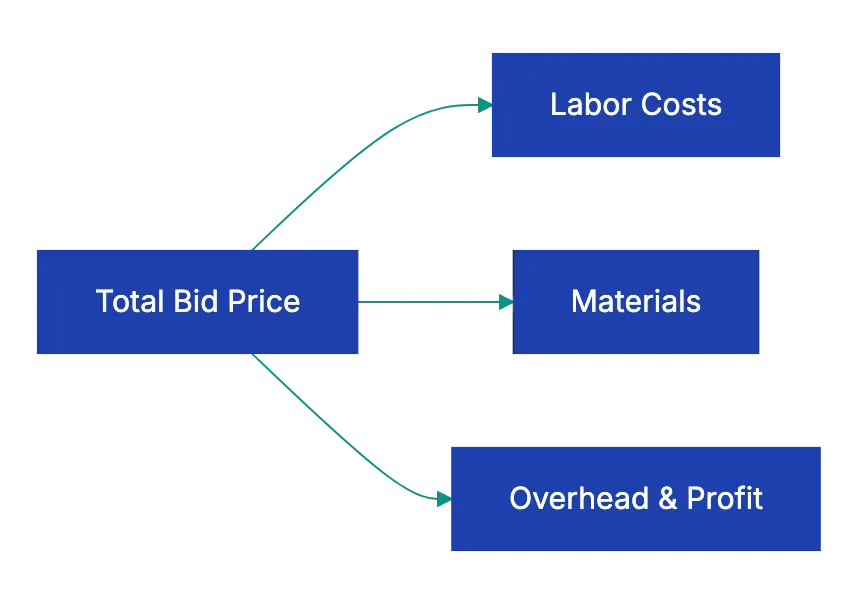
One total price hides the numbers that you need to compare bids. Ask for these lines:
- Labor, as a total for each phase, or as an hourly rate with estimated hours
- Materials, with brand, model, quantity and unit price
- Permit fees, and the name of the party that applies for the permits
- Equipment rental and disposal fees
- Overhead and profit
- Contingency and allowance amounts
- Sales tax, and a statement that tells you if the total includes it
If one bid includes tax and another bid does not, the real difference between them is not the difference between the totals.
Payment schedule
- Deposit: Keep the deposit small. Some states set a limit. In California, the down payment on a home improvement job cannot be more than $1,000 or 10% of the contract price, whichever is less. Later payments in California cannot be more than the value of the work done.
- Progress payments: Connect each payment to a defined stage of finished work, not to a date. If the work is late, the payments are late too.
- Payment method: Do not pay in cash. The FTC lists a request for full payment up front or for cash only as a sign of a scam.
- Final payment: Pay it only after a walkthrough shows that the work agrees with the contract.
- Lien waivers: Ask the contractor, and each subcontractor and supplier, for a lien release before the final payment. In some states, an unpaid subcontractor or supplier can file a mechanic’s lien against your home, even if you paid the contractor.
A lien waiver (or lien release) is a signed release of the right to file a lien. A mechanic’s lien is a legal claim against your home for unpaid work.
Change orders
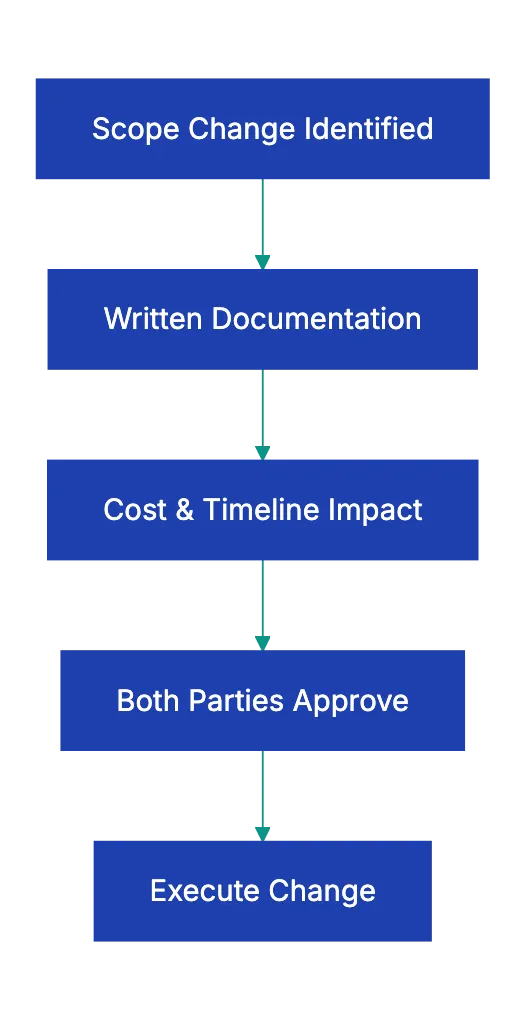
A change order is a written approval for work that is not in the contract. Renovations often find problems that nobody priced, for example a rotted subfloor or old wiring. Make sure that the bid tells you how changes work:
- The contractor writes down each change before work on it starts.
- The change order gives the new work, its cost for labor and materials, and its effect on the schedule.
- You and the contractor both sign the change order.
Also find out how the contractor prices changes. A fixed price for each change gives you a known cost. Time-and-materials pricing (you pay for hours and materials used) has no upper limit. If the contractor uses it, ask for a maximum amount.
Warranties and dispute terms
- Workmanship warranty: its length, what it covers and what it excludes
- Material warranties: transferred to you, with the name of the party that honors each one (contractor, distributor or manufacturer)
- Dispute resolution: a statement that tells you if mediation or arbitration comes before a lawsuit
Read the dispute clause before you sign, not after a problem starts.
Compare bids side by side
Put the bids in one table. Then add the cost of the excluded work to each total. In this example, the lowest bid is not the lowest after you add back the excluded work:
| Contractor A | Contractor B | Contractor C | |
|---|---|---|---|
| Bid total | $78,000 | $92,000 | $65,000 |
| Excluded work | None | None | Permits, debris removal, painting |
| Adjusted total | $78,000 | $92,000 | About $80,000 |
| Materials | Builder grade | Commercial grade | Builder grade |
| Workmanship warranty | 1 year | 2 years | 90 days |
| Deposit | 30% | 15% | 50% |
Fill in the same rows for each of your bids. If a bid leaves a row empty, ask the contractor about that row next.
Use this checklist with Claude or ChatGPT
Claude or ChatGPT can do a fast first pass. Paste the checklist into the chat and attach one or more bids. Then ask the AI to go through each item:
Below is my contractor bid checklist, followed by three bids.
For each bid, go through the checklist item by item and say whether
the bid covers it, quoting the line that does. List every missing
item as a question I should ask the contractor. Then fill in a
side-by-side table with the rows from the checklist.
Do not trust a finding until you find it in the bid yourself. The AI can miss a line or report something that the bid does not say. Remove your address, phone numbers and account details before you upload a bid. For a large contract or a dispute, ask a construction lawyer or your state’s contractor licensing board.
A docs portal with Ask AI
and support tickets
Connect a repository, or describe your product to start. Each docs site has search, Ask AI, an API console, an MCP server and support tickets.
- Publishes from GitHub on every push
- Works with Mintlify repositories
- API console from your OpenAPI file
- MCP server and llms.txt for AI agents
- Ask AI and support tickets
- Analytics for people and AI agents
Frequently Asked Questions
How many contractor bids do I need?
The FTC tells you to get written estimates from several companies and not to select the lowest bid automatically. If the prices are very different, ask each contractor to explain the difference. Make sure that each bid covers the same scope. If the scopes are different, you cannot compare the totals.
Can the final bill be higher than the bid?
Yes, if you sign change orders for extra work. Some state and local laws limit how much the final bill can go above the estimate without your approval. Ask your state or local consumer agency about the rule where you live. Keep each signed change order with the contract.
What do I examine before I make the final payment?
The FTC gives this sign-off list. Make sure that the work agrees with the standards in the contract. Make sure that you have written warranties for materials and workmanship. Get proof that the contractor paid the subcontractors and suppliers, for example lien releases. Make sure that the site is clean. Inspect and approve the finished work.