Prevent Costly Mistakes: Review W-9 Forms Effectively
Table of Contents
- W-9 verification checklist
- Lines 1 and 2: the name must match the TIN
- Line 3a: one box, and the LLC letter
- Part I: the TIN
- Line 4 and the address
- Signature: required less often than you think
- When to ask for a new W-9
- Compare name and TIN with IRS TIN Matching
- Red flags that stop a W-9
- What a wrong W-9 costs
- Use this checklist with Claude or ChatGPT
W-9 verification checklist
Use these ten items before you accept a Form W-9 from a vendor and pay the first invoice. Form W-9 gives you the taxpayer identification number (TIN) of the vendor. The TIN is a social security number (SSN) or an employer identification number (EIN). The line numbers below follow the current form, Rev. March 2024.
| # | Field | What to look for |
|---|---|---|
| 1 | Form revision | The top-left corner shows “Rev. March 2024”, or a newer revision from irs.gov/FormW9. |
| 2 | Line 1, name | Line 1 is not empty. It shows the legal name that goes with the TIN. For a sole proprietor or a disregarded entity (a single-owner business taxed as its owner), it shows the name of the owner. |
| 3 | Line 2, business name | The trade name, the DBA (“doing business as”) name, or the name of the disregarded entity. Line 2 is only necessary if this name is different from line 1. |
| 4 | Line 3a, tax classification | One box of seven has a mark. If the “LLC” box has a mark, the letter C, S, or P is in the entry space. |
| 5 | Line 3b | Usually empty. Only some partnerships, trusts, and estates with foreign partners, owners, or beneficiaries use it. |
| 6 | Line 4, exemptions | Usually empty. Exemption codes apply only to some types of entities, not to individuals. |
| 7 | Lines 5 and 6, address | Street, city, state, and ZIP code. You send the 1099 to this address. “NEW” at the top means that the address changed. |
| 8 | Part I, TIN | Nine digits in the correct box: SSN (XXX-XX-XXXX) or EIN (XX-XXXXXXX). The type of number agrees with line 3a. |
| 9 | Part II, signature and date | A signature and a date are present if the IRS or your own policy requires them. The signature section below gives the IRS rules. |
| 10 | Your records | The name, the TIN, and the address agree with the contract, the invoice, and your vendor file. |
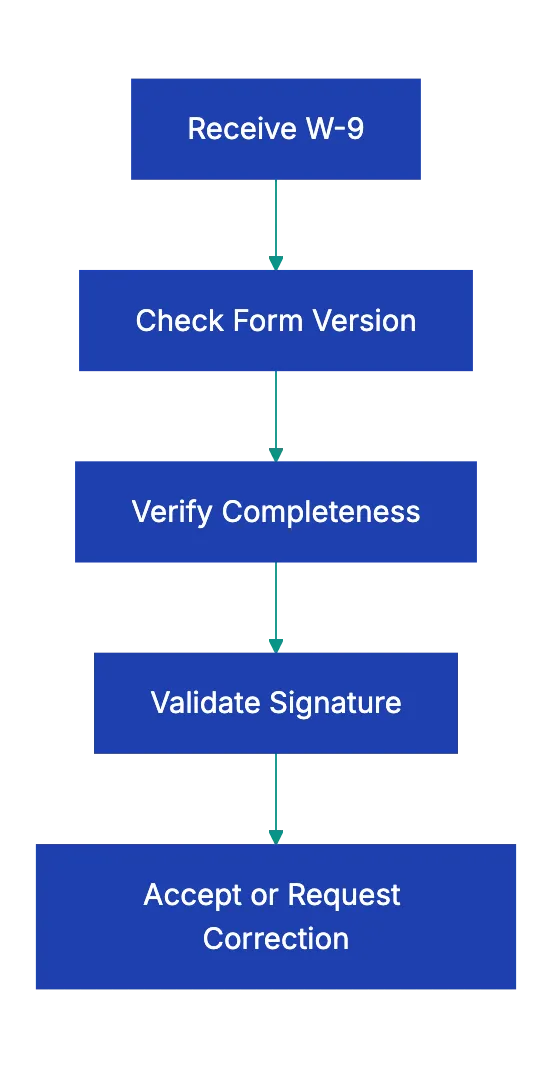
The review flow for a W-9:
Lines 1 and 2: the name must match the TIN
The IRS compares the name on line 1 with the TIN in Part I. The form says that the TIN “must match the name given on line 1 to avoid backup withholding.” Backup withholding is tax that you keep back from your payments to the vendor.
Make sure that line 1 has the correct name for the type of vendor:
- Individual or sole proprietor: the name of the person, as on their Form 1040. A business name, trade name, or DBA name goes on line 2.
- Disregarded single-member LLC: the name of the owner on line 1, and the name of the LLC on line 2. The IRS instructions do not permit the name of a disregarded entity on line 1.
- Corporation, partnership, or LLC that the IRS taxes as one of these: the name of the entity, as on its tax return.
Then compare the form with the invoice. For example, the invoices show “Bright Path Marketing”, but line 1 shows “David Chen” and line 2 is empty. The vendor is probably a sole proprietor who did not write his trade name. Ask him to write it on line 2, so that your records connect the two names.
If line 1 shows a business name and line 2 shows the name of a person, the lines are in the wrong order. Send the form back.
Line 3a: one box, and the LLC letter
Line 3a has seven boxes: Individual/sole proprietor, C corporation, S corporation, Partnership, Trust/estate, LLC, and Other. The form tells the vendor to mark only one box. If no box or two boxes have a mark, send the form back to the vendor.
If the vendor marked the LLC box, the vendor must also write C (C corporation), S (S corporation), or P (partnership). Make sure that the letter is there. A disregarded single-member LLC does not mark “LLC”. It marks the box for the classification of its owner, usually Individual/sole proprietor.
The classification tells you if you must send a Form 1099-NEC. This form reports what you paid a contractor in the year.
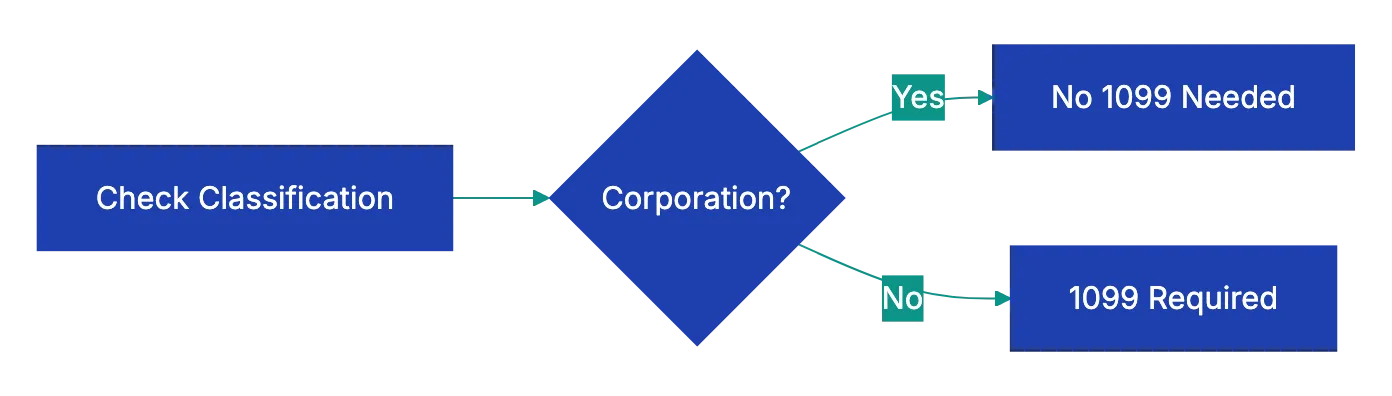
The chart shows only the general rule. The Form 1099-MISC and 1099-NEC instructions say that you usually do not report payments to corporations. Attorneys’ fees and medical and health care payments are exceptions. You report them also when the payee is a corporation.
For other vendors, a 1099-NEC is necessary for nonemployee compensation of $2,000 or more in a year. This threshold applies to payments from 2026. You must send the 1099-NEC to the vendor and to the IRS by January 31.
If a vendor said that it is an LLC but marked Individual/sole proprietor, ask the vendor about it. The vendor can be a single-member LLC that reported correctly. The vendor can also have made a mistake that changes your reporting.
Part I: the TIN
The correct type of TIN depends on the vendor:
- Individuals: usually an SSN. A resident alien who cannot get an SSN uses an ITIN (an IRS tax number for people without an SSN). The ITIN goes in the SSN box.
- Sole proprietors: an SSN or an EIN. The instructions permit both, but the IRS encourages the SSN.
- Disregarded single-member LLCs: the SSN of the owner, or the EIN of the owner if the owner has one. The EIN of the LLC is not correct here.
- Corporations, partnerships, and LLCs that the IRS taxes as one of these: the EIN of the entity.
If a W-9 from “Global Services Inc.” shows a number in SSN format, ask the vendor before you accept the form. Do the same for a number with the wrong count of digits.
“Applied For” in the TIN box means that the vendor applied for a number or will apply soon. The IRS instructions give a 60-day period to supply the TIN. That period applies only to interest, dividends, and some readily tradable instruments. It does not apply to usual vendor payments.
Until the vendor gives you a TIN, your payments to the vendor are subject to backup withholding. The IRS instructions set the backup withholding rate at 24%.
Line 4 and the address
Most vendors leave line 4 empty, and that is correct. The exempt payee codes 1 to 13 are for specific types of entities. For example, code 5 is “A corporation.” The IRS says that individuals and sole proprietors are generally not exempt from backup withholding.
If a freelancer marked Individual/sole proprietor and also wrote an exempt payee code, ask about it. The FATCA code (a code for foreign account reporting) applies only to accounts outside the United States.
For lines 5 and 6, make sure that:
- The address is complete: street, city, state, and ZIP code.
- The address agrees with your vendor file. If it does not, update the file. You send the 1099 to this address.
- The vendor wrote “NEW” at the top if the address changed. The instructions say that the requester can continue to use the old address until it updates its records.
Signature: required less often than you think
Part II is the certification. With the signature, the vendor certifies that the TIN is correct. The form says that for “payments other than interest and dividends” the payee does not have to sign. But the payee must give the correct TIN.
The IRS instructions put payments to a nonemployee for services, rents, and royalties in this group. A signature is necessary in two cases. The first case is a real estate transaction. The second case is a payee that the IRS told about an incorrect TIN in the past.
Many accounts payable teams require a signed and dated form as a policy. The signature is the certification of the vendor, under penalties of perjury, that the TIN is correct. Select one rule and use it for all vendors.
When to ask for a new W-9
A W-9 does not expire. The IRS instructions say that a certificate stops being valid when you know, or have reason to know, that its information changed. Ask for a new form if a vendor does one of these:
- Changes its legal name or its type of entity. For example, a sole proprietor forms a corporation.
- Gives you a new TIN or a new address.
- Appears in an IRS notice because its name and TIN do not match.
If a vendor gave you an old revision of the form, ask for a current one at your next contact.
Compare name and TIN with IRS TIN Matching
The IRS gives free TIN Matching to payers that file information returns. The interactive option compares up to 25 name and TIN pairs at a time, with immediate results. The bulk option accepts up to 100,000 pairs and returns results in 24 hours.
You need an IRS account and an approved TIN Matching application. Register well before your 1099s are due.
TIN Matching is the only step on this list that shows that the number belongs to that name. A visual review finds empty fields and format errors. It does not find a wrong number that looks correct.
Red flags that stop a W-9
Do not accept a W-9 that has one of these problems:
- An old revision of the form.
- An empty line 1 or an empty TIN box.
- No box or two boxes marked on line 3a, or “LLC” without C, S, or P.
- An individual or sole proprietor with an exempt payee code.
- A TIN type that does not agree with the entity, or a number with the wrong count of digits.
- A name that does not agree with the contract or the invoice, and no DBA on line 2 that explains it.
- No signature where the IRS or your policy requires one.
What a wrong W-9 costs
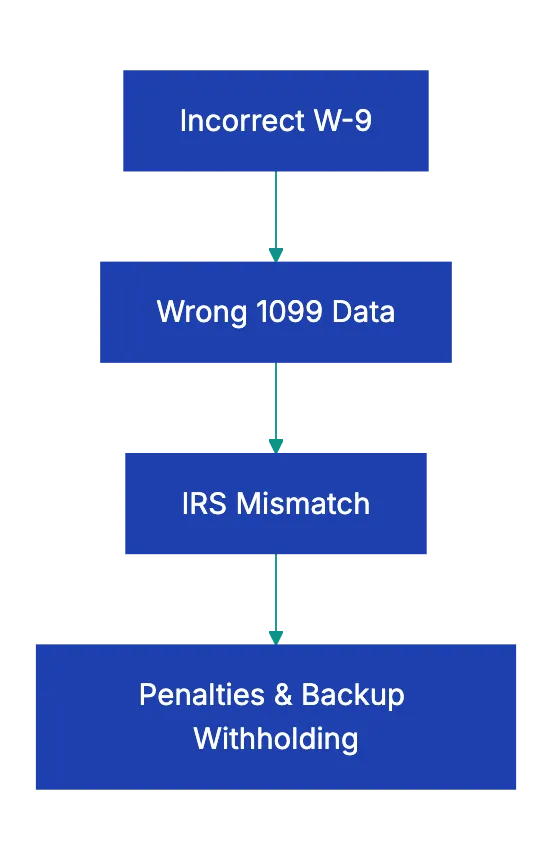
A wrong W-9 causes a wrong 1099. The IRS charges information return penalties for each return. For returns due in 2026, the penalties are:
| When you file a correct return | Penalty for each return |
|---|---|
| Not more than 30 days after the due date | $60 |
| More than 30 days late, but by August 1 | $130 |
| After August 1, or not at all | $340 |
| Intentional disregard | $680, with no annual maximum |
For example, 20 incorrect 1099s that you correct after August 1 cost $6,800 at the $340 rate. Also, if a vendor does not give you a TIN, you must withhold 24% of reportable payments as backup withholding.
Use this checklist with Claude or ChatGPT
Claude or ChatGPT can go through the checklist with you:
- Cover the TIN on the form before you upload it. An AI model cannot compare a TIN with IRS records. Only TIN Matching can do that.
- Paste the checklist above into the chat.
- Attach the W-9 as a PDF or a photo.
- Ask the model to go through each item and list what is missing.
Here is my W-9 review checklist and a vendor's Form W-9 (TIN covered).
Go through every item. For each one, answer Pass, Fail or Not sure, quote the
text on the form you based it on, and list what I need to ask the vendor to fix.
The vendor's invoices say: [name on invoice]. Our vendor file address: [address].
Use the answer as a first review only. The model can read handwriting or a mark incorrectly. It can also say that a field has an entry when the field is empty. Make sure that each finding agrees with the form.
Before you upload tax documents, read the data settings of your workspace. For decisions about 1099 reporting or backup withholding, follow the IRS instructions or ask a tax professional.
A docs portal with Ask AI
and support tickets
Connect a repository, or describe your product to start. Each docs site has search, Ask AI, an API console, an MCP server and support tickets.
- Publishes from GitHub on every push
- Works with Mintlify repositories
- API console from your OpenAPI file
- MCP server and llms.txt for AI agents
- Ask AI and support tickets
- Analytics for people and AI agents
Frequently Asked Questions
Do I send the W-9 of the vendor to the IRS?
No. The form says: “Give form to the requester. Do not send to the IRS.” Keep the form in your vendor file, and use it to prepare the 1099 for the vendor.
What if the vendor is not a US person?
Form W-9 is only for US persons, including resident aliens. A foreign vendor gives you a Form W-8 instead. For example, an individual uses Form W-8BEN, and an entity uses Form W-8BEN-E.
Do I need a W-9 from a corporation if I do not send it a 1099?
Yes. The W-9 is your record that the vendor is a corporation, and that record is the reason that you do not send a 1099. The W-9 also gives you the TIN for a payment that you must report, for example attorneys’ fees.