
Essential Construction Daily Report Checklist
Table of Contents
- The daily report checklist
- 1. Project and weather
- 2. Workforce and equipment
- 3. Work performed
- 4. Safety
- 5. Materials and deliveries
- 6. Visitors, instructions and documents
- 7. Delays and problems
- 8. Photos
- 9. Sign-off
- Weak and strong entries
- Habits that make reports hold up
- If someone is hurt
- Use this checklist with Claude or ChatGPT
The daily report checklist
Write one report for each site for every calendar day. Include days with no work, and write down why no work took place. Before you start, read your contract and the specifications. They can state the required content, the person who signs, and the deadline for the report.
1. Project and weather
- Project name and number, location, report date, author, and the start and end of the shift
- Weather at the start of the day and its changes: temperature, rain or snow with times, wind, ground conditions
- Work that the weather stopped or limited, and for how long
2. Workforce and equipment
- Each company on site with its trade, headcount and hours. Write “ABC Electric, 4 electricians, 7 hours”, not “12 workers”.
- Supervisors and other key people on site
- Equipment that the crews used, equipment that stood idle or broke down, and rentals that arrived or left
3. Work performed
- What the crews did, where they did it (floor, grid line, room or zone) and how much (quantities)
- Work that started, finished or stopped
- Inspections and tests: who did them, what they examined, and the result
4. Safety
OSHA requires some inspections that belong in the daily report. A competent person must inspect scaffolds for visible defects before each work shift (29 CFR 1926.451(f)(3)). If workers can be in an excavation, a competent person must inspect it daily. The inspection must happen before work starts and after every rainstorm (29 CFR 1926.651(k)(1)). OSHA defines a competent person as someone who can identify hazards and has authority to correct them (29 CFR 1926.32(f)).
- Each inspection, the name of the inspector and the findings
- Hazards that you saw and the corrective action, also when the crew corrected the hazard immediately
- Injuries, first aid cases and near misses (events that almost caused an injury)
- The topic of the toolbox talk (a short safety meeting) and the names of the attendees
- Observations about PPE (personal protective equipment) and housekeeping

5. Materials and deliveries
- Supplier, description, quantity and delivery ticket number for each delivery
- Shortages, damage and rejected items, compared with the ticket
- The storage location of the materials and how they are protected
6. Visitors, instructions and documents
- Visitors with times, such as the owner, the architect, the engineer and inspectors
- Verbal instructions: who gave them and what they changed
- RFIs (requests for information), submittals (product data sent for approval) and change orders that affected the work of the day
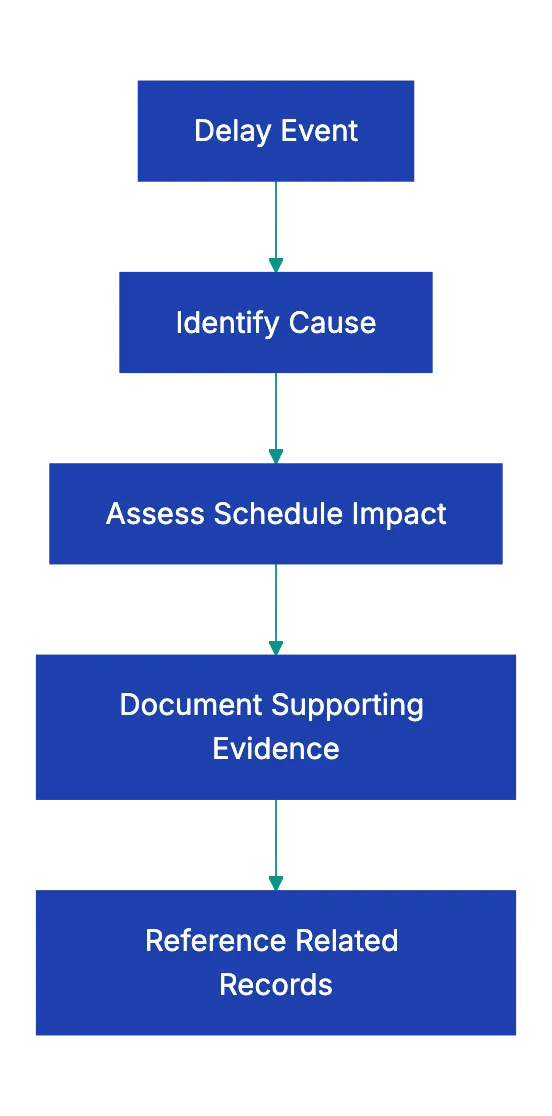
7. Delays and problems
- The work that stopped or slowed, and where
- The cause, and the responsible party if you know it
- The crews and hours affected, and the work that they did instead
- The expected effect on the schedule
- Related records, such as emails, RFIs, change orders and photos
8. Photos
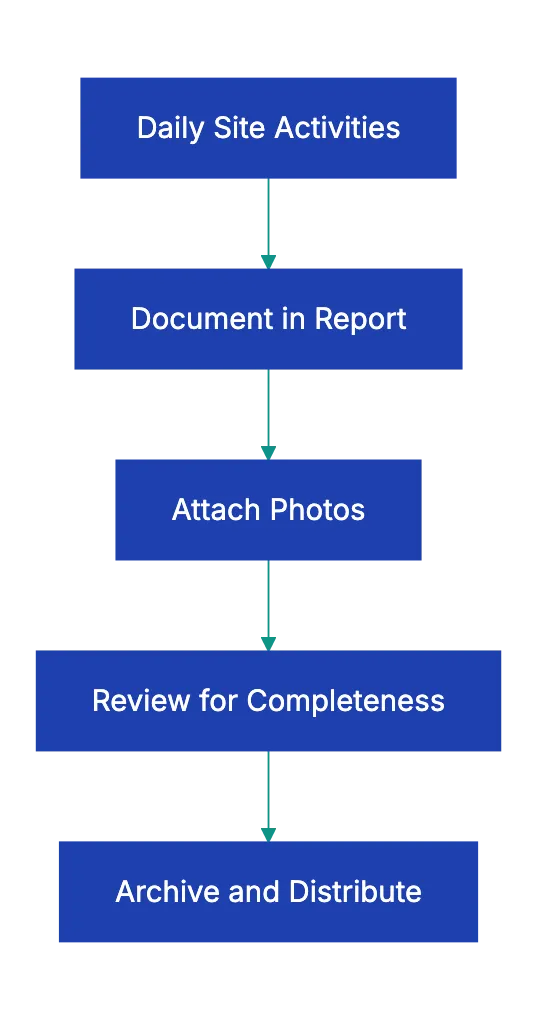
- Progress photos from the same positions each day
- Work before it is covered: rebar before a pour, framing, insulation and MEP rough-in before drywall, waterproofing before backfill, flashing before cladding. MEP rough-in is the pipes, ducts and wiring inside open walls.
- Deliveries, damage, hazards and weather conditions
- The date, the location and a one-line caption for each photo
9. Sign-off
- The name of the person who wrote the report, the name of the reviewer, and the date
- A list of the attached photos and documents
- Distribution to each person that the contract names
Weak and strong entries
A report is only as useful as its least specific line. A person who was not on site must be able to understand what happened.
| Weak | Strong |
|---|---|
| Rained today, crew worked on foundation. | Rain from 9 am to 2 pm. The ground was saturated. Smith Concrete (8 workers) poured east wall sections E1 to E4. The west wall pour moved to Monday because the pump truck had no access on the wet ground. |
| Worked on HVAC. | The crew installed 12 VAV boxes on the 3rd floor, zones 3A to 3D, and connected them to the main duct. The rough-in for the east wing is complete. |
| No framing today. | Second-floor framing did not start. Steel beam B-47 arrived damaged, and a replacement is on order (supplier email of 11/15). The crew moved to first-floor blocking. Expected delay to framing: 2 days. |
| Waiting on information. | The ceiling layout on level 2 is on hold until the architect answers RFI 23 (sent 10/3). The drywall crew of 4 moved to level 1. |
Habits that make reports hold up
These habits make a report useful later, for example in a dispute:
- Write the report on the same day. A record from the same day has more detail and more credibility than a record from memory weeks later.
- File a report for every day, also for days with no work (“No work, site closed for a holiday”). A missing day raises the question of what the report left out.
- Write what you saw and what people said. Do not write opinions about fault.
- Use the terms of the drawings, such as grid lines, room numbers and specification sections. Then readers can find each entry on the plans.
- If an earlier report has an error, add a dated correction. Do not edit the old report.
If someone is hurt
The daily report records the incident, but it does not replace a report to OSHA. An employer must report a work-related fatality to OSHA within 8 hours. It must report an in-patient hospitalization, an amputation or the loss of an eye within 24 hours (29 CFR 1904.39). In the daily report, write the time, the place, the people involved, the witnesses and the actions taken. Write facts only.
Use this checklist with Claude or ChatGPT
Before you file the report for the day, paste this checklist and your draft into Claude or ChatGPT. You can also paste your rough notes. Ask the AI to compare the draft with each item. The AI can find items that are missing or vague. It cannot know what happened on site. Ask it for questions, not for text that fills the gaps.
Below is a construction daily report checklist and my draft report.
Go through the checklist item by item. For each one, say "covered",
"vague" or "missing", and quote the line from my draft that covers it.
For vague or missing items, ask me the question I need to answer.
Do not invent quantities, names, times or weather.

CHECKLIST:
[paste the checklist]

DRAFT REPORT:
[paste your report or notes]
Compare the answer of the AI with your draft. The AI can miss gaps, and it can say that the draft covers an item when it does not.
Remove the names of workers and the details of injuries before you paste a report into a chat tool. Also read the rules of your company and the data settings of your workspace.
For an injury, a claim or a dispute, your safety manager or a construction attorney has the final word on what to record and report.
A docs portal with Ask AI
and support tickets
Connect a repository, or describe your product to start. Each docs site has search, Ask AI, an API console, an MCP server and support tickets.
- Publishes from GitHub on every push
- Works with Mintlify repositories
- API console from your OpenAPI file
- MCP server and llms.txt for AI agents
- Ask AI and support tickets
- Analytics for people and AI agents
Frequently Asked Questions
Who writes the construction daily report?
Usually the superintendent or the foreman who was on site all day writes it. The report is only as good as the observations of that person. The writer signs the report. A project manager reads it on the same day or the next morning. Then the writer can still add missing items from memory and photos.
Do subcontractors need their own daily reports?
A subcontractor benefits from its own report. The report records the crew hours of the subcontractor, the delays that others caused and the instructions that it received. The report of the general contractor can leave these out. If the two reports disagree about a day, discuss the difference while people still remember the events of that day.