
Business Letter Writing Checklist
The business letter checklist
Read your letter against each item before you print, sign, or send it. Start at the top of the page and work down.
Layout and header
- Your letterhead, or your full address at the top (street, city, state or region, and postal code)
- The date in words and numbers (“March 16, 2026”, not “3/16/26”)
- The recipient block: full name, job title, company, and full address, at the left margin
- A reference line, if the reader needs one (an account, invoice, order, or claim number)
- A salutation (the greeting) with the name of the person, spelled the same way that the person spells it (“Dear Ms. Alvarez:”)
- Block format (every line starts at the left margin), with single spacing in paragraphs and one blank line between paragraphs
- One page, with equal margins and a readable font (for example, 11 or 12 point)
Content
- The first one or two sentences give the purpose of the letter
- Each claim or request has the facts that support it: dates, amounts, reference numbers, and product or model names
- The letter has one topic
- The last paragraph tells the reader what to do and by which date
- Your direct phone number and email address are in the letter, also when they are on the letterhead
Tone and language
- The words are polite and firm, also in a complaint
- Plain words replace jargon when the reader works in a different field
- Active voice is the default (“We will ship your order on Friday”)
- Old phrases such as “Per your request” and “Enclosed please find” are gone (“As you asked” and “I enclose” are clearer)
Sign-off
- A closing that matches the salutation (“Sincerely,” or “Kind regards,”)
- Four blank lines for a handwritten signature, then your typed name and title
- An “Enclosures” or “Encl.” line when the letter mentions an enclosed or attached document, and the document is in the envelope or the email
- A “cc:” line for each other person who gets a copy
Final read
- Names, titles, and company names match a reliable source, for example an email signature or the company website
- Dates and amounts match your records
- You read the letter aloud one time, to find errors that spell-check does not find (“their” for “there”, “form” for “from”)
- Numbers, dates, and capital letters use one style in all of the letter
- In a mail merge (one letter sent to many people) or a reused letter, the name, address, and attachment are correct
Where each part goes
A standard business letter has six parts. The parts are always in the same order, so readers know where to find the date, the sender, and the request.
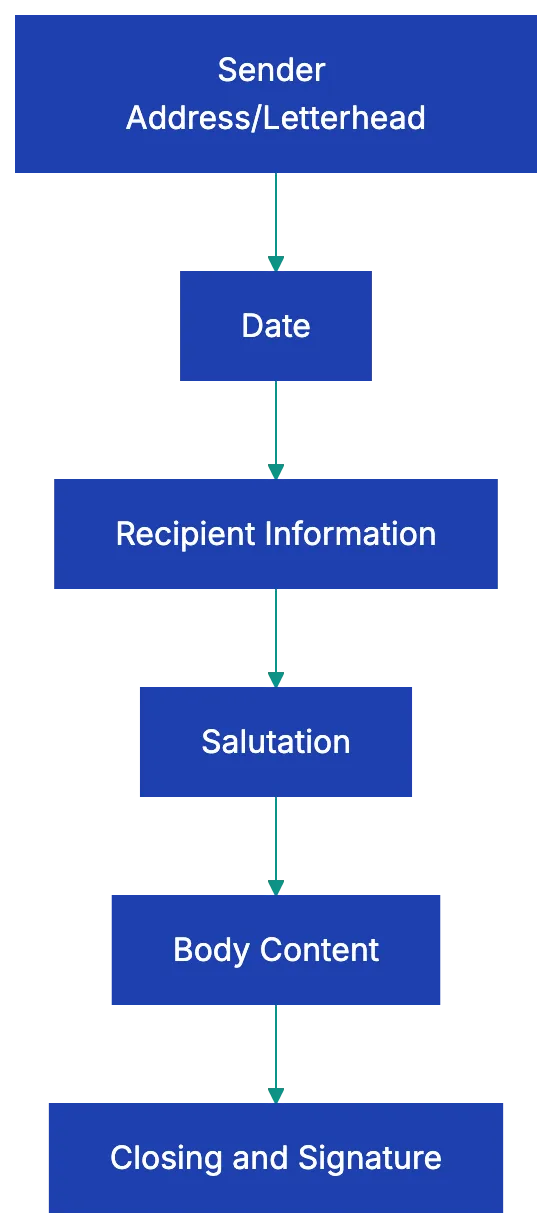
If you use printed letterhead, do not type your address again under it. Put the recipient block one or two lines below the date. If you cannot find the name of the person on the company website or by phone, use a role, for example “Dear Billing Manager:”. Do not use “To Whom It May Concern.”
What the body contains
The body of the letter has four parts: the purpose, the facts, a professional tone, and a call to action. A call to action is the step that you want the reader to take.
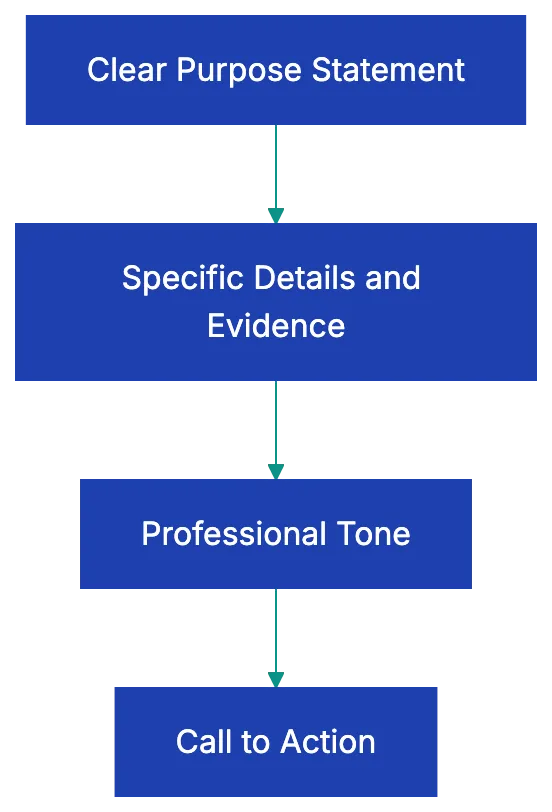
Write the purpose in the first one or two sentences. For example, write “I am writing to request a refund for order 48213.” Or write “I am applying for the Marketing Manager position on your website.” Then the reader does not have to search for the point.
Give the facts. “Please review this matter at your earliest convenience” gives the reader nothing to do. A complaint about a broken product needs the purchase date, the receipt or order number, the model, and a short description of the fault. A meeting request needs two or three possible dates and times.
End with the next step. Tell the reader what you want, by which date, and how to contact you. If the letter is longer than one page, it usually covers two topics or repeats facts.
Items for each type of letter
Some types of letters need specific items. This table shows what to include and what to leave out:
| Letter type | Include | Leave out |
|---|---|---|
| Cover letter | The exact job title, two or three qualifications that match the job posting, and a request for an interview | A summary of your full resume |
| Complaint | What happened, with dates and amounts, copies of receipts, the solution that you want, and a reasonable date for a reply | Insults and guesses about motives |
| Request for a recommendation | The purpose, the deadline, the points that you want the writer to cover, and your resume | Pressure. Give the person an easy way to say no. |
| Resignation | A statement that you resign, your last working day (see the notice period in your contract), and an offer to help with the handover | Complaints about the job or about people |
| Reference letter | How you know the person and for how long, the strengths of the person, and one or two real examples | General praise with no example |
A real example tells the reader more than a general claim. “She met or beat her sales target in every quarter of 2025” is better than “She is a great salesperson.”
Common mistakes
Look for these mistakes before you send the letter:
- A misspelled name. If the email signature says “Jon,” do not write “John.”
- A wrong date. “January 31” instead of “January 13” can cause a missed deadline.
- A missing enclosure. The letter mentions “the attached invoice,” but no invoice is attached.
- A hidden request. At the end of the letter, the reader does not know what you want.
- A merge error. The correct letter goes to the wrong person, or it has the attachment for a different person.
Use this checklist with Claude or ChatGPT
An AI assistant can do the first review of your letter. Paste the checklist into Claude or ChatGPT. Then paste or attach your letter. Ask the assistant to compare the letter with each item and to list the items that are missing or wrong.
Below is a business letter checklist, then my letter.
Go through the checklist one item at a time. For each item, answer
Pass, Fail or Not applicable, and quote the line of my letter that
shows it. Then list every problem, most serious first. Do not
rewrite the letter.

CHECKLIST:
[paste the checklist]

LETTER:
[paste your letter]
Make sure that each finding is correct before you change the letter. The assistant can miss errors, and it can report errors that are not in the letter.
If the letter contains account numbers, health details, or other private data, remove that data before you paste the letter. Also read the data settings of your workspace.
Review order
Do the review in the same order each time. Start with the layout, then the content and the tone. Do a final read for names, dates, and enclosures.

For an important letter, ask a colleague to read it too. A new reader finds a confusing sentence or a wrong name faster than the writer.
A docs portal with Ask AI
and support tickets
Connect a repository, or describe your product to start. Each docs site has search, Ask AI, an API console, an MCP server and support tickets.
- Publishes from GitHub on every push
- Works with Mintlify repositories
- API console from your OpenAPI file
- MCP server and llms.txt for AI agents
- Ask AI and support tickets
- Analytics for people and AI agents
Frequently Asked Questions
What is the difference between block format and modified block format?
In block format, all lines start at the left margin, and the paragraphs have no indent. In modified block format, the date and the closing start at the center of the page. The addresses and the body stay at the left margin. Block format is the most common layout.
How do I send a business letter by email?
Put the purpose of the letter in the subject line. You can leave out the address blocks and the date at the top, because the email header shows the sender, the recipient, and the date. Keep the salutation, the body, and the closing. Under the closing, add your name, title, and contact details. If the recipient needs a signed letter on letterhead, attach it as a PDF.