AI Writing Detection Checklist
The checklist
Read the text with these questions. Tick an item only when you can point to a passage that shows it. One tick proves nothing, because many people write this way. A group of ticks is a stronger signal. Read the ticks together with what you know about the writer and the situation.
Language
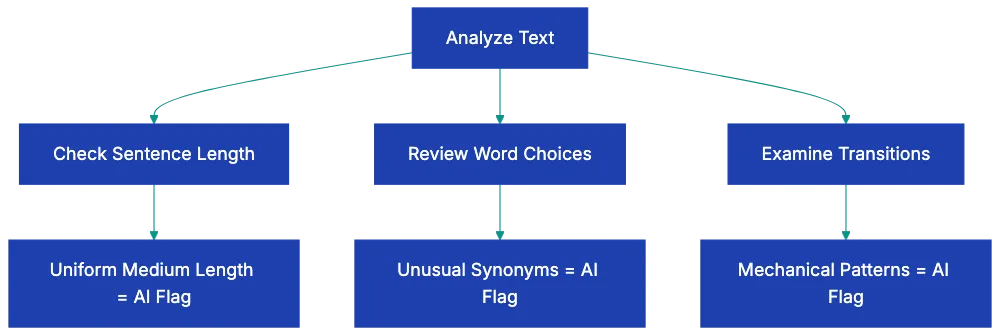
- Most sentences have about the same length and shape. Very short and very long sentences are rare.
- Stock phrases such as
it's worth noting,plays a crucial roleorin today's fast-paced worldreplace plain statements. - Many paragraphs start with the same connecting words, such as
Moreover,Furthermore,AdditionallyorIn conclusion. - The text uses words that became much more frequent after ChatGPT came out. In a 2024 study of more than 15 million PubMed abstracts, words such as
delves,underscoresandshowcasingrose sharply (Kobak et al.). - The tone does not fit the purpose. For example, a casual email or a personal reflection reads like a press release.
Content
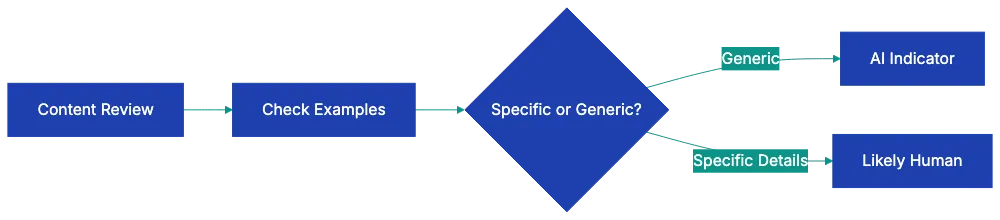
- The examples are general (“a small business owner can use this”). They name no person, place, date or number.
- The text covers every angle with equal weight. It does not choose the points that matter most.
- On a topic that invites an opinion, the text stays neutral on every point.
- First-person stories have none of the details that a real memory has, such as what someone said, what went wrong or what it cost.
- The text answers a slightly different question than the one asked. Or it ignores material that the writer received, such as a class reading or a client’s notes.
Structure
- An introduction lists the points, the sections have similar lengths, and the ending repeats the points.
- All paragraphs have three to five sentences. All list items have the same length and the same pattern.
- A short text has many headings and many bold phrases.
Facts and sources
- Some citations do not exist when you search for them. These can be studies, books, quotes or court cases. AI models can invent references that look real.
- Precise numbers have no source, for example “68% of small businesses” with no link and no name.
- Vague authorities replace sources, for example “studies show” or “experts say”.
- Correct facts and wrong details are mixed. An example is a real company with the wrong founder, or a real law with the wrong year.
The writer
These two items need some knowledge of the writer. Use them when you have read other work by the same person.
- The vocabulary, the typical mistakes or the voice differ from the earlier work of the same writer.
- When you ask about an argument, a source or a choice in the text, the writer cannot explain it in their own words.
How to read the results
Look for groups of signs, not single signs. Formal connecting words are normal in academic writing. Legal text uses cautious wording on purpose. A manual covers every case because that is its job. Compare each tick with what is normal for that type of text.
Give the most weight to the facts group. An invented citation or quote is a real problem, whoever wrote the text. Also, you can test it.
A clean result proves little. A writer who drafts with AI and then rewrites the text can remove most of the language and structure signs.
Some people write like this without AI. Non-native English writers and writers with formal training can match several language items. AI detectors have the same weakness, as the next section shows.
What AI detectors can and cannot tell you
An AI detector is a tool that estimates if AI wrote a text. A detector gives a score or a percentage, not proof. Results from the detector makers and from independent researchers show the limits:
- OpenAI withdrew its own AI text classifier on July 20, 2023, “due to its low rate of accuracy”. In tests by OpenAI, the classifier labeled 26% of AI-written text as likely AI-written. It labeled human-written text as AI-written 9% of the time (OpenAI). This type of error is a false positive.
- In a 2023 update, Turnitin reported a false positive rate below 1% for documents with more than 20% AI writing. For single sentences, the rate was about 4%. Turnitin added an asterisk to scores below 20% because these scores are less reliable. It asked educators to use the score to start a conversation with the student (Turnitin).
- A test of 14 detection tools, Turnitin included, concluded that “the available detection tools are neither accurate nor reliable” (Weber-Wulff et al., 2023).
- Researchers tested seven detectors on 91 essays from the TOEFL, an English test for non-native speakers. On average, the detectors labeled 61% of these essays as AI-generated. The detectors classified essays by US eighth graders almost perfectly (Liang et al., 2023).
The detectors changed after these tests. Read the current documentation of any tool that you use. Treat its score as one more item on the checklist. Do not base a grade, a dismissal or a refusal to pay on the score alone.
What to do when the checklist raises doubts
- Search for each citation, quote and statistic. If a source does not exist, the text has a quality problem, whoever wrote it.
- Compare the text with other work by the same person. Use work that the person wrote in front of you, such as an in-class essay.
- Ask the writer about the text. For example, ask them to explain the main argument or why they chose a source. A person who wrote the text can usually answer in their own words. Keep it a conversation, not an accusation.
- If the writer used a tool that keeps version history, such as Google Docs, ask for the drafts.
- Read the rules that apply. A school’s integrity policy, a publication’s AI policy or a freelance contract defines what is a problem. Some rules allow AI use if the writer discloses it.
Use this checklist with Claude or ChatGPT
You can paste the checklist and the text into Claude or ChatGPT. Ask the AI to go through the items one by one. Ask it to quote the passage for each answer and to list every citation and statistic. Then you can test these yourself.
Do not ask the AI who wrote the text. OpenAI says that ChatGPT has no knowledge of which content is AI-generated. It also says that the answers of ChatGPT to “did you write this?” are random (OpenAI Help Center).
Below is a checklist of signs of AI-written text, followed by a text.
For each checklist item, answer yes, no or unclear, and quote the
passage that supports your answer. Then list every citation, statistic
and quote in the text so I can check them. Do not give an overall
verdict on who wrote the text.

CHECKLIST:
[paste the checklist]

TEXT:
[paste the text]
Compare each quoted passage with the original text. The AI can miss signs, and it can point to signs that are not there.
Remove names and personal details before you paste the work of a student or a job candidate. Before you paste anything, read the rules of your school or employer and the data settings of your workspace.
A docs portal with Ask AI
and support tickets
Connect a repository, or describe your product to start. Each docs site has search, Ask AI, an API console, an MCP server and support tickets.
- Publishes from GitHub on every push
- Works with Mintlify repositories
- API console from your OpenAPI file
- MCP server and llms.txt for AI agents
- Ask AI and support tickets
- Analytics for people and AI agents
Frequently Asked Questions
How long does a text need to be before you can judge it?
A longer text gives better results, for people and for tools. OpenAI said that its classifier was more reliable with longer input. In 2023, Turnitin raised its minimum for AI scoring from 150 to 300 words. A single paragraph or a short email rarely gives enough evidence.
Is it wrong for a writer to use AI at all?
That depends on the rules for the work. Some schools, publishers and clients allow AI for some tasks, such as outlines or proofreading, if the writer discloses it. Other rules forbid it. If you hire writers, write down in the brief or the contract what is allowed. Then you have a clear rule to compare against.