Essential Academic Paper Checklist for Formatting and Citations
Before you start
This checklist is for a paper that you submit for a course or to a journal. The format rules follow APA Style, 7th edition, for a student paper. A table further down shows the differences for MLA and Chicago.
- Find the required style and edition, for example APA 7, in the syllabus or the journal guidelines.
- Write down the length limit, the file format, the file name pattern and the deadline with its time zone.
- Find out if the paper needs an abstract (a short summary at the start).
- If your instructor or journal has a different rule from the style guide, follow that rule.
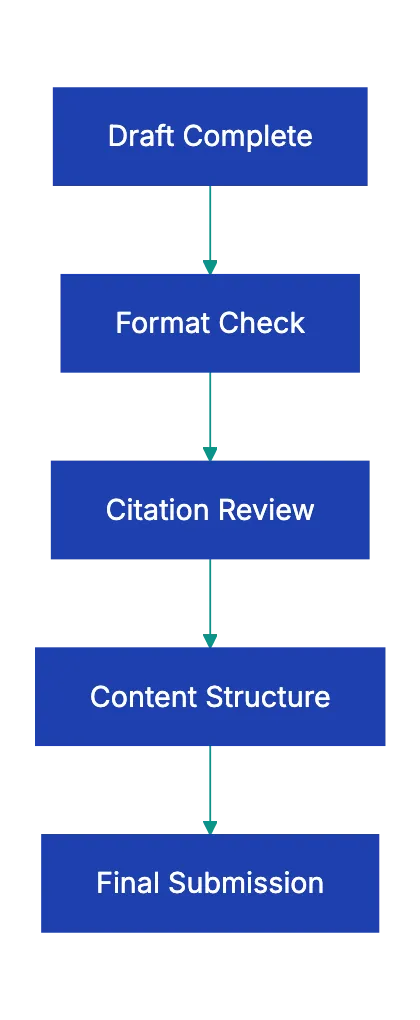
Format checklist (APA 7 student paper)
These rules come from two APA documents: the Student Paper Checklist and the Student Paper Setup Guide.
| Item | What to look for |
|---|---|
| Margins | 1 inch on all sides |
| Font | One font for the full paper, for example 12-point Times New Roman, 11-point Calibri, 11-point Arial or 11-point Georgia |
| Line spacing | Double spacing for all text, also block quotations and the reference list. No blank lines before or after headings or paragraphs |
| Text position | Text flush left with a ragged right edge, not justified. The first line of each paragraph has a 0.5-inch indent |
| Page numbers | A page number in the top right corner of every page. The title page is page 1 |
| Running head | Not necessary in a student paper. A running head is a short title in the page header. Professional papers for journals use one |
| Title page | Title (bold, centered, in the upper half of the page), author name, department and university, course number and name, instructor, due date |
| First page of text | The title again at the top, bold and centered. No “Introduction” heading |
| Page order | Title page, abstract (if required), text, references, footnotes, tables, figures, appendices |
| Section labels | “Abstract” and “References” in bold and centered. Each main section starts on a new page |
If the paper needs an abstract, write it as one double-spaced paragraph. Purdue OWL gives a usual limit of 250 words. A journal can set a different limit.
Heading levels
All APA headings use bold and title case. Use the levels in order, and do not skip a level.
| Level | Format |
|---|---|
| 1 | Centered, bold. The text starts as a new paragraph |
| 2 | Flush left, bold. The text starts as a new paragraph |
| 3 | Flush left, bold italic. The text starts as a new paragraph |
| 4 | Indented, bold, with a period at the end. The text continues on the same line |
| 5 | Indented, bold italic, with a period at the end. The text continues on the same line |
Make heading styles in your word processor before you write. Then you do not have to format each heading again at the end.
In-text citation checklist

- Each in-text citation has a matching reference entry. Each reference entry has at least one citation in the text. Personal communications are the exception, because they appear only in the text.
- The author names and the years in the citation and in the reference entry are the same.
- Each direct quotation has a page number: (Johnson, 2020, p. 47). If the source has no page numbers, use a paragraph number or a section name: (Johnson, 2020, para. 3).
- Each paraphrase also has a citation. A page number is optional for a paraphrase.
- Quotations of 40 words or more are block quotations. A block quotation is a separate paragraph with a 0.5-inch indent.
- For a work with three or more authors, each citation gives the first author and “et al.”
- For a work with two authors, a citation in parentheses uses “&” (Guirrez & Castillo, 2020). A citation in the sentence uses “and.”
- For a source that you only saw in another work, the citation is (Johnson, 1995, as cited in Smith, 2020). Only Smith goes in the reference list.
- When one parenthesis has several works, the works are in alphabetical order, with semicolons between them.
- Each paraphrase uses your own sentence structure. If you only change some words in the original sentence, it is still plagiarism.
Reference list checklist
- The reference list starts on a new page after the text.
- The entries are in alphabetical order and double-spaced. Each entry has a hanging indent of 0.5 inch: the first line starts at the margin, and the next lines have an indent.
- Author names have the surname and the initials (Lewis, C. S.), with “&” before the last author.
- Article and chapter titles use sentence case (a capital letter only for the first word and for names). They are not in italics. Book, report and journal titles are in italics.
- Each work that has a DOI shows it as a link in the form
https://doi.org/.... A DOI is a permanent ID for a published work. - No entry has “Retrieved from” before a DOI or a URL, and no entry has a period after it.
- Entries for works from academic research databases do not name the database.
Reference managers such as Zotero, Mendeley and EndNote format entries for you. They make mistakes with unusual source types and with missing data. Compare the first few entries with the APA rules by hand. Then compare a sample of the other entries.
Content and structure checklist
- The introduction gives the thesis or the research question early.
- The literature review puts studies in groups by theme. It shows how they lead to your question and does not summarize sources one by one.
- The method section gives enough detail for another researcher to repeat the study: sample, materials, procedure and analysis.
- The results section reports the findings. The interpretation is in the discussion.
- The discussion connects the results to earlier research and names the limitations of the study.
- Tables and figures have numbers in the order that they appear. The text refers to each one by its number.
- Each number, date and statistic agrees with your data or with its source.
MLA and Chicago differences
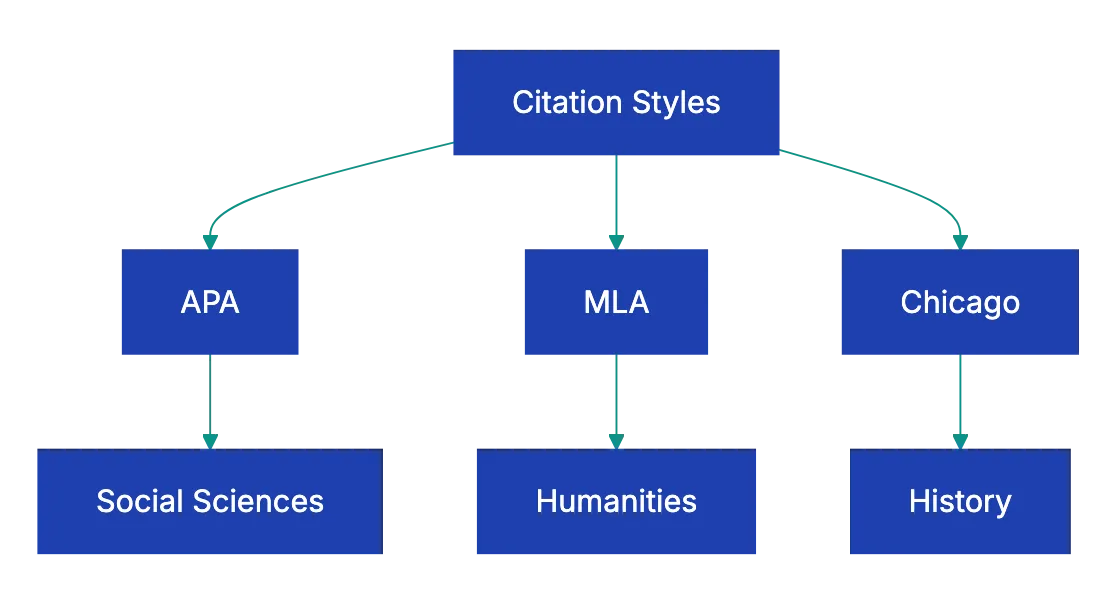
Find out which style your course or journal requires before you write. A change of style after the draft takes hours.
| Item | MLA (9th edition) | Chicago (18th edition) |
|---|---|---|
| In-text citation | Author and page, with no comma: (Johnson 47) | Notes and bibliography: numbered footnotes or endnotes. Author-date: author and year in parentheses |
| Title page | None, unless your instructor asks for one. Name, instructor, course and date go in the top left of page 1 | Follow your instructor or publisher |
| Page header | Last name and page number, top right | Follow your instructor or publisher |
| Source list | Works Cited | Bibliography (notes system) or reference list (author-date system) |
| Usual fields | Literature and other humanities | Notes: humanities, history and the arts. Author-date: sciences and social sciences |
The MLA format details come from the Purdue OWL MLA guide. The Chicago Manual of Style citation guide describes the two Chicago systems.
Final pass before you submit
- Read the paper aloud. You hear missing words and awkward sentences that your eyes skip.
- Find the reference entry for each in-text citation. Then find a citation in the text for each reference entry.
- If your school gives you a similarity checker (a tool that finds text copied from sources), run it. Rewrite each passage that stays too close to a source.
- Export the paper to the required file format. Then open the exported file and make sure that the fonts, headings and page numbers are correct.
- Give the file the name that the instructions ask for.
- Open each supplementary file (data, code, appendices) and make sure that it works.
- Upload the paper well before the deadline. Use the time zone of the deadline.
Use this checklist with Claude or ChatGPT
You can use this checklist with a general AI assistant, such as Claude or ChatGPT. Paste the sections of the checklist that you need. Then paste the text of the paper, or upload the file. Ask the assistant to go through each item and to list what is missing or wrong. Here is an example prompt:
Below is a checklist for an APA 7 student paper, followed by my paper.
Go through the checklist one item at a time. For each item, answer
Pass, Fail or Cannot tell, and quote the part of the paper that shows it.
Then list every in-text citation that has no reference entry, and every
reference entry that the paper never cites.
Compare each finding with the paper before you change anything. The assistant can miss problems, and it can report problems that do not exist. It also cannot see the page layout in pasted text.
Read the AI rules of your course and your university before you start. Remove unpublished data, participant details and confidential material before you upload the paper. The service keeps a copy of what you upload, so look at the data settings of your workspace.
A docs portal with Ask AI
and support tickets
Connect a repository, or describe your product to start. Each docs site has search, Ask AI, an API console, an MCP server and support tickets.
- Publishes from GitHub on every push
- Works with Mintlify repositories
- API console from your OpenAPI file
- MCP server and llms.txt for AI agents
- Ask AI and support tickets
- Analytics for people and AI agents
Frequently Asked Questions
Can I use "I" or "we" in an APA 7 paper?
Yes. APA 7 tells you to use first-person pronouns for your own work and reactions, for example “I examined.” With coauthors, write “We conducted.” Your instructor or journal can still ask for a different approach.
Do the title page and reference list count toward the word limit?
If the assignment instructions give a rule, follow it. If they do not, APA tells you to count every word in the paper with the word count of your word processor. This count includes the title page and the reference list. APA leaves out only the text inside figure images.